
NASA’s Mars Perseverance rover uses a drill to gather samples from Martian rocks and soil. The rover then stores the samples in tubes on the surface, a process called “sample caching”. The first mission to demonstrate this process was Mars 2020
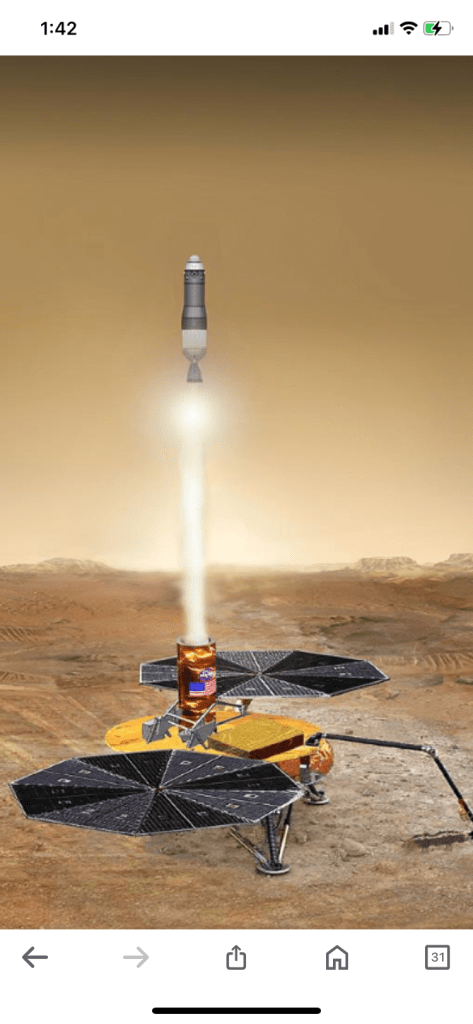
NASA is also developing a Sample Retrieval Lander to safely bring samples back to Earth. The lander will land near or in Jezero Crater, and will use a small rocket to carry the samples. The lander will also use two helicopters to retrieve samples, and a robotic arm to transfer them into the rocket. The Sample Recovery Helicopters will use wheels and gripping capabilities to pick up the sample tubes and transport them to the lander.
The samples were collected during a process known as ‘sample caching’ and then stored in tubes before being deposited on the surface for later collection. It’s a procedure that has never been undertaken before but set the foundations for future missions to collect and transport the samples back to Earth
Engineers are working on a prototype robotic arm to collect samples from the surface of Mars. The Mars Sample Return mission is planned to collect the tubes and bring them home for study. The current challenge is the gripper arm that will collect the samples and stow them safely and securely before transportation
As if the Mars Perseverance Rover and Ingenuity Drone were not exciting enough then the next step in this audacious mission takes it to a whole new level. Mars Sample Return Mission is to follow along, collect and return the samples collected by Perseverance back to Earth. However the status of Mars Sample Return is uncertain as engineers are still working on technology to retrieve the samples. The current challenge is the gripper arm that will …
Why do we need Mars Sample Return?
Humans have been exploring Marswith robotic spacecraft since the 1960s. We have learned that liquid water once existed on the surface, and that the planet had a warm, wet environment that could have supported life as we know it.
Was Mars warm and wet for long periods during which life could have arisen, or mostly cold and dry with only brief intervals that could have supported life? What was its early atmosphere like? Can we find direct evidence of past life there, such as fossilized microbes or ancient chemical signatures that resemble life as we know it?
These answers can be found in Mars’ rocks and soil, which lock in atmospheric gases, preserve signs of past life, and carry clues revealing the environment in which they formed. Despite impressive advances in miniaturizing science instruments for space missions, certain questions can only be answered by tools that are too large, heavy, and power-hungry to fly on spacecraft. Fortunately, there’s a way around this limitation: rather than bringing our tools to Mars, we can bring Mars samples back to Earth.
What are the specific benefits of bringing space samples back to Earth?
Precision. Some space-bound experiments can’t be done very precisely. One example is determining the origin and age of a rock, which is extremely important as we try to piece together just how long Mars may have been warm and wet for life to arise.
Reproducibility. Science is all about being able to reproduce your results, especially when those results could be something as astonishing as life on Mars. Even if a spacecraft found what looked like a microscopic fossilized cell, or a chemical signature that was identical to life on Earth, we need to reproduce those results using more than one science instrument in more than one laboratory.
Duration. When NASA returned samples from the Moon during the Apollo program, it knew technology would improve over time, so it stored some samples aside and even kept some sealed. Bringing Mars samples back from Earth would mean being able to pull them out for future generations.
Here are some other ways to collect samples from Mars:
- Rover-based sample collection: Send a rover to Mars with tools to collect soil and rock samples.
- Sample Collection for Investigation of Mars (SCIM): Send a spacecraft through Mars’s upper atmosphere to collect dust and air samples without landing or orbiting.
- Collector array: Capture particles of solar wind or cometary debris.
- Surface excavation: Excavate soil, debris, and rocks.
- Water extraction: Use an enclosed vessel to heat the soil via conventional electric heating. Place soil into the kettle/pot where electric heating would increase the temperature of the soil to release water vapor. The released vapor is then collected and condensed into liquid water.
Scientists believe that samples from Mars could help them piece together the planet’s past. The samples could also help scientists search for signs of life on Mars, including biosignatures that might reveal if life was abundant in the past or still exists today
Mars’ rocks and soil can preserve signs of past life, such as fossilized microbes or ancient chemical signatures. They can also carry clues about the environment in which they formed.
The samples could also help scientists learn about climate shifts that can fundamentally alter planets.
The samples could be analyzed on Earth with better instruments and experiments that have been impossible until now.
As of late fall 2023, NASA’s Perseverance rover has collected 21 scientifically selected samples of Martian rock. The rover has left the samples in capsules on the Martian surface for retrieval
As of 2023, NASA and ESA’s plans to return the samples to Earth are still in the design stage.
Although NASA and ESA’s plans to return the samples to Earth are still in the design stage as of 2023, samples have been gathered on Mars by the Perseverance rover. In January 2024, a proposed NASA plan had been challenged due to budget and scheduling considerations, and a newer overhaul plan undertaken
Considered one of the highest priorities by the scientists in the Science and Astrobiology Decadal Survey 2023-2032, Mars Sample Return would be the first mission to return samples from another planet and provides the best opportunity to reveal the early evolution of Mars, including the potential for ancient life. NASA is teaming with ESA (European Space Agency) on this important endeavor.
Learn more about Samples No. 2 and 3 – “Montdenier” and “Montagnac” – the first pair of rock cores collected by Perseverance, which were taken from an igneous rock on the floor of Jezero Crater. Scientists believe that detailed analysis of these samples could help them piece together the timeline of the area’s past, which was marked by volcanic activity and periods of persistent water.
A key objective for Perseverance’s mission on Mars is astrobiology, including the search for signs of ancient microbial life. The rover will characterize the planet’s geology and past climate, pave the way for human exploration of the Red Planet, as well as be the first mission to collect and cache Martian rock and regolith (broken rock and dust
A key chore for the Perseverance rover is snooping around for astrobiology clues, including caching specimens that may show signs of old age on Mars – ancient microbial life.
To that end, the robot has dropped on the planet ten sample tubes, stuffed with a range of Martian geology. There are more tube releases in the future. Of the 43 tubes hauled around by Perseverance, 38 are for collecting samples, and five are “witness tubes” designed to certify the cleanliness of its sampling system throughout the mission.
Wanted: Extraordinary evidence
The samples snared to date clearly represent a diversity of rock types. That has been a long-term goal of MSR sampling plans.
“So it’s great to see that Jezero Crater is providing both really interesting igneous rocks and sedimentary rocks clearly laid down in a watery environment,” says Steve Ruff, a planetary geologist and associate research professor at the School of Earth and Space Exploration at Arizona State University in Tempe, Arizona
But it’s going to be challenging to connect the organics to life given that they’ve likely been highly degraded after billions of years in the Martian environment,” says Ruff. “Some kind of textural evidence likely will be needed to provide the extraordinary evidence needed to make the extraordinary claim of life on Mars, to paraphrase Carl Sagan,” he concludes
The Mars Sample Return (MSR) mission is a proposed mission to collect and return samples from Mars to Earth. The mission would use robotic systems and a Mars ascent rocket to collect samples of Martian rocks, soils, and atmosphere. The samples would then be sent to Earth for chemical and physical analysis
The mission includes:
- Mars Perseverance rover: Collects and caches samples on Mars
- Sample Retrieval Lander: Launches to Mars in 2028, carrying a NASA-led Mars rocket and a pair of small Mars helicopters
- Rocket: Carries a container of sample tubes with Martian rock and soil samples into orbit around Mars and releases it for pick up by another spacecraft
Please like subscribe comment your precious thoughts on universe discoveries
Full article source google
Best astrology books on heavy discount on Amazon Universe discoveries