
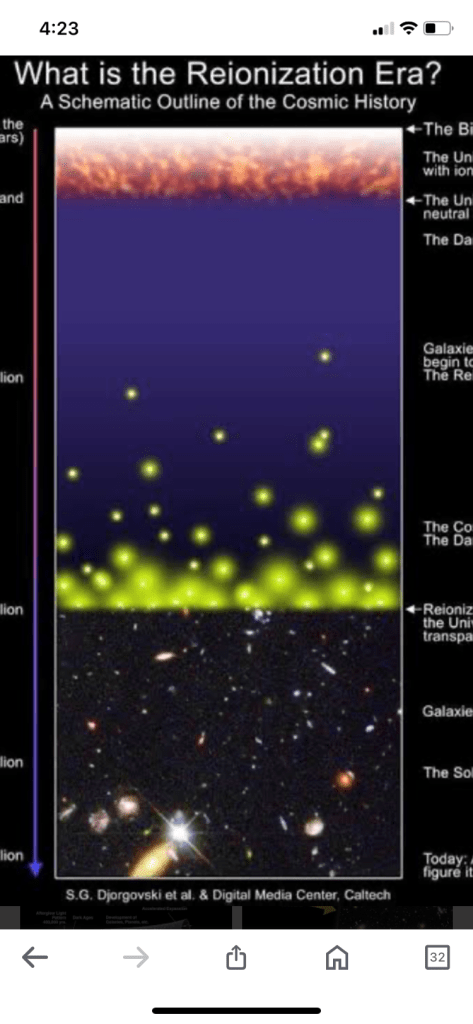
Scientists have tried to solve a mystery of the universe. With the help of the Webb Telescope, he has found the answer to the question that when initially the universe was immersed in darkness, then how did it become illuminated and filled with sparkling galaxies?
Scientists are constantly making efforts to uncover the secrets of the history of the universe. They also keep improving the perception formed on the basis of the information so far by adding new information to it. Till now it has been believed that initially there was darkness all around in the universe and then gradually light spread everywhere in many ways. How this happened is still a mystery, but in a recent study, astronomers have tried to find the answer with the help of the James Webb Telescope.
The universe has experienced many dark ages in the beginning. During this period, the light emanating from the stars could not travel far due to the surrounding gases. But how did our space become home to millions of shining galaxies? For this, scientists turned the telescope towards an area called Pandora Cluster.
पैंडोरा क्लस्टर भारी गैलेक्सी की वह समूह है जो अंतरिक्ष को ही लपेट देती हैं. इससे वक्री खगोलीय लेंस बनते हैं और पीछे के पिंड बहुत ही बड़े दिखाई देते हैं. नासा के यहां से गुजरने वाला प्रकाश सीधा चलने की जगह मुड़ जाती है. इससे पीछे के पिंड चमकीले और विकृत दिखाई देते हैं. इन्हीं लेंस की मदद से वैज्ञानिक बहुत ही पुरानी, धुंधली गैलेक्सी को देख पाए हैं
The Pandora Cluster is a group of massive galaxies that envelop space. This creates a curved astronomical lens and makes the objects behind appear very large. The light passing through NASA gets bent instead of traveling straight. Due to this, the posterior bodies appear bright and distorted. With the help of these lenses, scientists have been able to see very old, faint galaxies.
Scientists saw the small galaxy in the shape it had taken billions of years ago and after the long journey of light, it has reached us now. That means what we are seeing now is actually pictures billions of years old
But the smaller galaxies were producing huge amounts of ultraviolet light, enough to pierce dense cosmic gas clouds. Later the celestial gases could not stop the light of the stars and the stars started shining clearly and brightly. Researchers say that these celestial power houses used to extract a lot of energy.
In this study published in Nature, scientists found that low-mass galaxies produced energetic radiation and their combined effect was so much that it could change the entire state of the universe and in this way the universe kept coming out of darkness and becoming illuminated
नेचर में प्रकाशित इस अध्ययन में वैज्ञानिकों ने पाया कि कम भार वाली गैलेक्सी ऊर्जावान विकिरण पैदा करते थे और उनका मिला जुला असर इतना अधिक था कि उससे ब्रह्माण्ड की पूरी अवस्था ही बदल सकती थी और इसी तरह से ब्रह्माण्ड अंधकार से बाहर निकल कर रोशन होता रहा.
The James Webb Space Telescope (JWST) is a powerful infrared observatory that can help astronomers understand the formation of the universe’s early galaxies and stars. JWST’s infrared sensitivity allows astronomers to see the ancient light of the first galaxies, which is redshifted as it travels through space over billions of years
JWST is able to peer back over 13.5 billion years to see how the first stars and galaxies formed out of the darkness of the early universe. JWST has revealed that the earliest galaxies are more numerous and brighter than expected. For example, JWST has discovered galaxies as mature as our own in what was previously understood to be the dawn of the universe
According to the Big Bang theory, the universe began as a hot, dense point about 13.7 billion years ago. The universe was a dark place for a few hundred million years after the Big Bang, with no stars or galaxies
The universe began to emerge from the dark ages about 400 million years after the Big Bang. This period is known as the age of re-ionization.
The formation of the first stars and galaxies is closely linked to the universe becoming transparent to UV light again. Some of the first stars were massive and bright, and their light was energetic enough to ionize the surrounding hydrogen atoms. Ionized hydrogen doesn’t absorb or scatter light like neutral hydrogen does.
The process of star and galaxy formation continued until about 500 million years after the Big Bang, when nearly all the hydrogen and helium in the universe was ionized by starlight.
The Dark Ages fully ended about 1 billion years after the Big Bang. The universe gradually transitioned into the universe we see today, which is denser, hotter, and richer in smaller galaxies.
The first stars and galaxies formed, and their light brought the universe out of the dark ages,” says Mobasher. That’s because the newly born stars and galaxies ionized ever-expanding bubbles around them, allowing light to finally travel unimpeded again
Please like subscribe comment your precious thoughts on universe discoveries
Full article source google
Best astrology books on heavy discount on Amazon Universe discoveries