
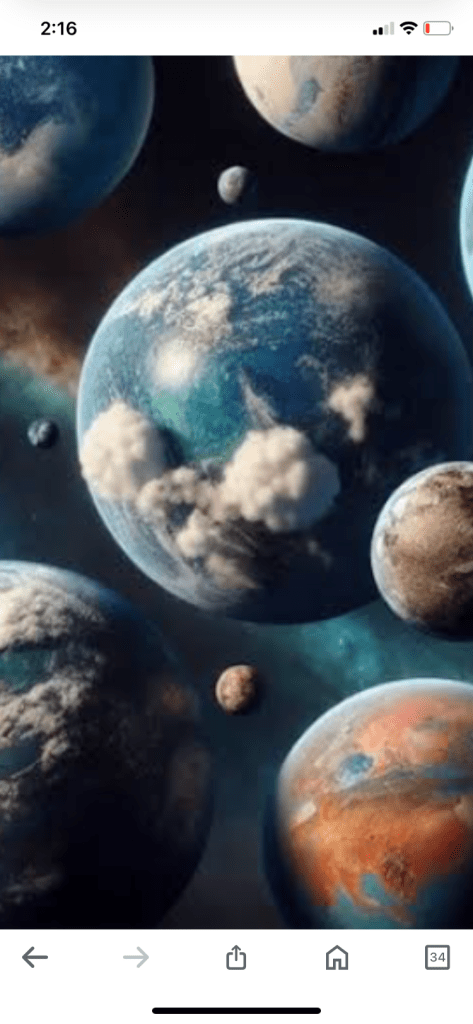
The Large Interferometer for Exoplanets (LIFE) telescope passed its first test by detecting biosignatures on Earth. LIFE is made up of five separate telescopes that will work together to detect biosignatures in exoplanet atmospheres
Biosignatures are substances that provide scientific evidence of past or present life on a planet. The field of astrobiology uses biosignatures to search for extraterrestrial life.
LIFE detected CO2, water, ozone, and methane on Earth. These are signs of a temperate, life-supporting world. For example, ozone and methane are produced by life on Earth.
A 2024 study focused on three types of molecules that are produced by ocean biology on Earth:
- Nitrous oxide (N2O)
- Methyl chloride (CH3Cl)
- Methyl bromide (CH3Br) The presence of these molecules in an exoplanet atmosphere could be an indication of life.
According to NASA, a habitable planet is one that can support life for a significant amount of time. NASA’s astrobiology roadmap defines the main criteria for habitability as:
- Extended regions of liquid water
- Conditions that are favorable for the assembly of complex organic molecules
- Energy sources to sustain metabolism
Scientists also consider surface temperature, mass, and the presence of liquid water and oxygen when determining whether a planet is habitable for humans.
According to MDPI, the simultaneous detection of CH4 and CO2 in the atmosphere of a habitable planet could be a potential biosignature
Physical structures These are morphological biosignatures, which include:
- Fossilized remains
- Stromatolites
- Patterns that indicate life’s complex organization Chemical traces These include:
- Organic, elemental, and/or mineral traces
- Biological macromolecules Isotopic traces These represent the physical presence of organisms and evidence of their metabolic activities and metabolites. Biosignatures can be ranked by how well they meet three criteria: Reliability, Survivability, Detectability. Biosignatures can be gaseous, surface, or temporal. Some examples of gaseous biosignatures include:
- Oxygen (O)
- Ozone (O)
- Nitrous oxide (NO) Earth’s main biosignature is oxygen. Astronomers are excited about discovering an oxygen-rich atmosphere on an exoplanet because it could be a sign of flourishing life
Chemical biosignatures include a huge range of possible ways that life can leave its mark within the chemistry of rocks, bodies of water, and even atmospheres. For instance, biological macromolecules such as lipids, carbohydrates, nucleic acids, and proteins might all be used as biosignatures
Here are some examples of biosignatures:
- Chemical compounds These can include pigments, specific features of biologically generated compounds, and characteristic biology patterns of complexity.
- Complex organic molecules These are structures that are almost impossible to form without life. Examples include:
- Cellular and extracellular morphologies
- Biomolecules in rocks
- Bio-organic molecular structures
- Chirality
- Biogenic minerals
- Gases These are gases that are unlikely to exist without life. Examples include:
- Oxygen (O)
- Ozone (O)
- Nitrous oxide (NO)
Other examples of biosignatures include:
- Layered minerals from stromatolites in a rock
- Insoluble manganese oxides
- Homochirality of certain molecules
- Presence of microfossils
A biosignature is a measurable phenomenon that indicates the presence of life. The term “biomarker” is sometimes used as a synonym for “biosignature”. However, the term “biosignature” is more commonly used in the astrobiology community as a general term for evidence of life
Agnostic biosignatures are attributes of a system that point to a biosphere, but that are not idiosyncratic properties resulting from the biochemistry of familiar terrestrial organisms
Agnostic biosignatures are based on a broader definition of life, based on processes and activities and not on specific molecular structures. They are independent of the form of life that produces them.
Agnostic biosignatures may manifest as unexpected complexity either in a system-wide alteration of a planetary environment or in preserved molecules.
Life detection methods that identify unknowable, unfamiliar features and chemistries that may represent processes of life as-yet unrecognized include:
- Molecular Complexity
- Molecular Complementarity
- Chemical Fractionation
- Disequilibrium and Energy Transfer
A good biosignature is one that is reliable, survivable, and detectable
Reliability A biosignature should be more likely to be produced by life than other processes. For example, oxygen is released by life on Earth, specifically by organisms that use sunlight for energy.
Survivability A biosignature should be able to persist in its environment long enough to be detected. For example, light from a star can naturally produce a small amount of oxygen in a planet’s atmosphere by splitting water vapor.
Detectability A biosignature should be likely to be detected by a probe, telescope, or human. For example, atmospheric gases that shouldn’t exist without life to replenish them could be a possible way to detect life on exoplanets
Years of scientific studies have culminated in three criteria that a potential biosignature must meet to be considered viable for further research: Reliability, survivability, and detectability. False positive mechanisms for oxygen on a variety of planet scenarios
Please like subscribe comment your precious thoughts on universe discoveries
Full article source google
https://2cf25kpj8zuz8sci64pcl9irbx.hop.clickbank.net Universe discoveries