
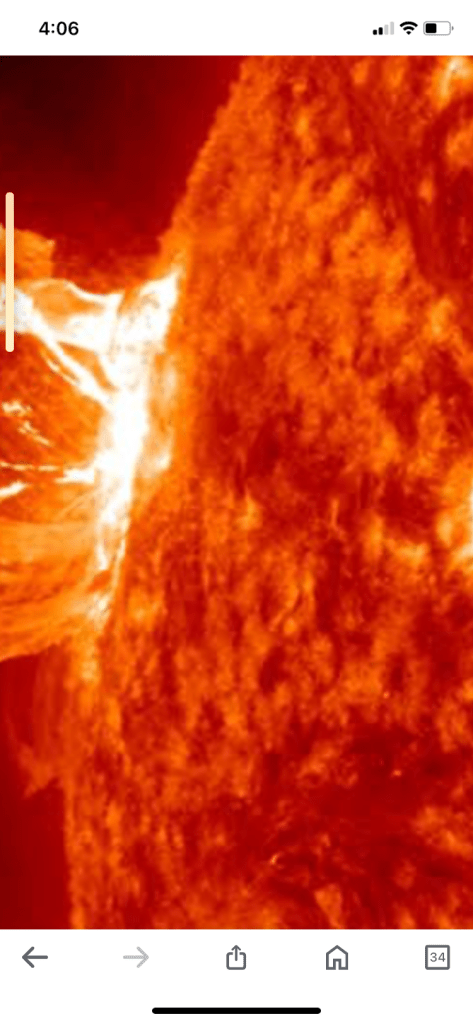
A widespread solar storm occurred on April 17, 2021, and affected six spacecraft at different locations. The storm was so widespread that one of the Solar Terrestrial Relations Observatory (STEREO) spacecraft captured a view of a coronal mass ejection billowing away from the sun
Solar storms are not uncommon, but this one was unusually widespread, hurling high-speed protons and electrons at velocities nearing the speed. Solar storms can disrupt communications systems and power grids, and can harm humans, satellites, and spacecraft.
High-energy particles from the sun can harm the human body if not shielded by Earth’s magnetic field or the walls of a spacecraft. For example, a high radiation dose can lead to radiation sickness, damaging bone marrow and causing infections or internal bleeding
This solar outburst happened on April 17, 2021, and although these storms are not uncommon, with this specific event, the storm was so widespread that six spacecraft at different locations and positions felt the blast
Solar storms can cause a number of problems for satellites, including:
- Destruction Solar storms can destroy satellites. In 1967, a solar storm caused the North American Aerospace Defense Command (NORAD) to lose connection to half of its satellites.
- Orbital changes Solar storms can cause satellites to slow down and change orbit slightly.
- Electronic damage High-energy rays from solar storms can strip electrons from metal components, ionizing them. This can short out electronics and create magnetic fields that damage satellite systems.
- Signal degradation Solar storms can make GPS satellite signals unreliable, which can affect high-accuracy positioning services.
Solar storms occur when the sun ejects large amounts of energy and particles into space, which can hit Earth. The Earth’s magnetic shield absorbs the energy from the storm and heats up the upper atmosphere. This can cause the upper atmosphere to expand, which increases the density of the air at the orbit of satellites. The increased density causes increased drag, which slows down satellites and causes them to change orbit
A major solar storm can cause significant and disruptive effects on Earth. These include:
- Power grids: Long-distance power lines can be overwhelmed with electrical currents, leading to transformers exploding. This can cause widespread blackouts.
- GPS systems: Satellites can be shorted out, making GPS systems useless.
- Satellites: The orbits of satellites can be disturbed.
- Shortwave radio communication: Aircraft flying over polar regions may experience interrupted shortwave radio communication.
- Auroras: Intense auroras can occur over much of the Earth.
- Tsunamis: Tsunamis could occur at equatorial regions.
- Forest fires: Forest fires could take place over much of the planet
The time it takes for solar storms to reach Earth depends on the type of solar event:
- Solar wind The sun’s continuous stream of charged particles, electrons, and protons, called solar wind, can reach Earth in about three days. Solar wind travels at about 400 km/s.
- Radiation storms Radiation storms can reach Earth within 10 minutes of a solar event and can impact the planet for hours to days.
- Solar flares The radiation emitted from solar flares travels at the speed of light and can reach Earth from the sun in just over 8 minutes. However, some of the energy released in the flare also accelerates very high energy particles that can reach Earth in tens of minutes.
- Coronal mass ejections (CMEs) The fastest Earth-directed CMEs can reach our planet in as little as 15-18 hours. Slower CMEs can take several days to arrive. When a CME reaches the Earth, its impact disturbs the Earth’s magnetosphere, setting off a geomagnetic storm. A CME typically takes 3 to 5 days to reach the Earth after it leaves the Sun.
Flares can last minutes to hours and they contain tremendous amounts of energy. Traveling at the speed of light, it takes eight minutes for the light from a solar flare to reach Earth. Some of the energy released in the flare also accelerates very high energy particles that can reach Earth in tens of minutes
The frequency of coronal mass ejections (CMEs) depends on the phase of the solar cycle:
- Near solar minimum: About 0.2 CMEs per day
- Near solar maximum: About 3.5 CMEs per day
- Peak occurrence rate: 6–12 months after sunspot number reaches its maximum
Scientists estimate there’s around a 12 percent chance of a massively disruptive coronal mass ejection hitting Earth every 10 years
The frequency of CMEs varies with the 11 year solar cycle. At solar minimum we observe about one a week.Near solar maximum we observe an average of two to three CMEs per day. CMEs disrupt the flow of the solar wind and cause disturbances that can damage systems in near-Earth and on Earth’s surface
Yes, a coronal mass ejection (CME) has hit Earth:
- March 9, 1989 A CME occurred on March 9, 1989 and struck Earth on March 13, 1989. The CME caused power failures in Quebec, Canada and short-wave radio interference.
- April 23, 2023 A severe geomagnetic storm hit Earth on April 23, 2023. The storm was caused by a CME from the sun that spewed plasma toward Earth at nearly two million miles per hour.
- Carrington Event, 1859 The most powerful geomagnetic storm on record, called the Carrington Event, occurred in 1859. The storm had impressive impacts on the telegraph network and even lit some equipment on fire.
When a coronal mass ejection (CME) reaches Earth, it can cause a geomagnetic storm. This storm can cause:
- Partial radio blackouts
- Vibrant auroras
- Disruptions to electrical systems
- Long-lasting radiation storms
- Damage to satellites, communications systems, and power grids
- A solar radiation storm
The storm can also compress Earth’s magnetosphere on the day side and extend the night-side magnetic tail.
If the explosion is close enough to Earth, the star could bathe the planet in ultraviolet radiation, which can strip away the ozone layer. This makes Earth vulnerable to charged interstellar particles
According to NASA, harmful radiation from solar flares cannot pass through Earth’s atmosphere to affect humans on the ground. The Earth’s magnetic field and atmosphere protect humans from the effects of solar flares
However, some studies suggest that increased solar activity can have negative effects on humans, both physically and mentally. For example, one study found that increased solar wind intensity was correlated with increases in heart rate. This is interpreted as a biological stress response.
Other studies have found that solar flares can:
- Damage machinery and technology
- Release high-energy particles that can be as dangerous to humans as the low-energy radiation from nuclear blasts
- Wreak havoc to electronics and communication systems
- Disturb GPS systems and radio signals Some people also say that solar flares and storms can deeply affect the human body and consciousness. For example, some people have noticed shifts and changes in their energy patterns throughout the day during solar storms.
What impact do solar flares have on human activities? Solar flares produce high energy particles and radiation that are dangerous to living organisms. However, at the surface of the Earth we are well protected from the effects of solar flares and other solar activity by the Earth’s magnetic field and atmosphere
Please like subscribe comment your precious thoughts on universe discoveries
Full article source google
https://2cf25kpj8zuz8sci64pcl9irbx.hop.clickbank.neta Universe discoveries