
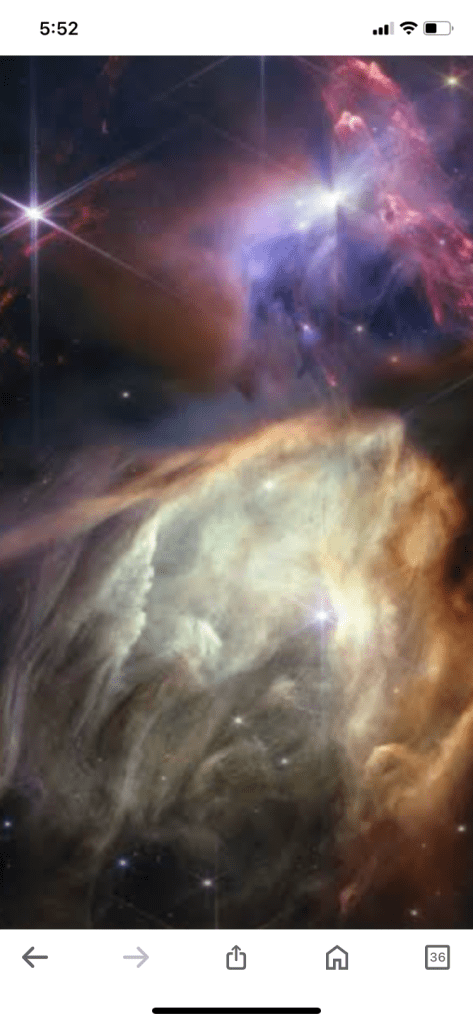
The James Webb Space Telescope (JWST) has confirmed that the universe is behaving strangely, and the next generation of telescopes will continue to investigate this mysterious unseen force. The JWST has discovered a thread-like arrangement of 10 galaxies that existed 830 million years after the Big Bang, and is anchored by a luminous quasar. The JWST can also see through time, with the farthest objects in the image being the oldest, and those in the foreground being more current. These images are called “deep field” observations, and allow scientists to see how the universe has evolved.
The JWST has also confirmed that Hubble’s measurements were right all along, despite some in the scientific community suggesting that Hubble’s measurements were incorrect due to different distance measurements.
The JWST is examining every phase of cosmic history, from the first luminous glows after the Big Bang to the formation of galaxies, stars, and planets, and the evolution of our own solar system. Next-generation telescopes, such as NASA’s upcoming Nancy Grace Roman Space Telescope and the ESA’s Euclid mission, will investigate this mysterious unseen force by measuring its influence on cosmic expansion
The Hubble Tension arises from the fact that different distance measurements result in different values. This led some in the scientific community to suggest that Hubble’s measurements were incorrect
According to NASA, the universe is a vast space that contains everything from the smallest particle to the largest galaxy. Scientists have known since the early 20th century that the universe is expanding, and in the 1990s, researchers discovered that the expansion is accelerating
NASA scientists suspect a mysterious substance called dark energy is accelerating the expansion. They believe it’s likely the universe will continue to expand forever.
NASA also has theories about the end of the universe:
- Big Crunch If the universe has enough matter, gravity would overcome the expansion, and the universe would collapse in a fiery “big crunch”.
- Expansion If the universe doesn’t have enough matter, the expansion would never end. Galaxies would grow farther and farther away until they pass the edge of the observable universe. Scientists estimate that the universe is about 13.8 billion years old. They arrived at this number by measuring the ages of the oldest stars and the rate at which the universe expands
The James Webb Space Telescope (JWST) has confirmed that the universe is expanding, which was first discovered by Edwin Hubble and Georges Lemaître over a century ago. The JWST has also found that the universe has become more opaque. For example, researchers have observed that early galaxies are often flat and elongated, like surfboards and pool noodles, instead of round like frisbees or volleyballs
The JWST has also discovered that the universe has an unexpected number of “ultra-massive” galaxies. These galaxies may not rewrite cosmology, but they do leave questions. The JWST has also found that the universe has changed in opacity, specifically during the Era of Reionization, a period when gas was heated, cooled, and then reionized.
The JWST’s longer wavelengths allow it to look back in time to the beginning of time, and to search for the formation of the first galaxies. The JWST has also been able to look inside dust clouds where stars and planetary systems are forming today.
Some astrophysicists have described the observations as “weird” in the sense that they’re not easily explainable. However, black holes and star formation are promising explanations so far. Scientists will be watching for new results to see which, if any, of these new models holds firm.
The James Webb Space Telescope (JWST) is in space because it’s designed to detect the universe’s coldest and most distant objects. The Earth’s atmosphere is nearly opaque and glows brightly at most of the infrared wavelengths that JWST observes, so a cold telescope in space is required. For those wavelengths that are transmitted to the ground, the Earth’s atmosphere blurs the images and causes stars to twinkle
JWST is NASA’s largest and most powerful space telescope. It was launched on December 25, 2021, and arrived at its permanent orbit on January 24, 2022. The JWST orbits the sun at a point called the second Lagrange point (L2), which is nearly 1.5 million kilometers from Earth. The JWST’s main job is to capture light and focus it so we can see further into the distance. It sees in a different part of the electromagnetic spectrum than our eyes do. The JWST sees infrared or “heat”, which allows it to see further than any telescope we’ve had before.
JWST’s mission objectives include:
- Observing farther into the universe than ever before
- Searching for the first stars and galaxies created after the Big Bang
- Better understanding how planets, stars and galaxies are born and evolve over time
- Exploring distant worlds and study our solar system
- Determining the potential for life on planets around other stars
Webb is designed to look deeper into space to see the earliest stars and galaxies that formed in the universeand to look deep into nearby dust clouds to study the formation of stars and planets
Please like subscribe comment your precious thoughts on universe discoveries
Full article source google
https://2ec59pip3wtq6-ge3qq6w8i417.hop.clickbank.net Universe discoveries