
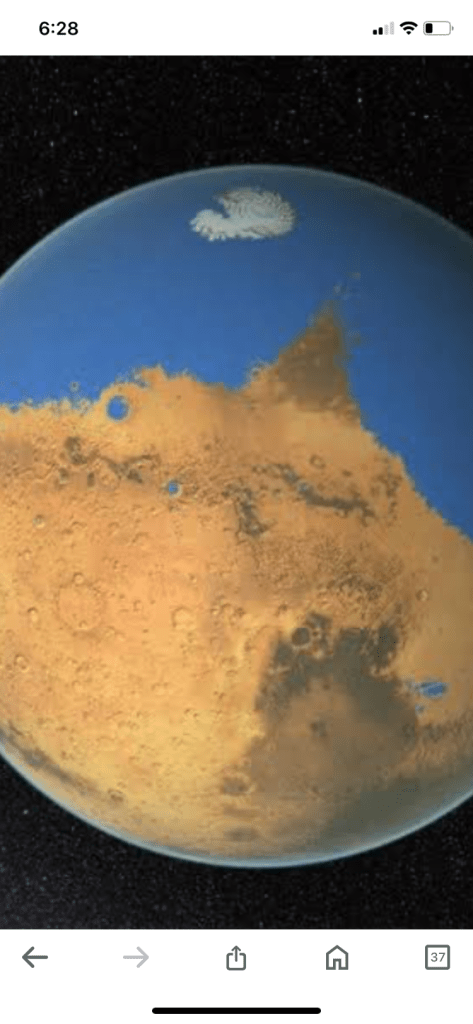
Mars is believed to have had a large ocean in its northern hemisphere about four billion years ago. However, all large areas of liquid water have since disappeared
Here are some reasons why Mars may have lost its water:
- Magnetic field According to research published in 2022, Mars lost its magnetic field billions of years ago. Without this protection, the atmosphere was stripped away and the oceans evaporated.
- Mass According to a 2021 NPR study, Mars’ relatively low mass allowed most of its water to be lost to space billions of years ago.
- Other ingredient According to a 2022 study published in Science Advances, the loss of some other important ingredient caused the planet to dry out. However, it’s not clear what this ingredient is.
Mars currently has 6–27% of Earth’s present ocean. Some of this water is retained as ice and locked into water-rich materials, including clay minerals and sulfates.
Research has determined that water can be recovered from Martian soil when heated to a temperature between 200°C and 500°C
There is likely a threshold on the size requirements of rocky planets to retain enough water to enable habitability and plate tectonics.” That’s because the lower mass and gravity of Mars makes it easier for volatile elements and compounds such as water to escape from its surface into space
Venus lost its water due to its close proximity to the sun, which caused massive evaporation. Venus has no water, and the temperatures are so high that even if there was water, it would have evaporated forever. The solar wind strikes the upper atmosphere and carries off particles into space
Mars may have lost its water due to Mars’s no magnetic field, which means that the solar wind could strip away water from the atmosphere. The water molecules are broken down and lost from the planet. Dust storms and the planet’s distance from the sun can increase the rate of water loss. The water that remained froze into ice, sank into salty underground lakes, or became locked into the crust of the planet
Mars’ atmosphere is dynamic, with extreme weather events like snow and dust storms. The planet’s atmosphere has been leaking into space over millions of years due to its light gravity and lack of a global magnetic field, which has left the atmosphere vulnerable to pressure from the solar wind.
Pure liquid water can’t exist in a stable form on Mars’ surface because of its low atmospheric pressure and temperature. At the lowest elevations, water boils for a few hours
The main reason that no liquid water exists on the surface of Mars today is because of its thin atmosphere and low temperatures. The atmospheric pressure on Mars is only about 0.6% of Earth’s, which is not enough to support liquid water on the surface. Additionally, the average temperature on Mars is around -80°F (-60°C), which is well below the freezing point of water
Liquid water is unstable on Mars and will vaporize unless it’s frozen. Water ice on the planet’s surface is only stable at high latitudes that are far too cold for astronauts and robots to survive.
A new study suggests that much of the water may have been locked up in minerals in Mars’s crust. The study also estimates that Mars may have had one or several oceans in its northern hemisphere
No large standing bodies of liquid water exist on the planet’s surface, because the atmospheric pressure there averages just 610 pascals (0.088 psi), a figure slightly below the vapor pressure of water at its triple point; under average Martian conditions, warming water ice on the Martian surface would sublime, meaning …
Yes, there is water on Mars, but it is frozen under the north and south polar ice caps
Can mars can get it water back
It’s unlikely that the Sun’s expansion will cause Mars to have liquid water again. However, it is possible to create water on Mars by extracting it from the soil or atmosphere
Here are some ways to create water on Mars:
- Extract from soil Mars’ soil contains water in the form of ice, which can be heated to produce liquid water.
- Extract from atmosphere Mars’ atmosphere is mostly carbon dioxide, which can be used to produce water through a chemical reaction.
- Extract from rocks Some proposed methods of extracting water from rocks include microwaves and blasting minerals with water.
The terraforming process to create a viable atmosphere on Mars may take thousands of years. Not the entire surface of Mars may become similar in climatic features as the Earth
It is unlikely that the expansion of the Sun will cause Mars to have liquid water again. The Sun is not currently in a phase of its life where it is expanding significantly, and even when it does enter this phase, the expansion will not be enough to significantly increase the temperature on Mars
Can we drink water from Mars?
Mars isn’t the best place to quench your thirst, although it might have been a few billion years ago. The red planet once had a global ocean, rivers, and lakes. Then, the solar wind — charged particles from the Sun — stripped away the Martian atmosphere
Is there oxygen on Mars?
Oxygen is Rare on Mars
There is less than 1% of air on Mars as there is on Earth, and carbon dioxide makes up about 96% of it on Mars. Oxygen is only 0.13%, compared to 21% in Earth’s atmosphere
Has gold been found on Mars?
Magnesium, aluminium, titanium, iron, and chromium are relatively common in them. In addition, lithium, cobalt, nickel, copper, zinc, niobium, molybdenum, lanthanum, europium, tungsten, and gold have been found in trace amounts
How long is a day on Mars?
Mars is a planet with a very similar daily cycle to the Earth. Its sidereal day is 24 hours, 37 minutes and 22 seconds, and its solar day 24 hours, 39 minutes and 35 seconds. A Martian day (referred to as “sol”) is therefore approximately 40 minutes longer than a day on Earth
How long is 1 hour in Mars?
1 min 39 sec
The term was adopted during NASA’s Viking project (1976) in order to avoid confusion with an Earth “day”. By inference, Mars’ “solar hour” is 1⁄24 of a sol (1 hr 1 min 39 sec), a “solar minute” 1⁄60 of a solar hour (61.65 sec), and a “solar second” 1⁄60 of a solar minute (1.0275 sec).
time faster on Mars?
Your workday would go by quicker in you lived on the red planet. A second on Mars is slightly shorter than a second on Earth.
Caltech researchers used the Mars Reconnaissance Orbiter to determine that surface water left salt minerals behind as recently as 2 billion years ago.
Mars once rippled with rivers and ponds billions of years ago, providing a potential habitat for microbial life. As the planet’s atmosphere thinned over time, that water evaporated, leaving the frozen desert world that NASA’s Mars Reconnaissance Orbiter (MRO) studies today.
It’s commonly believed that Mars’ water evaporated about 3 billion years ago. But two scientists studying data that MRO has accumulated at Mars over the last 15 years have found evidence that reduces that timeline significantly: Their research reveals signs of liquid water on the Red Planet as recently as 2 billion to 2.5 billion years ago, meaning water flowed there about a billion years longer than previous estimates.
The findings – published in AGU Advances on Dec. 27, 2021 – center on the chloride salt deposits left behind as icy meltwater flowing across the landscape evaporated.
While the shape of certain valley networks hinted that water may have flowed on Mars that recently, the salt deposits provide the first mineral evidence confirming the presence of liquid water. The discovery raises new questions about how long microbial life could have survived on Mars, if it ever formed at all. On Earth, at least, where there is water, there is lif
How was water discovered on Mars?
On July 31, 2008, NASA announced that Phoenix confirmed the presence of water ice on Mars. During the initial heating cycle of a new sample, the Thermal and Evolved-Gas Analyzer’s (TEGA) mass spectrometer detected water vapor when the sample temperature reached 0 °C.
Did NASA find liquid water on Mars?
“If the humidity in the Martian atmosphere gets high enough, perchlorate salts will absorb the atmospheric water until the salt dissolves forms a liquid solution,” says Mary Beth Wilhelm of NASA’s Ames Research Center. Wherever its source, it’s no surprise that there’s water on Mars
Did Mars once have life?
To date, no proof of past or present life has been found on Mars. Cumulative evidence suggests that during the ancient Noachian time period, the surface environment of Mars had liquid water and may have been habitable for microorganisms, but habitable conditions do not necessarily indicate life
What is the role of water on Mars?
Water on Mars is scientifically interesting. It can also be used as a resource. Missions similar to Mars Sample Return, which requires a rocket to launch from the surface of Mars, could fuel up on the red planet rather than ferrying heavy propellant from Earth
How will humans drink water on Mars?
To address the prospect of parched astronauts on Mars, NASA is considering a new proposal. The agency may develop a method of using synthetic biology to remove toxic perchlorates from Martian ice deposits, thus making water from those deposits suitable for drinking by humans
Who discovered water on Mars?
The National Aeronautics and Space Administration (NASA)’s Curiosity Rover has discovered new evidence that an ancient lake existed in a region of Mars, which was earlier believed to be drier
Impress your family and friends with these 20 fascinating and fun facts about Mars.
- Mars is also known as the Red Planet. This is because Mars is covered in soil, rock, and dust made from iron oxide which gives the surface a red rusty colour.
- Mars is named after the Roman god of war.
- Mars has 2 moons called Deimos and Phobos. They are named after the two horses that pull the Roman god of war, Mars’, chariot. They may be asteroids captured by Mars’ gravity.
- Mars is the 4th planet from the sun. It is 227,936,637 km (141 million miles) away from the sun. It would take 300 days (around 8 months) to get there from Earth.
- Mars is smaller than Earth with a diameter of 4217 miles. This makes it the second smallest planet in our solar system.
- A day on Mars lasts 24 hours and 37 minutes.
- One year on Mars is 687 days long. That’s 1.9 Earth years. This is because Mars is further away from the sun so it takes longer to orbit it.
- The tilt on the axis of Mars is 25 degrees which means that the planet experiences seasons like we do on Earth as different parts of the planet are closer to the sun at different times of its orbit.
- Mars has a thin atmosphere made from 95.9% carbon dioxide and 2.7% nitrogen. The atmosphere is so thin that it’s not thick enough to trap the sun’s heat so it is very cold – ranging from -100℃ in winter to 20℃ in summer.
- Mars has very weak gravity. Gravity on Mars is 37% less than on Earth. This means that on Mars you could jump 3x higher than on Earth.
- Mars is a terrestrial planet because it has a hard and rocky surface. Its northern side is full of flat plains and the southern side has ridges and craters.
- Mars’ surface has many channels, plains, and canyons which could have been caused by water erosion (water wearing away the surface). This could be evidence that open water in liquid form once existed on the surface billions of years ago.
- Mars experiences violent dust storms powered by the sun which can last for months. The dust storms can completely cover the planet and continually change Mars’ surface.
- Mars is home to Olympus Mons, a dormant volcano and the largest volcano and highest mountain in our solar system. It is 16 miles high and 600 km across the base, making it 3x the height of Mount Everest.
- The biggest crater on Mars is Borealis Basin. It is 5300 miles from end to end and covers 40% of planet’s surface.
- Mars has the largest canyon in our solar system, Valles Marineris. It is 4 miles deep and stretches thousands of miles long.
- Mars has north and south poles like earth. The polar ice caps are covered in a layer of frozen carbon dioxide (dry ice).
- As it’s so close to Earth, Mars is the planet that humans will most likely step foot on and explore first.
- We sent out Mars Rovers (which are like robots) on missions to explore Mars and collect samples and record scientific data for scientists on Earth to study. Some of these Rovers include Viking 1, Viking 2, Mars 2, Mars 3, Spirit, Phoenix, Pathfinder, Curiosity, and Opportunity.
- There is no evidence of life on Mars. However, it is the planet with the best conditions to support life and scientists believe there is potential for life under the surface of mars because they recently found water ice just under the surface.
Please like subscribe comment your precious thoughts on universe discoveries
Full article source google
https://2423fimg2800htbm66kglbmn95.hop.clickbank.net Universe discoveries