
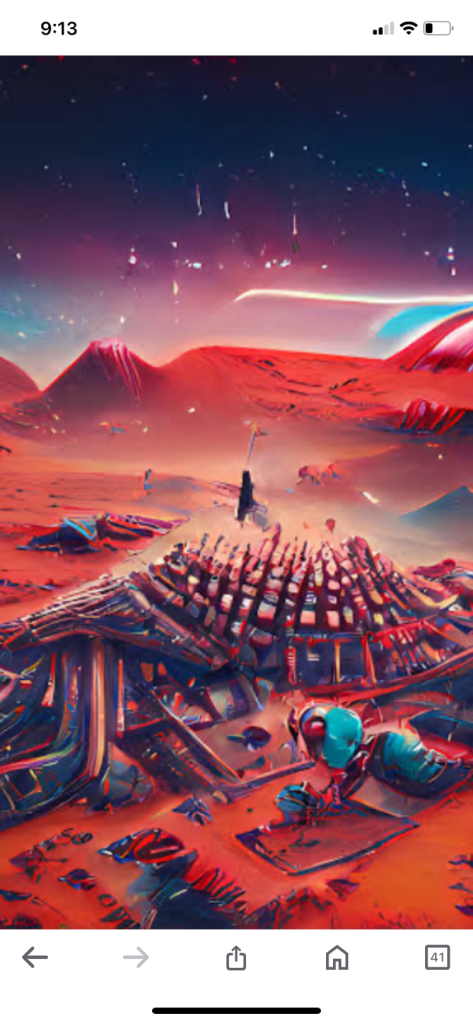
What is the Elon Musk Mars plan?
Elon Musk Mars Plan: Elon Musk said that he wants to take one million people to Mars, claiming that he is working on a “game plan” to achieve this. Earlier, he had said that he wants human to land on Mars in 2029. But Elon Musk’s company SpaceX planned for their first manned trip to Mars this year
What is the timeline for Elon Mars?
Mars has been a frequent topic for Musk dating back nearly a decade. Years ago, Musk stated that the first missions to Mars would take place in 2024 or 2025. Since then, the timeline has shifted slightly, with the new estimate being sometime before the end of the decade
In a conversation with Nicolai Tangen, the CEO of Norway’s Norges Bank Investment Management, Musk said that SpaceX would also be sending people to the Moon, which would be sooner than the human mission to Mars.
SpaceX founder Elon Musk has estimated that his company will be able to make crewed landing on Mars in the next 7-9 years. Musk said that the pace of the mission to Mars has to increase rapidly once the ability to land on Mars is confirmed.
“The first Starship that will land on Mars, which obviously would not have people at first, I think it’s probably within about 5 years. And then we would probably launch several ships and just confirm that they can land on Mars,” Musk said
He explained: “We need massive numbers of ships going. And Earth and Mars only are in the same quadrant of the solar system roughly for six months every two years. It’s only possible to really transfer efficiently from Earth to Mars, I say every six months, but really about a couple months where it’s ideal every 26 months.”
“So, every two years, you would see a fleet depart for Mars. And, I think it will be quite a spectacular thing to see a thousand ships depart for Mars all at once like Battlestar Galactica
I think it’s important for consciousness in general. If we wish to maximise the lifespan of consciousness then being a multiplanet species will result in a much longer existence of consciousness than if we’re on one planet. If we’re on one planet, we’re simply biding our time until there’s eventually a calamity. It could be soon, it could be a long time but eventually something will happen. It could be a global thermo-nuclear war. It could be simply that civilization merely subsides
Our civilization may not die with a bang, it may die with a whimper. Just gradually falling into obsolescence. But if we’re multiplanet species then we’ve got two planets. And they can support each other and we can go beyond two planets ultimately to the moons of Jupiter, to the beyond, to the outer parts of the solar system and ultimately to other star systems
Why does Elon want to go to Mars?
As early as 2007, Elon Musk stated a personal goal of eventually enabling human exploration and settlement of Mars, although his personal public interest in Mars goes back at least to 2001 at the Mars Society. SpaceX has stated its goal is to colonize Mars to ensure the long-term survival of the human species
elon musk has announced how long it would take to build a self-sustaining city on mars. going back on previous timelines, the spacex and teslaCEO has tweeted some maths for how long he thinks it would take to transport the materials necessary to create the civic concept.
musk has said that it would take 1,000 of spacex‘s starship rockets 20 years to transport the cargo. speaking at the us air force space pitch day on tuesday, musk estimated that spacex’s 100-passenger reusable rocket design otherwise known as starship, would cost $2 million to launch.
‘a thousand ships will be needed to create a sustainable mars city… as the planets align only once every two years,’he said.
Elon Musk has said that he wants to establish a human settlement on Mars, but has not yet outlined details about individual houses or a sustainable habitat. His long-term goal is to establish self-sufficient urban centers on Mars that can generate their own energy, water, and other resources. This would require many technologies, including 3D printing, renewable energy sources, and closed-loop systems for recycling garbage and other resources
Musk has also said that he wants to make humanity a “multi-planetary species” by establishing a colony on Mars. In 2011, he stated that he would put a man on Mars in the next 10 years, but in 2022 he revealed that he has pushed back his target date for reaching the Red Planet.
However, the Mars vision faces daunting technical challenges. For example, a recent Starship test flight ended in an explosive crash, showing progress remains slow
Some technologies that could be used to build houses on Mars include:
- Marshmallow-style houses These houses could fit inside the SpaceX Starship rocket, and are meant to give astronauts a place to work and relax while they’re on the Moon or Mars. They are designed to protect humans from deadly space radiation.
- Sulfur concrete This concrete has been around for decades, and has been used in pipelines and to build artificial reefs. A study found that sulfur concrete is twice as strong as earthly concrete
Building a house on Mars by 2050presents significant challenges and depends on technological advancements, funding, and the overall progress of space exploration efforts. Elon Musk, through his company SpaceX, has ambitious plans for colonizing Mars, but predicting specific timelines involves uncertainties
According to Elon Musk, it could take 40–100 years to build a self-sustaining civilization on Mars. However, some say that creating a city or colony for humans on Mars could take decades or longer.
Some challenges to overcome include: The harsh Martian environment, Life support systems, Sustainable resources, Transportation logistics, and Planning and design.
The planning and design phase alone could take several years to ensure that structures are suitable for the Martian environment and provide radiation protection.
According to PBS, terraforming could take anywhere from 50 years to 100 million years to complete
Creating an entire city or colony of buildings for humans to live in on Mars is an extremely complex and long-term endeavor that would likely take decades, if not longer
According to Quora, it’s unlikely that humans will be able to build permanent homes on Mars within the next 10 years. This is because establishing a human settlement on Mars would require a vast amount of resources, time, and technology that are not yet available.
However, some have proposed using local materials to build houses on Mars, such as:
- Sulfur concrete: This concrete is twice as strong as Earth concrete, solidifies in an hour or less, and is attractive for 3-D printing. Sulfur is widely available on Mars and can replace water in concrete.
- Geopolymer concrete: This is considered the best material based on multiple multi-criteria decision-making methods.
- Potato starch: This, when combined with a pinch of salt, could help build houses on Mars.
Other proposals include prefabrication and 3D printing using local materials. For example, in 2019 NASA held a competition to design a 3D printed habitat on Mars to house four astronauts for a year. The competition proposed a phase strategy where autonomous machines would harvest the raw Martian materials, then create a building material using the Martian soil and other composites.
Scientists at the University of Manchester in the UK have made a potato-based called StarCrete, which could be used to build structures on Mars. It is made from a special combination of space dust, salt and potato starch and is said it can help in transporting heavy materials to the red planet
Mars is not currently suitable for human life. Some reasons include:
- Atmosphere: Mars’ atmosphere is mostly carbon dioxide and has 100 times less atmosphere than Earth. The atmospheric pressure at the surface is over 100 times less than Earth’s. Humans cannot breathe Martian air.
- Temperature: Mars is hundreds of degrees colder than Earth.
- Gravity: Mars’ gravity is 38% of Earth’s.
- Travel time: It takes nine months to travel to Mars, which is a long time to be without gravity.
- Radiation: Mars’ atmosphere is not effective as a radiation shield.
- Bodily fluids: Without a protective suit, bodily fluids would evaporate, making you completely parched.
However, some scientists believe that one day it could be possible for humans to live on Mars if some fundamental problems can be solved. For example, NASA has been experimenting with MOXIE, an instrument that would convert CO2 to oxygen on Mars
Here are some reasons why we can live on Mars:
- Resources Mars has resources that can support human life, including carbon, nitrogen, and oxygen. Carbon dioxide can be converted into oxygen and fuel. Mars also has frozen water that can be used for drinking, growing crops, and generating oxygen.
- Atmosphere Mars’ atmosphere is very thin, but it does provide some protection from harmful radiation. The atmosphere also contains carbon dioxide, which can be used to produce oxygen and fuel.
- Similar to Earth Mars has a similar axial tilt and rotation period to Earth, which means that it has similar seasons and weather patterns.
- Gravity Mars has lower gravity than Earth, but it is still strong enough to provide some health benefits for humans.
- Geological features Mars has a variety of geologic features that could be useful for supporting human settlements, such as caves and lava tubes.
- Technology With advances in technology, it is becoming increasingly feasible to transport humans and supplies to Mars and create sustainable habitats.
Other reasons include:
- Reduced environmental impact
- Energy storage research
- Terraforming possibilities
- Interstellar travel hub
- The human spirit
- The search for life
- Understanding the surface and the planet’s evolution
- Preparing for future human exploration
Land for Expansion: Mars has a vast surface area, providing ample room for expansion. Economic Potential: The Martian surface contains valuable resources such as minerals and potentially rare elements. Technological Advancements: Advances in space travel technology make reaching Mars more feasible than ever before
Humans have found many things on Mars, including:
- Ancient mud cracks The Curiosity rover has found well-preserved ancient mud cracks that form a hexagonal pattern, indicating the presence of wet-dry cycles on early Mars. These cycles may be key to the assembly of chemical building blocks necessary for microbial life.
- Evidence of ancient lakes The Curiosity rover has found evidence of ancient lakes on Mars.
- Crossbeds Opportunity has discovered centimeter-scale rock layers that overlap and cut into each other, known as crossbeds. The shapes and sizes of these layers indicate that water once flowed on the surface of Mars.
- Brine Opportunity has found a thick stack of exposed rock layers, some deposited by wind, in nearby “Endurance Crater”. These minerals are rich in sulfur, chlorine, and bromine, and many have settled to the bottom of a salty body of water, known as a brine.
- Water ice Deposits of water ice have been discovered at Mars’ equator, stretching over two miles below the ground. If melted, there is enough water in the newly found deposits to cover the entire surface of the red planet in a layer of water 1.5 to 2.7 meters deep.
- Organic compounds The findings of organic compounds inside sedimentary rocks are of interest as they are precursors for prebiotic chemistry.
- Boron The findings of boron on Mars are of interest as they are precursors for prebiotic chemistry
Other things that have been found on Mars include:
- A giant volcano
- A possible sheet of buried glacier ice
- Sulfur, nitrogen, oxygen, phosphorus and carbon
Wind-Swept PlanetModern Mars is a vast desert of sand dunes, ripples, dust devils, and streaks of materials deposited by wind. Dust even covers icy deposits at the poles. But the surface of the Red Planet has been wet at times. Both Mars rovers as well as orbiters have found plenty of evidence for water in the past
Please like subscribe comment your precious thoughts on universe discoveries
Full article source google
Best electric tea kettles on around 70% discount on Amazon
https://www.amazon.in/b?_encoding=UTF8&tag=555101-21&linkCode=ur2&linkId=80fb4c3470b5df5903dc59fd3da06150&camp=3638&creative=24630&node=1983518031 Universe discoveries
BUONA SERATA
LikeLike
Really interesting.
LikeLike
So good article with details.🛍️
LikeLike