
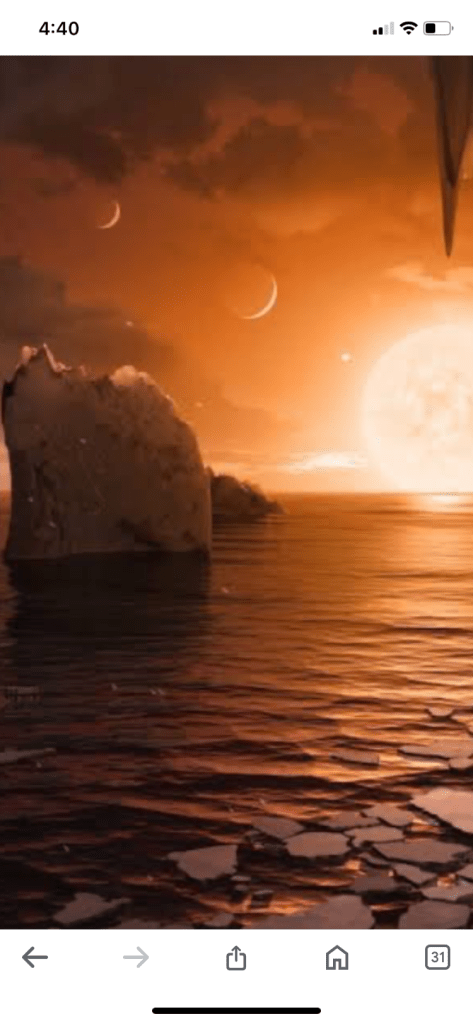
The outer planets fare a little better. They could retain some of their water unless their initial water was low at about 1 TO. “We find T1-e, f, g, and h lose, at most, approximately 8.0, 4.8, 3.4, and 0.8 TO, respectively,” they write. These outer planets probably have more oxygen than the inner planets, too
Most stars in the Milky Way are M dwarfs. As the TRAPPIST-1 makes clear, they can host many terrestrial planets. Large, Jupiter-size planets are comparatively rare around these types of stars.
As M dwarfs are the most common stars in our local stellar neighbourhood, whether their planetary systems can harbour life is a key question in astrobiology that may be amenable to observational tests in the near term,” the authors write. “Terrestrial planetary targets of interest for atmospheric characterization with M dwarf hosts may be accessible with the JWST,” they explain. They also point out that future large ground-based telescopes like the European Extremely Large Telescope and the Giant Magellan Telescope could help, too, but they’re years away from being operational.
Despite the challenges, the T-1 system is a great opportunity to study M dwarfs, atmospheric escape, and rocky planet habitability. “TRAPPIST-1 is a high-priority target for JWST General and Guaranteed Time Observations,” the authors write. The JWST has observed parts of the T-1 system, and that data is part of this work.
In this work, the researchers simulated early atmospheres for each of the TRAPPIST-1 (T-1 hereafter) planets, including different initial water amounts expressed in Terrestrial Oceans (TO.) They also modelled different amounts of stellar radiation over time. Their simulations used the most recent data for the T-1 planets and used a variety of different planetary evolution tracks
An international team of astronomers used the NASA/ESA Hubble Space Telescope to estimate whether there might be water on the seven earth-sized planets orbiting the nearby dwarf star TRAPPIST-1. The results suggest that the outer planets of the system might still harbor substantial amounts of water. This includes the three planets within the habitable zone of the star, lending further weight to the possibility that they may indeed be habitable.
As it is very light, hydrogen gas can escape the exoplanets’ atmospheres and be detected around the exoplanets with Hubble, acting as a possible indicator of atmospheric water vapor. The observed amount of ultraviolet radiation emitted by TRAPPIST-1 indeed suggests that the planets could have lost gigantic amounts of water over the course of their history.
This is especially true for the innermost two planets of the system, TRAPPIST-1b and TRAPPIST-1c, which receive the largest amount of ultraviolet energy. “Our results indicate that atmospheric escape may play an important role in the evolution of these planets,” summarises Julien de Wit, from MIT, USA, co-author of the study.
TRAPPIST-1: 7 Earth-like planets surprised scientists, how are they so similar to each other?
TRAPPIST-1: There are 7 rocky planets in a star system located 40 light years away from Earth. Their shape is like the Earth but the density is less. They all seem to have the same density
7 rocky planets are orbiting the TRAPPIST-1 red dwarf star, located 40 light years away from Earth. Scientists have got new information about them. In fact, it has been found that their density is similar, which indicates that their structure may also be similar. All of these planets are equal to or smaller than Earth. This is the largest group of Earth-like planets revolving around a star
According to NASA’s Jet Propulsion Laboratory, the latest study has found that the density of these planets is 8% less than the Earth. Caroline Dorn, an astrophysicist at the University of Zurich, says, ‘The TRAPPIST-1 system is very interesting because this one star gives us the opportunity to know the diversity of rocky planets in the same system and we can tell about a planet and its neighbors. You can also find out by studying. That’s why this system is perfect.
When the planet comes in front of the star, a decrease in its brightness is detected. With this, based on the time of the planets’ orbit, astronomers estimate the mass and diameter of the planets, from which the density can be known. The similarity in density of TRAPPIST-1’s planets suggests that they may be composed of equal amounts of iron, oxygen, magnesium, and silicon.
However, their density is 8% less than that of Earth. Based on this, three possibilities for their structure have been suggested. One is that the structure of these planets should be like Earth but iron should be 21% which is 32% in Earth. It is possible that iron was present along with lighter elements like oxygen, which reduced the density. In such a situation, oxygen and iron form iron oxide or rust. It is also possible that 5% of the mass on their surface is water due to which their density is low. However, given the distance of the three planets from the star, it is difficult for this much water to exist
TRAPPIST-1 is a sun-like star, 7 new planets are revolving around it
Space agency NASA has claimed to have found 7 new Earth-like planets, out of which the possibility of life on 3 cannot be ruled out. All of them revolve around the TRAPPIST-1 star
How is TRAPPIST-1?
This is a dwarf star. Which is up to 10 times smaller than our Sun and 2.5 times colder. It looks more like Jupiter than the Sun. It is true that its planets look like Earth. Although all these planets are very close to each other
TRAPPIST-1 System – Life can exist on the planets of this solar system
Friends, there are two possibilities for the existence of life in this vast universe. The first of which is that we Earthlings are not alone in this vast universe and like us, many other intelligent and advanced civilizations reside in this universe. But due to the great distance they have so far failed to contact us. Another answer is that in this vast universe, intelligent life like us humans is very rare and only a few selected intelligent civilizations exist in this vast universe. But such planets may definitely exist in our universe where life is in its initial stage i.e. microbial phase or is moving towards becoming an intelligent species like us humans.
TRAPPIST-1 System and Red Dwarf Stars
To know the answer to this question, we humans started identifying such planets where all the necessary conditions are present for life to flourish and where some kind of life can exist. In this search, we discovered a red dwarf-star system located about 40 light years away from our solar system, where some planets may exist where life is thriving.
During the search, scientists found a total of seven planets revolving around this red dwarf star, out of which three planets revolve around their star in the habitable zone. These planets present in the habitable zone are rocky worlds where there may be more water, active atmosphere and perhaps some kind of life than our Earth.
Red dwarf stars live for several trillion years longer than our Sun, during which they continue to transmit their light and energy to their exoplanets. In such a situation, there is a lot of time for any kind of life to evolve on the exoplanets revolving around these stars. And for this reason these red dwarf stars are considered one of the most selected places for any kind of life hosting exoplants.
One such red dwarf star is Trappist 1, which is present in the Aquarius constellation, about 40 light years away from our Earth. This star was discovered in 1999 by astronomer John Gizis and his colleagues. At that time it was named 2MASS J23062928-0502285. This star is actually an ultra cool red dwarf star which is much smaller and less bright than our Sun
May 2016, a team of scientists using the Transiting Planets and Planetesimals Small Telescope i.e. TRAPIST discovered three rocky planets revolving around it, after which this star system was named Trappist 1.
But the most special thing about this discovery was that out of these seven planets, three planets revolve around this star in its habitable zone. The habitable zone of a star is a special zone of that star where it is neither too hot nor too cold. Due to which water remains in its liquid form in the planets present in this zone, which is considered to be the most important ingredient for the flourishing of life. In such a situation, a hard surface, liquid water, active atmosphere and perhaps life can also exist on these planets.
All seven worlds were observed to be approximately the same mass and size as Earth. Of these, 3 to 4 planets are present in the habitable zone of this star. These are TRAPPIST-1e, f, and g. Now imagine about a solar system in which there are worlds full of life one after the other and these worlds are so close to each other that traveling between them would be like here. Moving from one country to another on earth.
Water on outer planets of Trappist 1
It was a remarkable discovery, especially because up to four of them could be the right distance from the star to have liquid water. The TRAPPIST-1 system still gets a lot of scientific attention. Potential Earth-like planets in a star’s habitable zone are like magnets for planetary scientists
A 2021 study revealed more about TRAPPIST-1planets. They are likely made of similar stuff, but they are different from Earth. That could mean they all contain about the same ratio of materials thought to compose most rocky planets, like iron, oxygen, magnesium, and silicon
Does trappist-1e have an ozone layer?
We find that under strong to intermediate TRAPPIST-1 UV irradiation, the planet may have a thick ozone layer ranging from 30 to 1000 Dobson units (1/10 to 3 times Earths value).
Does TRAPPIST-1e have liquid water?
TRAPPIST-1e is confirmed to be a terrestrial planet with a solid, rocky surface. It is cool enough for liquid water to pool on the surface, but not so cold that it would freeze like on TRAPPIST-1f, g, and h
Which planet has life like Earth?
Kepler-452b (sometimes quoted to be an Earth 2.0 or Earth’s Cousin based on its characteristics; also known by its Kepler Object of Interest designation KOI-7016.01) is a super-Earth exoplanet orbiting within the inner edge of the habitable zone of the sun-like star Kepler-452 and is the only planet in the system
What is NASA’s search for life?
NASA’s search for life
The ultimate goal of NASA’s Exoplanet Program is to find unmistakable signs of current life. Exoplanets’ own skies could hold such signs, waiting to be revealed by detailed analysis of the atmospheres of planets well beyond our solar system
The processes that shape the evolution of a terrestrial planet are critical to whether or not it can be habitable, as well as our ability to interpret possible signs of life,” Victoria Meadows, co-author of the study and professor of astronomy at UW, said. “This paper suggests that we may soon be able to search for potentially detectable signs of these processes on alien worlds.”
Please like subscribe comment your precious thoughts on universe discoveries
Full article source google
Best fish food on discount on Amazon Universe discoveries