
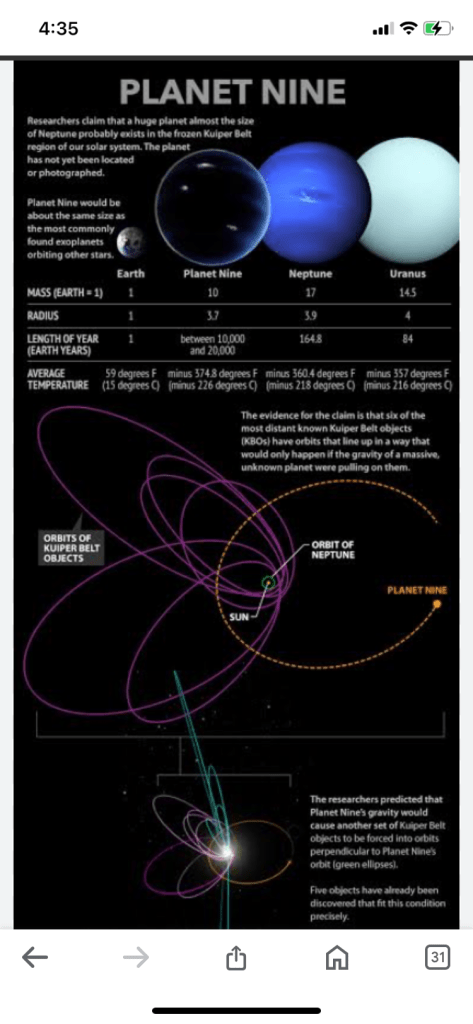
A newly released study of unusual asteroid orbits strengthens the case for the hypothesized distant, massive planet. Recent papers by Michael Brown and Konstantin Batygin, both astronomers at Caltech, are providing a whole new line of evidence in support of the existence of our solar system’s hypothesized Planet Nine
A recent study of unusual asteroid orbits has strengthened the case for the hypothetical Planet Nine, a massive planet that some scientists believe exists in the outer solar system. In 2016, astronomers Konstantin Batygin and Michael Brown proposed the existence of Planet Nine, a planet with a mass about 10 times that of Earth and a highly eccentric orbit. The study suggests that the newly discovered asteroid fits easily into the Planet Nine scenario, though the evidence is not conclusive
Planet Nine’s orbit would explain the clustered perihelia and the orbits of Sedna and other bodies. The planet would have a perihelion about 300 astronomical units (AU) away, where one AU is the distance between the Earth and the Sun
Does Planet Nine exist? The new evidence says yes.
A newly released study of unusual asteroid orbits strengthens the case for the hypothesized distant, massive planet
First evidence
This distant, massive world was first predicted in 2014 by astronomers who noted the unusual orbits of various outer solar system bodies called extreme trans-Neptunian objects. Trans-Neptunian objects (TNOs) have orbits that are farther from the Sun than Neptune. Extreme TNOs, or ETNOs, have even more elongated, distant orbits that are unaffected by interactions with any of the known planets. The dwarf planet Sedna, discovered in late 2003, was the first known ETNO.
Natural consequences
What’s going on, he explains, is that they’re seeing “not just clustering in the direction the orbits point, but also they are all tilted off the plane of the ecliptic [the plane of the solar system] by an average of about 15°. So both of these things together are pretty strange.”
The researchers have seen similar clustering turned in the perihelia — the point of their closest approach to the Sun — of these distant objects that varies up and down, sometimes dipping close to Neptune’s orbit, and sometimes swinging farther away. “That turns out to be another natural consequence of Planet Nine,” Brown says. “We didn’t think about it at the time when we first proposed the planet, it was not in our minds. But we quickly realized that was it.”
New tools
But there is new hope. Next year, the Vera C. Rubin Observatory will come online in Chile, scanning the entire southern sky every four days with the largest camera ever built. The team’s analysis says there is a very high probability that if Planet Nine exists, the Rubin system should be able to find it within a year or two, proving its existence once and for all
Has Planet 9 been found?
Although sky surveys such as Wide-field Infrared Survey Explorer (WISE) and Pan-STARRS did not detect Planet Nine, they have not ruled out the existence of a Neptune-diameter object in the outer Solar System
Is Planet 9 a black hole?
While investigating other gravitational sources of what may be messing with TNOs (no matter how improbable they are) is good science, it’s more likely that Planet Nine is a planet and not a primordial black hole
Why is Planet 9 so mysterious?
Its elusive nature suggests that it’s at the far edge of its enormous orbit, meaning it’s unlikely to be reflecting much light from the Sun. As such, it will remain in shadow, hidden within the sparkling starfield of the Milky Way.
Planet 9 a gas giant?
The paper is titled “Evidence for a Distant Giant Planet in the Solar System.” This artistic rendering shows the distant view from Planet Nine back towards the sun. The planet is thought to be gaseous, similar to Uranus and Neptune
Does Planet 9 have rings?
It is also likely to have a simple ring system similar to that of Neptune’s. Because of its distance from the Sun, it is hypothesized that a year on Planet Nine would take around 20,000 years, although the planet itself could be a Super Earth
Scientists have chased a theory for decades…but is it a ghost, a black hole, or a newfound planet?
A ‘ghost planet’ sounds like something JJ Abrams is considering for his next project, but that’s just one of the many terms used to describe Planet Nine, a hypothetical mystery world. If it is discovered, it would be the first newfound planet to be recognised within the solar system since 1846
Where did the idea originate?
In the early 1900s, astronomers believed Planet Nine could exist as it would offer an explanation for the “wobbles” in the orbits of Uranus and Neptune. The gravitational pull of another planetary body was thought to be responsible and so when Pluto was discovered in 1930, scientists believed this was the ‘ghost planet’ they’d been seeking, so the search was over. However, the hunt restarted when further research revealed that Pluto was too small to affect Neptune and Uranus (poor Pluto would later be demoted to a ‘dwarf planet’ – and whether it is a planet at all is hotly debated).2 Based on data collected from Voyager 2’s fly-by of Neptune in 1989, NASA announced that there were no anomalies in the orbits of the outer planets at all; they were not rogue. So, at this stage, it seemed that they had been searching for something that did not exist.
What do the experts say?
There are Planet Nine sceptics. Of course there are, this is modern astronomy. Some believe it isn’t even a planet, but a primordial black hole, one of the compressed masses that formed during the very first second of our universe’s existence. Black holes are some of the densest objects in the Universe, making it possible that it – rather than a planet – is affecting the orbits of other masses.12
Does Planet 9 have moons?
According to the paper, Planet Nine might be host to up to 20 moons, each up to 62 miles (100 kilometers) across. If it does have those moons, they might be the key to revealing Planet Nine’s presence in the Kuiper Belt, and the secret is tides
Why do scientists think Planet 9 exists?
The connection between MOND and a hypothetical Planet 9 may seem odd, but it emerges from the fact that the primary evidence for this world — that supposedly lurks at the edge of the solar system — is the strange behavior of objects in a distant structure called the Kuiper belt
Is Planet 9 an ice giant?
A massive ice giant may be traveling through the outer solar system. Dubbed “Planet Nine,” the hypothetical world was proposed to exist after scientists noticed that a handful of objects beyond Pluto had been shaken up in unusual orbits
Could Planet 9 be habitable?
NASA finds Earth-size planet that could be habitable: ‘An exciting prospect’ If their calculations serve them correctly, Planet Nine would have a mass that is about 1.5 to 3 times that of Earth, at 500 times the distance between our home and the sun
What would Planet 9 look like?
What might Planet Nine look like? Assuming this planet-like object really does exist out there, Planet Nine’s mass would most likely be a magnitude (roughly 10 times) greater than Earth’s, with a girth approaching the range of one of our ice giants
What is the hidden planet like Earth?
Kuiper Belt planet
Kuiper Belt planet
“We predict the existence of an Earth-like planet,” the researchers wrote. “It is plausible that a primordial planetary body could survive in the distant Kuiper Belt as a Kuiper Belt planet (KBP), as many such bodies existed in the early solar system
For centuries, astronomers have been shining a flashlight, hoping to stumble upon a cosmic mystery in the darkness. Hopefully when the Vera C. Rubin Observatory finally arrives, it’ll be like turning on a light switch
A small team of planetary scientists from the California Institute of Technology, Université Côte d’Azur and Southwest Research Institute reports possible new evidence of Planet 9. They have published their paper on the arXiv preprint server, and it has been accepted for publication in The Astrophysical Journal Letters
In April 2024, the Times of India reported that new studies have provided compelling evidence supporting the existence of a hypothetical planet in the outer reaches of our solar system, called “Planet Nine”. The concept of Planet Nine was first proposed in 2016 by Caltech researchers Konstantin Batygin and Michael Brown. Their original evidence was based on the unusual orbit patterns of trans-Neptunian objects (TNOs), which are celestial bodies that spend most of their orbits beyond Neptune. In May 2024, Astronomy reported that new evidence has emerged in the form of a population of objects that orbit between Jupiter and Neptune, but also extend beyond Neptune. According to Astronomy, these objects have orbits that are “twisted by about 90° from the plane of the solar system and are on very eccentric orbits”.
Researchers have created simulations with and without Planet Nine, and found that the simulations that include Planet Nine more accurately reflect what astronomers see in the Solar System. These simulations align with what has been observed over long-period orbits that cross Neptune’s path.
Planet Nine is thought to be a super-Earth-sized planet with an elongated orbit that is 400 to 800 times farther from the Sun than Earth. Its elusive nature suggests that it is at the far edge of its orbit, unlikely to reflect much light from the Sun, and will remain hidden within the Milky Way
Please like subscribe comment your precious thoughts on universe discoveries
Full article source google
Best kitchen and housewares products on heavy discount on Amazon Universe discoveries