
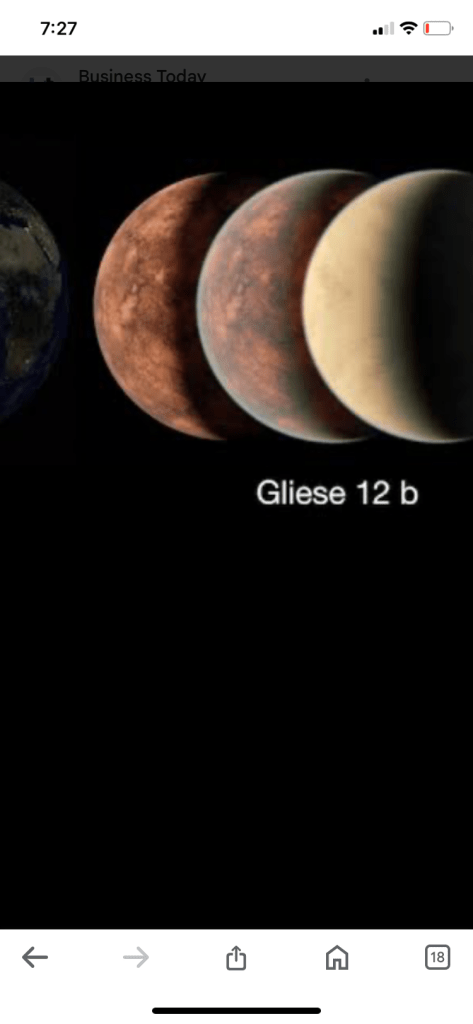
University College of London has a major contribution in the discovery of the new planet Gliese 12-b. Larissa Palethorpe, who was part of this discovery, said, ‘It is quite interesting that this is a very close transiting planet to the Earth. It may be in the habitable zone of its star/sun or may be evolving to inhabit it
Alien Life Hunting: Recently scientists have discovered a new planet about 40 light years away from Earth. Its information was published in the Monthly Journal of the Royal Astronomical Society. It is the closest to Earth among the habitable exoplanets discovered so far. It is like our Earth in terms of size and atmosphere, it is estimated that life may be possible on it. The temperature here is such that water can remain in liquid state on its surface. This planet has been named Gliese 12-B. It was discovered by NASA’s international team with the help of Transiting Exoplanet Survey Satellite (TESS)
The University College of London has a major contribution in the discovery of this new habitable planet Gliese 12-b. Larissa Palethorpe, who was part of this discovery, said, ‘It is quite interesting that this is a very close transiting planet to the Earth. It may be in the habitable zone of its star/Sun or may be evolving to inhabit it.
orbiting a red dwarf star
It is slightly smaller than the Earth. Scientists have found it revolving around a red and dwarf star. Its distance from its main star is 7% of the distance between Earth and the Sun, yet it may be habitable. Its life part is known as ‘Goldilocks Zone’. Here it is neither too cold nor too hot for any liquid, which can be important for life.
This planet found in the part between Venus and Earth is also being said to be their child because it has similarities with both the planets. Scientists said it receives 1.6 times the heat of its star, yet it is only 50 degrees Fahrenheit hotter than Earth
Gliese 12 (GJ 12) is a red dwarf star located 39.7 light-years (12.2 parsecs) away in the constellation Pisces. It has about 24% the mass and 26% the radius of the Sun, and a temperature of about 3,296 K (3,023 °C; 5,473 °F). It is an inactive star and hosts one known exoplanet
The transiting exoplanet Gliese 12 b was discovered by TESS, and two independent studies confirming it as a planet were published in May 2024. Gliese 12 b is similar in size to Earth and Venus, and completes an orbit around its star every 12.8 days. Its mass is poorly constrained but is known to be less than 4 times that of Earth.
Along with the planets of TRAPPIST-1, Gliese 12 b is one of the nearest known relatively temperate transiting exoplanets, and so is a promising target for the James Webb Space Telescope to determine whether it has retained an atmosphere. Gliese 12 b orbits slightly closer than the inner edge of its star’s habitable zone, with an insolationbetween those of Earth and Venus. Its equilibrium temperature, assuming zero albedo, is 315 K (42 °C; 107 °F); if it has an atmosphere, the surface temperature would be greater than this
Gliese in the Milky Way?
Summary. The Hubble telescope’s crisp vision has captured a first-time view of one of the smallest stars in our Milky Way Galaxy. Called Gliese 623b or Gl623b, the diminutive star [right of center] is 10 times less massive than the Sun and 60,000 times fainter
Our knowledge of terrestrial planets akin to Earth around stars beyond our own has progressed vastly since the beginning of the 2010s. The Kepler mission revealed that these small planets are abundant around low-mass M-dwarf stars (Dressing & Charbonneau 2015; Muirhead et al. 2015). This discovery has opened the doors to a wealth of study on small planets orbiting M-dwarfs throughout the last decade. M-dwarfs are especially well-suited for transiting planet detection and characterization due to their frequency in our galaxy, small size, and low luminosities. These properties of M-dwarfs result in advantages in detection efficiency due to nearer transiting systems, deeper transits, and higher a priori geometric transit probability for temperate planets due to their closer orbital separations.
TESS stares at a large swath of the sky for about a month at a time, tracking the brightness changes of tens of thousands of stars at intervals ranging from 20 seconds to 30 minutes. Capturing transits — brief, regular dimmings of stars caused by the passage of orbiting worlds — is one of the mission’s primary goals.
The host star, called Gliese 12, is a cool red dwarf located almost 40 light-years away in the constellation Pisces. The star is only about 27% of the Sun’s size, with about 60% of the Sun’s surface temperature. The new world, named Gliese 12 b, orbits every 12.8 days and is Earth’s size or slightly smaller — comparable to Venus. Assuming it has no atmosphere, the planet has a surface temperature estimated at around 107 degrees Fahrenheit (42 degrees Celsius).
The distance separating Gliese 12 and the new planet is just 7% of the distance between Earth and the Sun. The planet receives 1.6 times more energy from its star as Earth does from the Sun and about 85% of what Venus experiences
Thrillingly, this planet is the closest Earth-sized and temperature planet we know,” Dr Wilson added.
“The light we are seeing now is from 1984 [40 years ago] – that’s how long it has taken to reach us here on Earth.
“Planets like Gliese 12 b are very few and far between, so for us to be able to examine one this closely and learn about its atmosphere and temperature is very rare.”
Larissa Palethorpe, co-lead of the study and doctoral student at the University of Edinburgh and University College London, said it was a “unique candidate” for further atmospheric study to help unlock some aspects of our own solar system’s evolution.
“Earth remains habitable, but Venus does not due to its complete loss of water. Gliese 12 b’s atmosphere could teach us a lot about the habitability pathways planets take as they develop,” she added.
An Australian university student has co-led the discovery of an Earth-sized, potentially habitable planet just 40 light years away.
Shishir Dholakia, a PhD candidate in astrophysics at the University of Southern Queensland, is part of an international team that published the discovery in the Monthly Notices of the Royal Astronomical Society.
He described the “Eureka moment” of finding the planet, which has been named Gliese 12b.
“We did the back-of-the envelope calculations,” he said. “We worked out it’s probably Earth-sized, it’s probably temperate, and that it’s really, really nearby. In the span of a day we were like, ‘Oh, we have to write this up. This is something really cool.’
Gliese 12b is the size of Earth or slightly smaller, like Venus. And its surface temperature is estimated to be a balmy 42C.
Its 12-day orbit is around Gliese 12, a cool red dwarf in the Pisces constellation. Gliese 12 is about a quarter of the sun’s size, with about 60% of its surface temperature.
Dholakia co-led the team – with a University of Edinburgh PhD student, Larissa Palethorpe – who collaborated with Nasa to confirm the new planet.
“It’s only 40 light years away, and this might not mean that we can actually get to it any time in the near future, but it does mean that we can point the largest space telescopes in the world at it, and understand what its atmosphere might be like,” Dholakia said.
List of potentially habitable planets
This is a list of potentially habitable exoplanets. The list is mostly based on estimates of habitability by the Habitable Exoplanets Catalog (HEC), and data from the NASA Exoplanet Archive. The HEC is maintained by the Planetary Habitability Laboratory at the University of Puerto Rico at Arecibo. There is also a speculative list being developed of superhabitable planets.
Surface planetary habitability is thought to require an orbit at the right distance from the host star for liquid surface water to be present, in addition to various geophysicaland geodynamical aspects, atmospheric density, radiation type and intensity, and the host star’s plasma environment.
ObjectStarStar typeMass (M⊕)Radius (R⊕)Density(g/cm3)Flux (F⊕)Teq (K)Period (days)Distance (ly)Refs/NotesEarthSunG2V1.001.005.5141.00255365.250Reported for reference. Only planet known to support life.[3]VenusSunG2V0.8150.94995.2431.911244.261224.70Reported for reference. [5]Gliese 12 bGliese 12M4V0.881.034.441.631512.7614440[6]Gliese 163 cGliese 163M3V≥6.80——1.2527725.649[1]Gliese 180 cGliese 180M2V≥6.40——0.7823924.339Not confirmed[1][7]Gliese 180 dGliese 180M2V≥7.56——0.26106.339[1]Gliese 229 AcGliese 229AM1V≥8.57——0.44216121.918.8Gliese 357 dGliese 357M2V≥6.10——0.3820055.731Gliese 433 dGliese 433M2V≥5.22——1.0636.129.6[1]Gliese 514 bGliese 514M1V≥5.20——0.28 (0.114−0.79)202140.425Highly eccentric[8]Gliese 625 bGliese 625M2V≥2.82——14.62821.1Only in HZ if very optimistic models used[9][10][11]Gliese 667 CcGliese 667CM1V≥3.81~1.54—0.8827728.123.62[12][1]Gliese 1002 bGliese 1002M5V≥1.08~1.03—0.6723110.315.8[13]GJ 1002 cGJ 1002M5V≥1.361.1—0.2618221.215.8[13][14]GJ 1061 cGJ 1061M5V≥1.74~1.18—1.452756.712GJ 1061 dGJ 1061M5V≥1.64~1.16—0.6921813.012GJ 3293 dGJ 3293M2V≥7.60——0.5922348.166[1]HD 40307 gHD 40307K2V≥7.09——0.67226197.842Not confirmed[1][15]HD 216520 cHD 216520K0V≥9.44——1.28154.464[1]HIP 38594 bHIP 38594M0V≥8.10——1.3460.758 K2-9bK2-9M2V—2.25—1.4527918.4270[1][16]K2-72eK2-72M?V~2.211.29—1.3026124.2217[17]K2-332bK2-332M?V—2.20—1.1717.7402[1]K2-288BbK2-288 BM3V4.271.91—0.4420731.4214[18]Kepler-22bKepler-22G5V—2.38—1.10261289.9635[1][19]Kepler-62eKepler-62K2V4.5+14.2
−2.61.61—1.15264122.4981[1][20]Kepler-62fKepler-62K2V2.8+0.4
−0.41.41—0.41204267.3981[1][21]Kepler-155cKepler-155M0V—2.24—1.0552.7957[1]Kepler-174dKepler-174K3V—2.19—0.59206247.41254 Kepler-186fKepler-186M1V1.44+2.33
−1.121.17—0.29188129.9579 Kepler-283cKepler-283K5V—1.82—0.8924892.71526 Kepler-296eKepler-296K7V2.961.52—1.4127634.1737 Kepler-296fKepler-296K7V—1.80—0.4422563.37371][24]Kepler-442bKepler-442K5V2.36+5.9
−1.31.35—0.70233112.31193 Kepler-440bKepler-440K6V—1.91—1.44273101.198 Kepler-443bKepler-443K3V—2.35—0.89247177.7261 Kepler-452bKepler-452G2V~51.63—1.11261384.81799Not confirmedKepler-705bKepler-705M?V—2.11—0.7724356.1903Kepler-1229bKepler-1229M?V2.5401.40—0.3221386.8865 Kepler-1410bKepler-1410K?V—1.78—1.0727460.91196Kepler-1540bKepler-1540K?V—2.49—0.78250125.4799Kepler-1544 bKepler-1544K2V—1.78—0.84248168.81092[1]Kepler-1606bKepler-1606G?V—2.07—1.64277196.42710 Kepler-1649cKepler-1649M5V1.201.06—0.7523719.5301 Kepler-1652bKepler-1652M?V—1.60—0.8424438.1822Kepler-1653bKepler-1653K?V—2.17—1.04258140.32461Kepler-1701bKepler-1701K?V—2.22—1.42275169.11904[1][31]L 98-59 fL 98-59M3V≥2.46—
Is it possible to live on an exoplanet?
The orbit must lie in the “habitable zone” where the exoplanet’s surface is just the right temperature for liquid water to exist. Every form of life we know requires liquid water, so an exoplanet too close or too far from its host star is less likely to contain life
What are NASA possible signs of life?
A small, rocky world with clouds, oceans and an atmosphere bearing signs of possible life. This might be a combination of gases – oxygen, carbon dioxide and methane – that, seen by themselves, don’t tell us very much, but together speak volumes
there life in our galaxy?
Our galaxy likely holds trillions. But so far, we have no evidence of life beyond Earth. Is life in the cosmos easily begun, and commonplace? Or is it incredibly rare?
there another Earth with humans?
The Moon is the only other place humans have visited. No other planet in our solar system currently has the conditions to support life as we know it on Earth. Even if scientists discover another habitable planet outside of our solar system, humans do not yet have the technology to visit it.
Has another Earth been found?
A new “super-Earth” has been discovered in a nearby solar system’s habitable zone, according to NASA. The planet, designated as TOI-715 b, is “about one and a half times as wide as Earth” and in a system that is only a measly 137 light-years from Earth
Please like subscribe comment your precious thoughts on universe discoveries
Full article source google and Wikipedia
 Universe discoveries
very very interesting post! Greetings from Italy
LikeLiked by 1 person
Thanks a lot dear friend 🌹🎸
LikeLiked by 1 person
Very good post with sharing 💥
LikeLiked by 1 person
Thanks
LikeLiked by 1 person
Very nice
LikeLike