
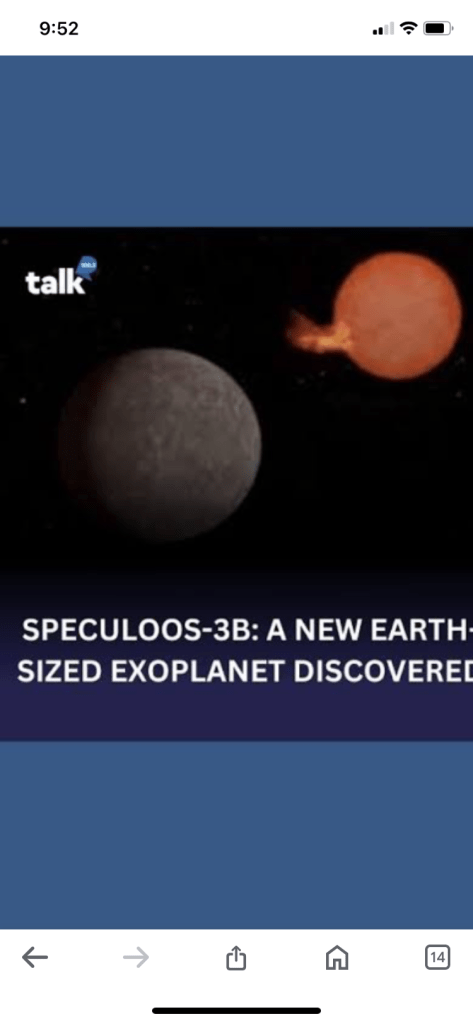
7 planets that look similar to our Earth, after TRAPPIST-1, now another planet has been discovered, whose size is similar to the Earth and it is not too far from us.
So, apart from the Moon and Mars, are there preparations to settle on this other Earth also? What is the name of this planet and what is its atmosphere like
The name of this new earth is SPECULOOS-3 b. It is about 55 light years away from our Earth, which is considered very close on the cosmic scale. It is an exoplanet, i.e. a planet outside our solar system and its size is largely similar to the Earth. Just as the Earth revolves around the Sun, every planet revolves around some star.
One year is only 17 hours
According to scientists, SPECULOOS-3 b is very close to the star it revolves around. This is the reason that while the Earth takes one year i.e. 365 or 366 days to revolve around the Sun, SPECULOOS-3 b takes only 17 hours to revolve around its star. That means one year of SPECULOOS-3 b is only 17 hours.
Proximity to star a matter of concern
This new Earth being so close to its star is a matter of concern for scientists, because in fact, due to this proximity, one side of the planet is always towards its star, due to which there is always light here, it is called the day side.
The other side of the star is always in the grip of darkness, because there is no scope for light to reach there, it is called the night side. This is exactly the same as between the Earth and the Moon. One side of the Moon always faces the Earth.
who discovered it
Search for Planets Eclipsing Ultra Cool Stars i.e. SPECULOOS is a project of the University of Liege, in which such planets revolving around ultra cool stars are being searched where humans can settle. Ultracool stars are smaller and much cooler than the Sun. It is difficult to find them among the twinkling stars in the darkness of night, because their brightness is very less. That is why under this project, especially such stars and their planets are being studied with the help of robotic telescopes.
In the SPECULOOS project itself, the Earth-like planet SPECULOOS-3 b has also been discovered, where its size is like the Earth, while its star is slightly bigger than Jupiter, but its mass is more.
About 16 times more than the sun’s radiation
Researchers and scientists believe that it will be difficult for humans to settle here, because just as the Sun’s radiation reaches the Earth, similarly its star on SPECULOOS-3 b is responsible for about 16 times more radiation than the Sun. However, the discovery of SPECULOOS-3 b has given a positive direction to the search for Earth-sized exoplanets in the habitable zone (ie the zone around a star where water is likely to be found).
Found: An Earth-sized exoplanet named SPECULOOS-3 b
The planet is likely tidally locked, meaning one side always faces the sun while the other is shrouded in darkness
The data from SPECULOOS-3 b discovery could lead to further research using the James Webb Space Telescope, according to the release. Its planetary composition and its location are subject to more research.
‘‘We’re making great strides in our study of planets orbiting other stars. We have now reached the stage where we can detect and study Earth-sized exoplanets in detail. The next step will be to determine whether any of them are habitable, or even inhabited,’’ said Steve B. Howell, one of the planet’s discoverers at NASA Ames Research Center, in the release.
What is speculoos 2c?
SPECULOOS 2c has a radius 30 to 40 per cent larger than Earth’s and takes just 8.4 days to orbit its star. It is also tidally locked, which means it has a permanent day on one side and it is always night on the other
SPECULOOS-3 b adds to the growing list of Earth-sized exoplanets found in habitable zones, but the extreme conditions on this planet present unique challenges for habitability. The constant daylight on one side and perpetual darkness on the other could create stark temperature differences, potentially affecting atmospheric and surface conditions.
Researchers are eager to conduct further observations to understand the planet’s atmosphere and its potential to support life. Future studies will focus on characterizing the atmospheric composition and looking for signs of habitability, such as the presence of water vapor or other biosignatures.
Finding an Earth-sized planet around an ultra-cool star is a step forward in our quest to find habitable worlds beyond our solar system,” said a representative from the SPECULOOS project. This discovery not only enhances our understanding of planetary systems around different types of stars but also brings us closer to answering the age-old question of whether we are alone in the universe
As technology and methods for detecting exoplanets continue to improve, the search for potentially habitable worlds becomes more promising. SPECULOOS-3 b represents a significant milestone in this ongoing journey, offering a glimpse into the diverse range of planets that exist in our galaxy
About SPECULOOS-3b:
- It is an Earth-size planet orbiting an ultracool red dwarf star, 55 light-years away from Earth.
- This red dwarf, though similar in size to Jupiter, emits light 100 times dimmer than the sun and has half the temperature.
- The planet is only the second of its kind to be discovered around this type of star.
- SPECULOOS-3b receives high levels of radiation from its sun, probably leaving the planet without an atmosphere. The planet receives almost 16 times more energy per second than Earth receives from the Sun.
- It takes around 17 hours tocomplete an orbit of the star.
- The planet is thought to be tidally locked, so the same side, known as the dayside, always faces the star, like the Moon to Earth. The nightside would be locked in never-ending darkness.
- The discovery was made by the team from the SPECULOOS (Search for Planets EClipsing ULtra-cOOl Stars) project, which is led by the University of Liège, in Belgium, in collaboration with the Universities of Birmingham, Cambridge, Bern, and the Massachusetts Institute of Technology, using the observatory located in the Atacama Desert of northern Chile.
- The SPECULOOS project was established to search for exoplanets orbiting ultra-cool dwarf stars using a network of robotic telescopes based around the world.
Astrophysical Significance of the Discovery
- Prevalence of Ultracool Dwarfs:Ultracool dwarf stars, like the host of Speculoos-3b, constitute about 70% of all stars in our galaxy and are known for their longevity, surviving up to 100 billion years.
- Importance for Life’s Potential:The extended lifespan of these stars provides a stable environment that could potentially support the development of life on orbiting planets.
Please like subscribe comment your precious thoughts on universe discoveries
Full article source google
https://www.amazon.in/b?_encoding=UTF8&tag=555101-21&linkCode=ur2&linkId=d2354e59fdf8c3057b92c417d679fb1f&camp=3638&creative=24630&node=976442031 Universe discoveries