
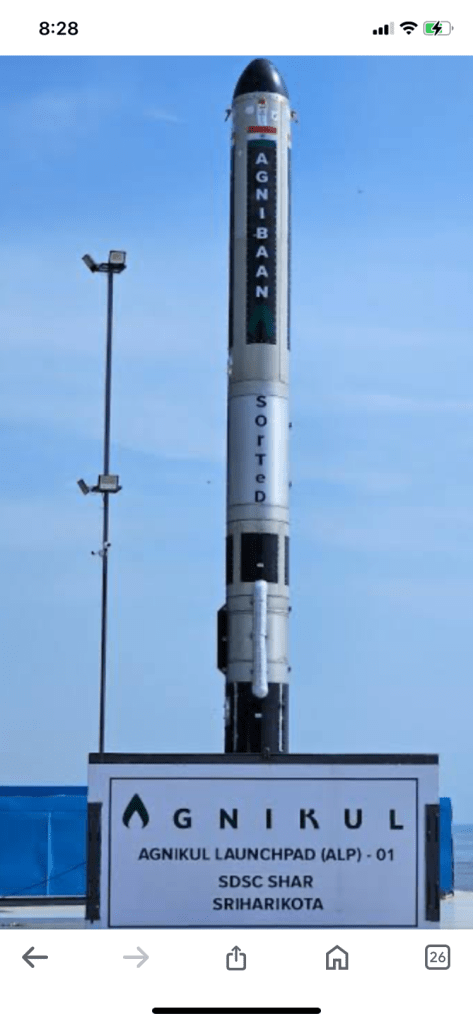
Agnibaan SOrTeD 3D-printed Rocket Engine Launch: On May 30, 2024, Agnikul Cosmos, an IIT Madras-incubated startup, successfully launched the world’s first rocket with a fully 3D printed engine, named ‘Agnibaan – SOrTeD
The startup was founded in 2017 by CEO Srinath Ravichandran, a Wall Street trader-turned-aerospace engineer, operations specialist Moin SPM, and Satyanarayanan Chakravarthy, an IIT Madras professor. The startup was incubated at the IIT Madras Research Park.
Who are the investors in Agnikul Cosmos?
This is a monumental achievement and a testament to the relentless spirit and innovation of the Agnikul team,” Anirudh A Damani- Managing Partner, Artha India ventures, a prime investor in Agnikul. Anand Mahindra, Chairman, Mahindra Group, and an investor in Agnikul in X said, “Another piece of India-related good news
This launch, which comes after several previous attempts, marks a major achievement as the first-ever controlled flight of a semi-cryogenic liquid engine realized through additive manufacturing
Indian Space Research Organisation in X said, “Congratulations @AgnikulCosmos on the successful launch of the Agnibaan SoRTed-01 mission from their launch pad. This is a major milestone, as it is the first-ever controlled flight of a semi-cryogenic liquid engine realised through additive manufacturing.”
“A remarkable feat which will make the entire nation proud,” said Prime Minister Narendra Modi.
The mission featured a 6.2-meter-tall single-stage launch vehicle with an elliptical nose cone and was equipped with advanced avionics architecture and autopilot software developed in-house.
The Agnilet engine, the world’s first single-piece 3D-printed semi-cryogenic rocket engine, powered the vehicle
Innovative Use of Inconel Material
Agnikul utilized the Inconel material to build the 3D-printed rocket. Inconel is an alloy known for its oxidation-corrosion resistance and suitability for space travel, making it an ideal choice for this groundbreaking project
Agnibaan Rocket and Agnilet Engine
The Agnibaan rocket is a customizable two-stage rocket with a height of approximately 20 meters. It has the capability to carry a payload of up to 300 kg to the low Earth orbits (LEO), roughly 700 km above Earth. Agnibaan is a SOrTeD (SubOrbital Technological Demonstrator) with a plug-and-play configuration, allowing it to be expanded or shrunk depending on the satellite’s requirements for space travel.
Agnikul’s Journey and Achievements
Agnikul Cosmos was founded by Moin SPM and Srinath Ravichandran in 2017 and incubated at IIT Madras. The company specializes in building small launch vehicles for commercial space missions and designs, manufactures, tests, and launches orbital-class rockets for micro and nanosatellites.
Agnikul became the first company in India to build a factory capable of manufacturing 3D-printed rockets.
3D-Printed Rocket definitionA 3D-printed rocket is a functional spacecraft that is largely composed of additively manufactured parts. At this time, 3D-printed rockets are primarily developed as satellite launch vehicles, which transport satellites and place them into specific, low-earth orbits
What are the advantages of 3D printing rocket engines?
Advantages for ISRO
By utilizing 3D printing, ISRO reduced the PS4 engine’s parts from 14 to a single piece, eliminating 19 weld joints and saving 97% of raw material. Additionally, it slashed the production time by 60%.
What is the use of 3D printing in space?
There are already several plastic 3D printers on board the International Space Station (ISS), the first of which arrived in 2014. Astronauts have already used them to replace or repair plastic parts, since one of the major problems of everyday life in space is the supply of equipment, which can take months to arrive
What is the name of NASA 3D-printed rocket engine?
the Rotating Detonation Rocket Engine (RDRE)
NASA has achieved a new benchmark in developing an innovative propulsion system called the Rotating Detonation Rocket Engine (RDRE
What was the first 3D-printed rocket?
In March, the Relativity Space Terran 1 rocketlit up the night sky as it launched from Cape Canaveral Space Force Station in Florida. This was the first launch of a test rocket made entirely from 3D-printed parts, measuring 100 feet tall and 7.5 feet wide
What is a 3D printed rocket?
A 3D-printed rocket is a spacecraft that features additively manufactured components using 3D-printing technology. Compared to most traditional rockets, the 3D-printed variety is more fuel efficient, lighter in weight and built in a fraction of the time
When did NASA start using 3D printing?
The Ultimate Space Exploration Machine
Forty-four years later, NASA moved to prevent the use of that phrase by outfitting the International Space Station with a 3D printer in 2014.
How tall is a 3D-printed rocket?
110-feet
The rocket is 110-feet (33.5 meters) tall with a diameter of 7.5 feet (2.2 meters) and 85 percent of its mass is 3D printed with metal alloys, including the engines. It is the largest ever 3D printed object according to the Long Beach-based company whose goal is to produce a rocket that is 95 percent 3D printed
Why is it called 3D printing?
3D printing, also known as additive manufacturing, is a method of creating a three dimensional object layer-by-layer using a computer created design. 3D printing is an additive process whereby layers of material are built up to create a 3D part.
Who made the first 3D printing?
Chuck Hull3D printing/Inventor
Charles Hull is the inventor of stereolithography, the first commercial rapid prototyping technology commonly known as 3D printing. The earliest applications were in research and development labs and tool rooms, but today 3D printing applications are seemingly endless
Which technology is commonly used in 3D printing?
The most frequently chosen technologies are: Fused Deposition Modeling (FDM), Stereolithography (SLA), Selective Laser Sintering (SLS), PolyJet and Direct Metal Laser Sintering (DMLS
Additive manufacturing, also known as 3D printing, is a promising method for building habitats on the moon and Mars because it can produce strong structures from abundant materials with minimal manipulation. 3D printing can also be used to make tools for humans
Here are some benefits of 3D printing for habitats on the moon and Mars:
- Withstand harsh environments: 3D printing can create structures that can withstand the moon’s radiation and lack of atmosphere, as well as Mars’s extreme temperatures, radiation, and lower atmospheric pressure.
- Use local materials: 3D printing can use materials found on the moon’s surface, like rocks, or materials from Mars’s EDL system after landing, like nylon, titanium, and carbon fiber composites.
- Build a variety of structures: 3D printing can create a wide range of structural geometries on demand.
NASA has identified 3D printing as a potential construction method for lunar and Martian habitats. In 2020, NASA announced a project to build a lunar habitat with 3D printing company ICON, which has been building houses using 3D printing since 2017. The habitat will include a safe and dry place, landing pads, shields, and roads, and will be built using materials found on the moon. NASA is also testing how moon dust could be used as a building material.
How can 3D printing be used for on Mars?
This 3D printing technology also allows building structures on the Red Planet without transporting large amounts of building materials from Earth. Instead, the abundant materials on Mars such as Martian soil, rock, and ice could be used to produce the concrete mixture on-site
The engines and airframes of 3D-printed rockets can be built in one piece — without any joints, seams or welds. Its additive manufacturing process also streamlines production pipelines, requiring little to no tooling and fewer parts, while enabling aerospace startups to partake in rapid prototyping
At this time, 3D-printed rockets are primarily developed as satellite launch vehicles, which transport satellites and place them into specific, low-earth orbits. With more development, they may eventually be used for passenger-boarded space travel and Mars-bound missions.
“Almost anything can be 3D printed today, and more printing will be feasible in the future,” Ryan Kraft, senior director of integrated performance at private rocket company Relativity Space, told Built In. “The challenge is to determine what to print, and how to best integrate printed components into the overall launch vehicle system.”
What is the world’s first 3D printed engine?
Agnibaan SOrTeD has got many firsts in its strides with being India’s first launch from a private launchpad, the first semi-cryogenic engine-powered rocket launch and the world’s first single-piece 3D printed engine designed and built indigenously.
Please like subscribe comment your precious thoughts on universe discoveries
Full article source google
https://www.amazon.in/b?_encoding=UTF8&tag=555101-21&link Universe discoveries