
Voyager did, however, reveal that Titan had traces of acetylene, ethane, and propane, along with other organic molecules, and that its atmosphere was primarily nitrogen
What have we found on Titan?
We now know that Titan is a world with lakes and seas composed of liquid methane and ethane near its poles, with vast, arid regions of hydrocarbon-rich dunes girdling its equator. And deep below the surface, Titan harbors a large internal ocean.
Overview: Cassini at Titan
Until the Cassini mission, little was known about Saturn’s largest moon Titan, save that it was a Mercury-sized world whose surface was veiled beneath a thick, nitrogen-rich atmosphere. But Cassini mapped Titan’s surface, studied its atmospheric reactions, discovered liquid seas there and even sent a probe to the moon’s surface, completely rewriting our understanding of this remarkably Earth-like world.
Key Points
◆ Before 2004, we knew very little about Titan other than its size and that it had a dense, nitrogen-rich atmosphere.
◆ Data from Cassini-Huygens revealed Titan has lakes and seas of liquid methane and ethane, replenished by rain from hydrocarbon clouds.
The mission also provided evidence that Titan is hiding an internal, liquid ocean beneath its surface, likely composed of water and ammonia.
Before Cassini-Huygens began its focused study of Saturn’s largest moon, we knew Titan as a hazy orange ball about the size of Mercury. Scientists had determined it had a nitrogen atmosphere—the only known world with a dense nitrogen atmosphere besides Earth. But what might lie beneath the smoggy clouds was still largely a mystery.
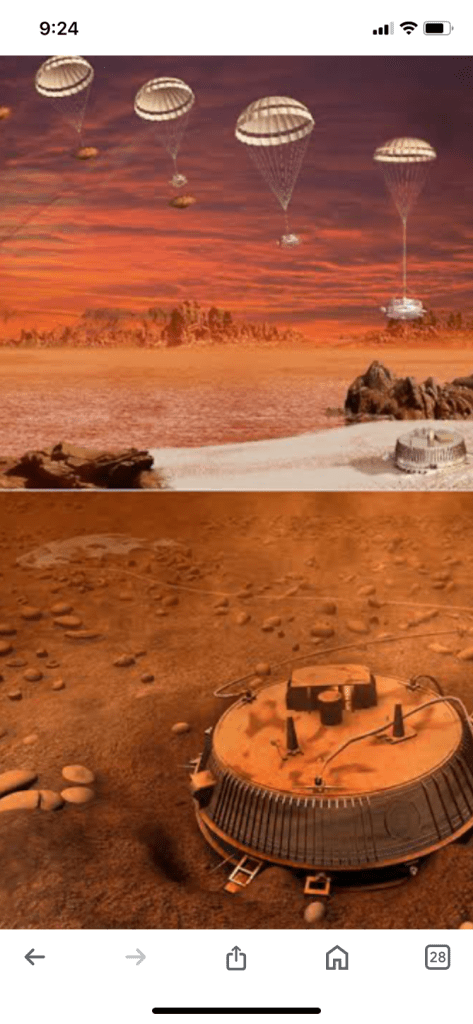
NASA’s Cassini spacecraft would eventually complete more than 100 targeted flybys of Titan, sending European Space Agency’s Huygens probe to land on the mysterious, alien world—the first landing on a surface in the outer solar system. As it descended for two and a half hours, Huygens took measurements of Titan’s atmospheric composition and pictures of its surface. The hardy probe not only survived the descent and landing, but continued to transmit data for more than an hour on Titan’s frigid surface, until its batteries were drained
Titan is the only other place in the solar system known to have an Earth-like cycle of liquids flowing across its surface as the planet cycles through its seasons. Each Titan season lasts about 7.5 Earth years. Cassini caught glimpses of the transition from fall to winter at Titan’s south pole—the first time anyone has seen the onset of a Titan winter—and watched as summer came to the north. “We’re monitoring the weather on Titan, watching for predicted methane rainstorms at the north pole,” Linda Spilker, Cassini project scientist at NASA’s Jet Propulsion Laboratory, said at the time.
Whether there is life on Titan, the largest moon of Saturn, is currently an open question and a topic of scientific assessment and research. Titan is far colder than Earth, but of all the places in the Solar System, Titan is the only place besides Earth known to have liquids in the form of rivers, lakes, and seas on its surface. Its thick atmosphereis chemically active and rich in carbon compounds. On the surface there are small and large bodies of both liquid methane and ethane, and it is likely that there is a layer of liquid water under its ice shell. Some scientists speculate that these liquid mixes may provide prebiotic chemistry for living cells different from those on Earth.
Titan’s consideration as an environment for the study of prebiotic chemistry or potentially exotic life stems in large part due to the diversity of the organic chemistry that occurs in its atmosphere, driven by photochemical reactions in its outer layers
Saturn’s largest moon, Titan, is an icy world whose surface is completely obscured by a golden hazy atmosphere. Titan is the second largest moon in our solar system. Only Jupiter’s moon Ganymede is larger, by just 2 percent. Titan is bigger than Earth’s moon, and larger than even the planet Mercury.
This mammoth moon is the only moon in the solar system with a dense atmosphere, and it’s the only world besides Earth that has standing bodies of liquid, including rivers, lakes and seas, on its surface. Like Earth, Titan’s atmosphere is primarily nitrogen, plus a small amount of methane. It is the sole other place in the solar system known to have an earthlike cycle of liquids raining from clouds, flowing across its surface, filling lakes and seas, and evaporating back into the sky (akin to Earth’s water cycle). Titan is also thought to have a subsurface ocean of water.
Titan has a radius of about 1,600 miles (2,575 kilometers), and is nearly 50 percent wider than Earth’s moon. Titan is about 759,000 miles (1.2 million kilometers) from Saturn, which itself is about 886 million miles (1.4 billion kilometers) from the Sun, or about 9.5 astronomical units (AU). One AU is the distance from Earth to the Sun. Light from the Sun takes about 80 minutes to reach Titan; because of the distance, sunlight is about 100 times fainter at Saturn and Titan than at Earth
Titan takes 15 days and 22 hours to complete a full orbit of Saturn. Titan is also tidally locked in synchronous rotation with Saturn, meaning that, like Earth’s Moon, Titan always shows the same face to the planet as it orbits. Saturn takes about 29 Earth years to orbit the Sun (a Saturnian year), and Saturn’s axis of rotation is tilted like Earth’s, resulting in seasons. But Saturn’s longer year produces seasons that each last more than seven Earth years. Since Titan orbits roughly along Saturn’s equatorial plane, and Titan’s tilt relative to the sun is about the same as Saturn’s, Titan’s seasons are on the same schedule as Saturn’s—seasons that last more than seven Earth years, and a year that lasts 29 Earth years
Formation
Scientists aren’t certain about Titan’s origin. However, its atmosphere provides a clue. Several instruments on the NASA and ESA Cassini-Huygens mission measured the isotopes nitrogen-14 and nitrogen-15 in Titan’s atmosphere. The instruments found Titan’s nitrogen isotope ratio most resembles that found in comets from the Oort Cloud—a sphere of hundreds of billions of icy bodies thought to orbit the Sun at a distance between 5,000 and 100,000 astronomical units from the Sun (Earth is about one astronomical unit from the Sun—roughly 93 million miles or 150 million kilometers). Titan’s atmospheric nitrogen ratio suggests the moon’s building blocks formed early in the solar system’s history, in the same cold disk of gas and dust that formed the Sun (called the protosolar nebula), rather than forming in the warmer disk of material that Saturn later formed from (called the Saturn sub-nebula).
Titan, Saturn’s largest moon, has many similarities to Earth, including:
- Atmosphere Both Titan and Earth have a nitrogen-rich atmosphere, but Titan’s is denser and has a higher surface pressure.
- Weather Titan has seasonal weather patterns and an Earth-like cycle of liquids that rain from clouds, flow across the surface, and evaporate back into the sky.
- Landscape Titan has Earth-like landscapes, including lakes, rivers, canyons, sand dunes, and seas. However, these geological formations are made of different materials than Earth:
- Rivers: Liquid methane instead of water
- Dunes: Hydrocarbons instead of sand
- Sands: Organic hydrocarbons that are not as strong as silica sands found on Earth, Mars, or Venus
- Subsurface Titan is thought to have a subsurface ocean of water.
Because of these similarities, Titan is sometimes called the most Earth-like celestial object in the solar system. However, Titan is also very different from Earth in other ways, including its chemical structure and external environment. For example, Titan lacks the phosphorus and oxygen found in phospholipids on Earth.
Titan’s atmosphere is made mostly of nitrogen, like Earth’s, but with a surface pressure 50 percent higher than Earth’s. Titan has clouds, rain, rivers, lakes and seas of liquid hydrocarbons like methane and ethane. The largest seas are hundreds of feet deep and hundreds of miles wide.
What would life on Titan look like?
A life-form whose solvent was a hydrocarbon would not face the risk of its biomolecules being destroyed in this way. Titan appears to have lakes of liquid ethane or liquid methane on its surface, as well as rivers and seas, which some scientific models suggest could support hypothetical non-water-based life
What would the sky look like on Titan?
The sky of Titan
Titan is the only moon in the Solar System to have a thick atmosphere. Images from the Huygens probe show that the Titanean sky is a light tangerine color. However, an astronaut standing on the surface of Titan would see a hazy brownish/dark orange color
Can we walk on Titan?
Titan is extremely cold, with an annual temperature of -180 C (-291 F), but thankfully, due to its thick atmosphere, humans walking outside on titan would only need warm clothing and respirators. Titan’s atmosphere lacks oxygen; however it contains ice water below its surface that can be used as a source of oxygen.
Could humanity live on Titan?
Habitability. Robert Zubrin has pointed out that Titan possesses an abundance of all the elements necessary to support life, saying “In certain ways, Titan is the most hospitable extraterrestrial world within our solar system for human colonization.” The atmosphere contains plentiful nitrogen and methane
Is landing on Titan possible?
Huygens separated from the Cassini orbiter on 25 December 2004, and landed on Titan on 14 January 2005 near the Adiri region. Huygens’s landing is so far the only one accomplished in the outer Solar System or on a moon other than Earth’s.
Can we swim on Titan?
Methane is liquid between minus 182 and minus 162 degrees, Celsius. You’d be frozen very quickly. Of course, there isn’t any oxygen in the atmosphere of Titan, and you can’t swim, or live, without breathing
What if Titan was our moon?
Not only is Titan physically larger than the Moon, with a mean radius almost 50% larger than our companion body’s, it also has a mass more than 80% greater than the Moon’s. If Titan was somehow swapped with the Moon in its current orbit, it would exert substantially greater force on the Earth
Could a plane fly on Titan?
Barnes at the University of Idaho. Compared to Earth, Titan has about one-seventh the gravity but four times the atmospheric density. These conditions make it easier to fly there. Artist’s rendering of the AVIATR airplane flying over the surface of Titan.
Life on Titan: शनि के चांद टाइटन पर मिशन के लिए NASA की तैयारी, मीथेन की झीलों से मिलेगा ईंधन, जीवन कितना मुमकिन?
NASA का मानना है कि ये सौर मंडल में जीवन का आधार हो सकते हैं और धरती पर भी जीवन की उत्पत्ति से जुड़े सवालों के जवाब मिल सकते हैं। टाइटन पर क्राफ्ट लैंड करना भी मंगल या दूसरे ऑब्जेक्ट्स की तुलना में आसान है।
Life on Titan: NASA’s preparation for mission on Saturn’s moon Titan, fuel will be available from methane lakes, how possible is life?
NASA believes that these can be the basis of life in the solar system and answers to questions related to the origin of life on Earth can also be found. Landing a craft on Titan is also easier than on Mars or other objects.
मंगल के अलावा सौर मंडल में अगर कहीं वैज्ञानिकों को जीवन के होने की उम्मीद दिखती है, तो वह है शनि का चांद टाइटन। इसके लिए कुछ रिसर्चर वहां तक जाने के मिशन पर काम भी कर रहे हैं ताकि किसी तरह के सबूत को धरती पर लाया जा सके। इसके लिए अमेरिकी स्पेस एजेंसी NASA ने ग्रांट दिया है। दिलचस्प बात यह है कि धरती पर वापसी के सफर के लिए ईंधन टाइटन में बह रहीं मीथेन की झीलों से लेने का प्लान है। NASA ने हाल ही में NASA इनोवेटिव अडवांस्ड कॉन्सेप्ट्स की 1.25 लाख डॉलर की ग्रांट NASA ग्लेन रिसर्च सेंटर को दी है।
Apart from Mars, if anywhere in the solar system scientists see hope for life, it is Saturn’s moon Titan. For this, some researchers are also working on a mission to go there so that some kind of evidence can be brought to Earth. The American space agency NASA has given a grant for this. Interestingly, there is a plan to take fuel for the return journey to Earth from the methane lakes flowing in Titan. NASA has recently given a grant of 1.25 lakh dollars from NASA Innovative Advanced Concepts to NASA Glenn Research Center.
Why is NASA sending Dragonfly to Titan?
The rotorcraft, targeted to arrive at Titan in 2034, will fly to dozens of promising locations on the moon, looking for prebiotic chemical processes common on both Titan and the early Earth before life developed. Dragonfly marks the first time NASA will fly a vehicle for science on another planetary body
What is this mission NASA’s Dragonfly Mission to Titan 2026?
Dragonfly will launch in 2026 and arrive in 2034. The rotorcraft will fly to dozens of promising locations on Titan looking for prebiotic chemical processes common on both Titan and Earth
Please like subscribe comment your precious thoughts on universe discoveries
Full article source google and Wikipedia
https://www.amazon.in/b?_encoding=UTF8&tag=555101-21&link Universe discoveries
I would love to see in my lifetime the fruition of these efforts translate into a manned expedition from earth to Titan. Perhaps it’s just too far away.
LikeLike