

A team of Chinese scientists is working on an ambitious project to develop a magnetic launch system designed to fling cargo from the Moon’s surface towards Earth. This innovative concept, which seems straight out of science fiction, is being seriously considered with a proposed budget of $18 billion
In his famous novel The Moon is a Harsh Mistress, Robert A. Heinlein describes a future lunar settlement where future lunar residents (“Loonies”) send payloads of wheat and water ice to Earth using an electromagnetic catapult. In this story, a group of Loonies conspire to take control of this catapult and threaten to “throw rocks at Earth” unless they recognize Luna as an independent world. Interestingly enough, scientists have explored this concept for decades as a means of transferring lunar resources to Earth someday.
Given that space agencies are planning on sending missions to the Moon to create permanent infrastructure, there is renewed interest in this concept. In a recent paper, a team of scientists from China’s Shanghai Institute of Satellite Engineering (SAST) detailed how a magnetic launcher on the lunar surface could provide a cost-effective means of sending resources back to Earth. This proposal could become part of China’s long-term vision for a lunar settlement known as the International Lunar Research Station (ILRS) – a joint project they are pursuing with the Russian space agency (Roscosmos)
A team of Chinese scientists is working on an ambitious project to develop a magnetic launch system designed to fling cargo from the Moon’s surface towards Earth. This innovative concept, which seems straight out of science fiction, is being seriously considered with a proposed budget of $18 billion.
The project aims to use the Moon’s low gravity and lack of atmosphere to facilitate the launch process, according to a study published in the journal Aerospace Shanghai and highlighted by Interesting Engineering
The system would feature a 165-foot rotating arm that would gradually increase in speed, eventually reaching the Moon’s escape velocity of 2.38 kilometres per second. Once this velocity is achieved, the arm would release a capsule into space, sending it on a trajectory toward Earth.
The entire operation would be powered by a combination of solar panels and nuclear energy. The primary goal of this magnetic launch system is to transport helium-3, a rare isotope on Earth but plentiful on the Moon, back to our planet. Helium-3 is highly valued by scientists for its potential application in future nuclear fusion power plants, which could revolutionize energy production.
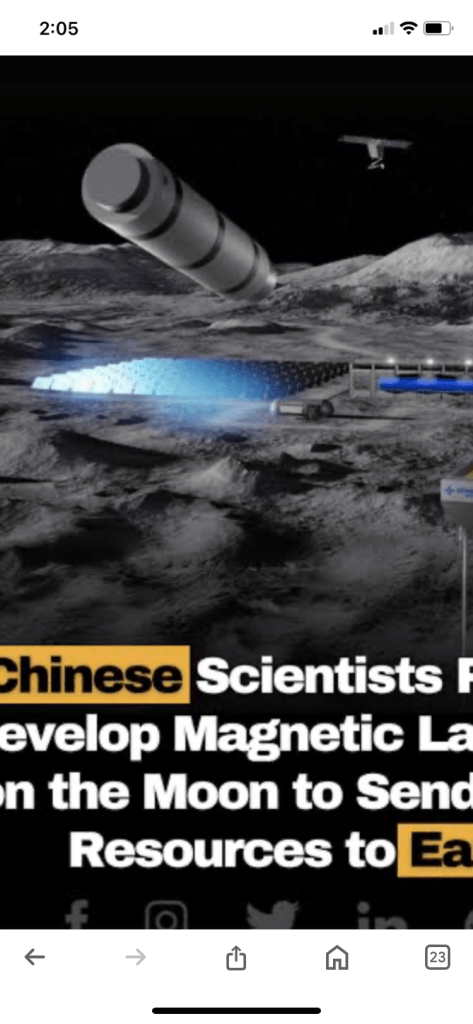
A look at the magnetic launch system’s design
The proposed magnetic launch system features a 165-feet rotating arm, designed to gradually increase in speed until it reaches the Moon’s escape velocity of 2.38km per second. At this point, the arm would release a capsule into space on a trajectory toward Earth. The entire operation is expected to be powered by solar panels and nuclear energy, ensuring sustainability and efficiency in cargo transportation.
Resource race intensifies as countries eye moon’s wealth
China’s project indicates an intensifying race for lunar resources, particularly rare and valuable minerals. The prospect of a new “gold rush” on the Moon is becoming increasingly likely as nations and companies explore its surface for precious resources. In the US, a start-up is also seeking funding to mine helium-3 from the Moon and transport it back to Earth, reflecting similar ambitions in establishing a “lunar economy.”
The moon might soon become the launchpad for an exciting new project that sounds like it’s straight out of a science fiction movie. Chinese scientists are proposing a magnetic launcher on the lunar surface, designed to hurl valuable resources, like helium-3, back to Earth. This ambitious plan, if successful, could revolutionize space mining and help solve Earth’s energy crisis
चंद्रमा जल्द ही एक रोमांचक नई परियोजना का लॉन्चपैड बन सकता है जो ऐसा लगता है जैसे यह सीधे किसी विज्ञान कथा फिल्म से निकला हो। चीनी वैज्ञानिक चंद्रमा की सतह पर एक चुंबकीय लांचर का प्रस्ताव कर रहे हैं, जिसे हीलियम -3 जैसे मूल्यवान संसाधनों को पृथ्वी पर वापस फेंकने के लिए डिज़ाइन किया गया है। यह महत्वाकांक्षी योजना, यदि सफल रही, तो अंतरिक्ष खनन में क्रांति ला सकती है और पृथ्वी के ऊर्जा संकट को हल करने में मदद कर सकती है
Why Use the Moon?
The Moon offers a unique environment that makes this kind of launch system possible. Unlike Earth, the Moon has much lower gravity and no atmosphere, which means it’s easier to reach the necessary speeds to escape its gravitational pull. This allows the magnetic launcher to operate more efficiently, using only electricity from solar and nuclear energy sources
चंद्रमा का उपयोग क्यों करें?

चंद्रमा एक अनोखा वातावरण प्रदान करता है जो इस प्रकार की प्रक्षेपण प्रणाली को संभव बनाता है। पृथ्वी के विपरीत, चंद्रमा में बहुत कम गुरुत्वाकर्षण है और कोई वायुमंडल नहीं है, जिसका अर्थ है कि इसके गुरुत्वाकर्षण खिंचाव से बचने के लिए आवश्यक गति तक पहुंचना आसान है। यह चुंबकीय लांचर को केवल सौर और परमाणु ऊर्जा स्रोतों से बिजली का उपयोग करके अधिक कुशलता से संचालित करने की अनुमति देता है
The Goal: Helium-3 Extraction
One of the primary objectives of this magnetic launcher is to transport helium-3, a rare isotope on Earth but abundant on the Moon. Helium-3 is being eyed by scientists as a potential fuel for nuclear fusion, a cleaner and safer alternative to current nuclear energy. According to Chinese researchers, just 20 tonnes of helium-3 could power China for an entire year
लक्ष्य: हीलियम-3 निष्कर्षण

इस चुंबकीय लांचर का प्राथमिक उद्देश्य हीलियम-3 का परिवहन करना है, जो पृथ्वी पर एक दुर्लभ आइसोटोप है लेकिन चंद्रमा पर प्रचुर मात्रा में है। वैज्ञानिक हीलियम-3 को परमाणु संलयन के लिए एक संभावित ईंधन के रूप में देख रहे हैं, जो वर्तमान परमाणु ऊर्जा का एक स्वच्छ और सुरक्षित विकल्प है। चीनी शोधकर्ताओं के मुताबिक, सिर्फ 20 टन हीलियम-3 से चीन को पूरे साल तक ऊर्जा मिल सकती है
How It Works: The Magnetic Launch System
The magnetic launcher would work similarly to the Olympic hammer throw, where an athlete spins before releasing the hammer. In this case, a rotating arm on the Moon would speed up until it reaches the escape velocity needed to break free of the Moon’s gravity
यह कैसे काम करता है: चुंबकीय प्रक्षेपण प्रणाली

चुंबकीय लांचर ओलंपिक हैमर थ्रो के समान ही काम करेगा, जहां एक एथलीट हथौड़ा छोड़ने से पहले घूमता है। इस मामले में, चंद्रमा पर घूमने वाली भुजा तब तक तेज हो जाएगी जब तक कि वह चंद्रमा के गुरुत्वाकर्षण से मुक्त होने के लिए आवश्यक पलायन वेग तक नहीं पहुंच जाती
Challenges Ahead
While the concept is exciting, the project faces significant challenges. The Moon’s surface is rugged and uneven, which could make installing the rotating arm difficult. Additionally, the system needs to be stable at high speeds and capable of withstanding the harsh lunar environment, including extreme temperature variations and cosmic radiation
आगे की चुनौतियां

हालाँकि अवधारणा रोमांचक है, परियोजना को महत्वपूर्ण चुनौतियों का सामना करना पड़ता है। चंद्रमा की सतह ऊबड़-खाबड़ और असमान है, जिससे घूमने वाली भुजा को स्थापित करना मुश्किल हो सकता है। इसके अतिरिक्त, सिस्टम को उच्च गति पर स्थिर होना चाहिए और अत्यधिक तापमान भिन्नता और ब्रह्मांडीय विकिरण सहित कठोर चंद्र वातावरण का सामना करने में सक्षम होना चाहिए
A New Space Race?
China isn’t the only country interested in lunar mining. The United States is also exploring ways to extract valuable resources from the Moon, with startups looking to raise funds for helium-3 extraction. Both nations are part of a growing network of businesses and organizations eager to establish a “lunar economy
एक नई अंतरिक्ष दौड़?

चीन चंद्र खनन में रुचि रखने वाला एकमात्र देश नहीं है। संयुक्त राज्य अमेरिका भी चंद्रमा से मूल्यवान संसाधन निकालने के तरीके तलाश रहा है, स्टार्टअप हीलियम-3 निष्कर्षण के लिए धन जुटाने की कोशिश कर रहे हैं। दोनों देश "चंद्र अर्थव्यवस्था" स्थापित करने के इच्छुक व्यवसायों और संगठनों के बढ़ते नेटवर्क का हिस्सा हैं
Please like subscribe comment your precious thoughts on universe discoveries
Full article source google
https://ef319omq1vrt6xbghnm0-e-nfe.hop.clickbank.net/
https://www.amazon.in/b?_encoding=UTF8&tag=555101-21&link Universe discoveries
Very nice information brought by post
LikeLiked by 1 person
Thanks sir🌹🌹
LikeLike