
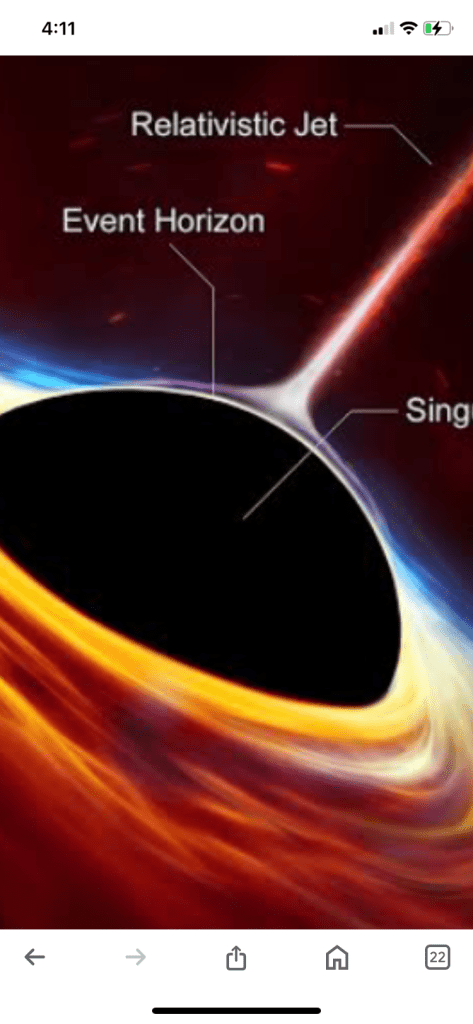
Black Hole Energy: ब्लैक होल से ऊर्जा निकालने का विचार नया नहीं है. हालांकि, एक नई स्टडी कहती है कि ब्लैक होल से किसी ग्रह को असीमित शक्ति मिल सकती है.

Science News: 1971 में नोबेल पुरस्कार विजेता भौतिक विज्ञानी रोजर पेनरोस ने यह प्रस्ताव रखा कि एक घूमते हुए ब्लैक होल से ऊर्जा कैसे निकाली जा सकती है. उनके मुताबिक, ब्लैक होल की एक्रेशन डिस्क के चारों ओर एक हार्नेस बनाकर ऐसा किया जा सकता है. यहां पर गिरते पदार्थ को प्रकाश की गति के करीब त्वरित किया जाता है, जिससे कई तरंगदैर्घ्यों में ऊर्जा का उत्सर्जन शुरू हो जाता है.
Black Hole Energy: The idea of extracting energy from black holes is not new. However, a new study says that a black hole can provide unlimited power to a planet. Science News: In 1971, Nobel Prize-winning physicist Roger Penrose proposed how energy could be extracted from a rotating black hole. According to him, this can be done by making a harness around the accretion disk of the black hole. Here the falling matter is accelerated close to the speed of light, causing the emission of energy in many wavelengths.
कई वैज्ञानिकों ने सुझाया है कि एडवांस्ड एलियन सभ्यताएं इस तरीके (पेनरोस प्रक्रिया) से ऊर्जा प्राप्त कर सकते होंगे. हार्वर्ड के प्रोफेसर अवी लोएब वैज्ञानिकों की उस कड़ी में ताजा नाम हैं. उन्होंने हालिया पेपर में बताया है कि कैसे कोई भी उन्नत सभ्यता अपने ग्रह को अनंत काल तक ऊर्जा प्रदान करने के लिए ‘ब्लैक होल चंद्रमा’ पर निर्भर हो सकती है. उनका पेपर Illumination of a Planet by a Black Hole Moon as a Technological Signature हाल ही में अमेरिकन एस्ट्रोनॉमिकल सोसायटी के रिसर्च नोट्स (RNAAS) में छपा है
Many scientists have suggested that advanced alien civilizations may have been able to obtain energy in this manner (Penrose process). Harvard Professor Avi Loeb is the latest name in that list of scientists. He has explained in a recent paper how any advanced civilization can depend on a ‘black hole moon’ to provide energy to its planet indefinitely. Their paper Illumination of a Planet by a Black Hole Moon as a Technological Signature recently appeared in Research Notes of the American Astronomical Society (RNAAS)
ब्लैक होल से ऊर्जा खींचने के दो तरीके
1975 में, स्टीफन हॉकिंग ने कहा कि ब्लैक होल से फोटॉन, न्यूट्रिनो और कुछ अन्य बड़े कणों का उत्सर्जन होता है. इसे बाद में ‘हाकिंग रेडिएशन’ कहा गया. उसके बाद से ब्लैक होल को ऊर्जा के स्रोत के रूप में इस्तेमाल करने के प्रस्ताव मुख्य रूप से दो तरीके के आए हैं.
Two ways to extract energy from a black hole In 1975, Stephen Hawking said that black holes emit photons, neutrinos and some other massive particles. This was later called ‘Hawking Radiation’. Since then, there have been mainly two types of proposals to use black holes as a source of energy.
एक संभावना यह है कि ब्लैक होल की एक्रेशन डिस्क की कोणीय गति का दोहन किया जाए (पेनरोस प्रक्रिया) या उनके हाइपरवेलोसिटी जेट्स (शायद डायसन स्फीयर के रूप में) द्वारा उत्पन्न गर्मी और ऊर्जा को पकड़ा जाए. दूसरा तरीका कहता है कि ब्लैक होल पर पदार्थ डालने और परिणामस्वरूप हॉकिंग विकिरण का दोहन किया जा सकता है
One possibility is to harness the angular momentum of the black holes’ accretion disks (Penrose process) or capture the heat and energy generated by their hypervelocity jets (perhaps in the form of Dyson spheres). The second approach says that injecting matter onto a black hole and the resulting Hawking radiation can be exploited
कभी खत्म नहीं होगी पावर की सप्लाई!
अपने पेपर में लोएब प्रस्ताव रखते हैं कि कैसे एक एडवांस्ड सभ्यता अपने ग्रह की परिक्रमा करने वाले ब्लैक होल का निर्माण करके बाद वाली प्रक्रिया पर निर्भर हो सकती है. यह ब्लैक होल बेहद छोटा होगा, बस कुछ सौ हजार टन के बराबर. अगर इसे अनियंत्रित छोड़ दिया जाए तो यह ब्लैक होल हॉकिंग रेडिएशन के उत्सर्जन के कारण सिर्फ डेढ़ साल में वाष्पित हो जाएगा. लेकिन लोएब के अनुसार, इसे प्रति सेकंड अपेक्षाकृत कम मात्रा में पदार्थ (2.2 किलोग्राम) जमा करके बनाए रखा जा सकता है. इसके बदले में, यह बिजली की अंतहीन आपूर्ति प्रदान करेगा
Power supply will never end! In his paper, Loeb proposes how an advanced civilization could rely on the latter process by creating a black hole orbiting its planet. This black hole will be very small, just a few hundred thousand tons. If left unchecked, this black hole will evaporate in just one and a half years due to the emission of Hawking radiation.
But according to Loeb, it can be maintained by accumulating a relatively small amount of matter (2.2 kilograms) per second. In return, this will provide an endless supply of electricity.
What is black hole short answer?
A black hole is a place in space where gravity pulls so much that even light can not get out. The gravity is so strong because matter has been squeezed into a tiny space. This can happen when a star is dying
What is inside a black hole?
Black holes have two parts. There is the event horizon, which you can think of as the surface, though it’s simply the point where the gravity gets too strong for anything to escape. And then, at the center, is the singularity. That’s the word we use to describe a point that is infinitely small and infinitely dense
What causes a black hole?
Stellar black holes form when the center of a very massive star collapses in upon itself. This collapse also causes a supernova, or an exploding star, that blasts part of the star into space. Scientists think supermassive black holes formed at the same time as the galaxy they are in.
Do white holes exist?
The negative square root solution inside the horizon represents a white hole. A white hole is a black hole running backwards in time. Just as black holes swallow things irretrievably, so also do white holes spit them out. White holes cannot exist, since they violate the second law of thermodynamics
Are black holes hot?
Stellar black holes are very cold: they have a temperature of nearly absolute zero – which is zero Kelvin, or −273.15 degrees Celsius. Supermassive black holes are even colder. But a black hole’s event horizon is incredibly hot
What is the biggest black hole?
That title goes to TON 618, which is an astonishing 66 billion solar masses. It’s so big that astronomers had to invent a new term to describe it; hence, TON 618 is what’s become known as an ultramassive black hole.
What is the closest black hole to Earth?
Gaia-BH1
The closest stellar-mass black hole scientists have found is called Gaia-BH1, and it sits only 1,560 light-years away from us.
Can we create a black hole?
But creating a black hole with even a microscopic event horizon would require billions of times more energy than the LHC is able to produce. And even if it could produce such a black hole, that object would quickly lose energy and dissipate in the blink of an eye
Does time exist in a black hole?
Time does stop at the event horizon of a black hole, but only as seen by someone outside the black hole
Do grey holes exist?
A Q-star, also known as a grey hole, is a hypothetical type of a compact, heavy neutron star with an exotic state of matter. Such a star can be smaller than the progenitor star’s Schwarzschild radius and have a gravitational pull so strong that some light, but not all photons, can escape
Do wormholes exist?
While scientists have no evidence that wormholes actually exist in our world, they’re good tools to help astrophysicists like me think about space and time
Can I touch a black hole?
Ritz: No, there isn’t something there that you could touch. Perhaps that is one of the hardest things to understand about black holes. Some people would say a black hole does have a surface, others would say it doesn’t, and they’d both be right
Can we survive in black hole?
Within any black hole is the central point, the singularity, which has infinite gravity and where mass is compressed into an infinitely small point. There, it is game over. There’s no surviving. And therefore the idea of traveling through time and space, via black hole or wormhole, don’t really register in reality
Are we inside a black hole?
A cosmologist explains the mind-bending hypothesis that our universe could have branched off from a black hole singularity in another universe. We do not live inside of a black hole, but that does not rule out the possibility that our universe was born from one
Where do black holes take you?
When matter falls into or comes closer than the event horizon of a black hole, it becomes isolated from the rest of space-time. It can never leave that region. For all practical purposes the matter has disappeared from the universe.
How did Einstein predict black holes?
Black holes were predicted as an exact mathematical solution to Einstein’s equations. Einstein’s equations describe the shape of space around matter. The theory of general relativity connects the geometry or shape of shape to the detailed distribution of matter
Do green holes exist?
Green Holes are special types of star that are so rare! Green holes form if black holes don’t lose mass or only lose a ton of mass in a billion years! That happens if the star is super massive, like a hypergiant or a metagiant
Are white holes real?
White holes are the opposite of black holes, in that they spit out light and matter, rather than trapping it. So far, white holes are purely hypothetical objects, but astronomers are contemplating how they could form in reality.
Did Einstein believe in wormholes?
Einstein’s theory of general relativity mathematically predicts the existence of wormholes, but none have been discovered to date. A negative mass wormhole might be spotted by the way its gravity affects light that passes by
Who is the father of black hole?
But the true “father” of the black hole concept was a humble 18th century English rector named John Michell–a man so far ahead of his scientific contemporaries that his ideas languished in obscurity, until they were re-invented more than a century later.
Please like subscribe comment your precious thoughts on universe discoveries
Full article source google
https://ef319omq1vrt6xbghnm0-e-nfe.hop.clickbank.net/
https://www.amazon.in/b?_encoding=UTF8&tag=555101-21&link Universe discoveries