
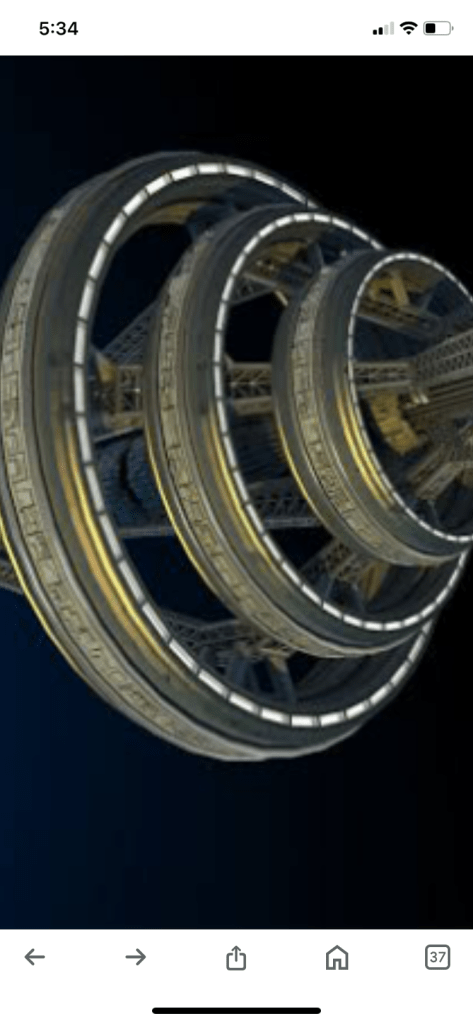
Designing an Interstellar Generation Ship for Project Hyperion
Key Considerations:
- Self-Sufficiency: The ship must be a self-contained ecosystem, capable of sustaining life for generations.
- Habitability: The environment must be comfortable and psychologically sound for the crew.
- Propulsion: The ship needs a sustainable propulsion system to maintain a constant velocity.
- Radiation Shielding: Protection against cosmic radiation is paramount.
- Resource Management: Efficient use of resources, including food, water, and energy, is crucial.
- Social Structure: A stable society must be established to prevent societal collapse.
Proposed Design: The OASIS (Orbital Autonomous Spacecraft for Interstellar Settlement)
Structure: - Central Hub: A massive, rotating cylinder providing artificial gravity through centrifugal force. This will house most of the living quarters, agricultural areas, and industrial facilities.
- Radial Arms: Extending from the hub, these arms will contain the propulsion systems, power generation, and storage facilities.
- Peripheral Ring: A protective outer shell shielding the ship from radiation and micrometeoroids.
Life Support Systems: - Agriculture: Advanced hydroponics and aeroponics systems will produce a variety of crops.
- Water Recycling: Sophisticated water purification and recycling technologies will ensure a constant supply.
- Air Purification: Advanced air filtration and oxygen generation systems will maintain a breathable atmosphere.
- Waste Management: A closed-loop system will recycle waste products into usable resources.
Propulsion: - Fusion Reactors: Powerful fusion reactors will provide the energy needed for propulsion and life support.
- Ion Drives: High-efficiency ion drives will provide continuous thrust for decades.
Social and Psychological Considerations: - Education: A comprehensive education system will be vital for the survival and advancement of the crew.
- Healthcare: Advanced medical facilities will be necessary to treat illnesses and injuries.
- Entertainment: Recreational facilities, such as theaters, gyms, and virtual reality environments, will help maintain morale.
- Psychological Counseling: Trained counselors will be available to address mental health issues.
Challenges and Innovations: - Long-Term Isolation: Addressing the psychological impact of extended isolation and confinement.
- Genetic Diversity: Maintaining genetic diversity within the population to prevent health problems.
- Resource Depletion: Developing strategies for efficient resource management and potential replenishment.
- Technological Advancements: Incorporating future technological breakthroughs to improve the ship’s capabilities.
By carefully addressing these challenges and leveraging cutting-edge technology, the OASIS could become a viable solution for interstellar travel, opening up the possibility of humanity’s expansion beyond our solar system.
Project Hyperion, launched in 2011, was a significant endeavor aimed at exploring the feasibility of crewed interstellar travel. It was a two-year study conducted primarily by the WARR student group at the Technical University of Munich (TUM).
Key Goals of Project Hyperion:
- Feasibility Assessment: The project aimed to evaluate the technical and logistical feasibility of interstellar flight using current and near-future technologies.
- Conceptual Design: To develop integrated concepts for a crewed interstellar starship or generation ship, considering various aspects like propulsion, life support, and social systems.
- Future Research Guidance: To identify key areas for future research and development to advance interstellar travel.
- Public Awareness: To inform the public about the challenges and potential of interstellar exploration.
Notable Achievements of Project Hyperion: - Stanford Torus-Based Generation Ship: The project proposed a Stanford Torus-based design for a generation ship, which would provide artificial gravity through rotation.
- Population Size Assessment: The study explored the optimal population size for a self-sustaining interstellar colony.
- World Ship System Architectures: The project analyzed various world ship architectures and their implications for long-term space missions.
Legacy and Impact:
Project Hyperion made significant contributions to the field of interstellar studies. It helped to spark interest and discussion about the challenges and possibilities of interstellar travel. Many of the concepts and ideas explored in the project continue to influence ongoing research and development in this field.
The core team members of Project Hyperion have since transitioned to the Initiative for Interstellar Studies (IISS) and continue to work on advanced concepts for interstellar flight. Their work has been presented at prestigious conferences and published in scientific journals, further advancing the field of interstellar exploration.
Human technology has allowed us to extend the scope of our curiosity beyond the confines of our home world and into the solar system. But it’s not hard to imagine that one day humans will want to venture further, perhaps towards a star in our galactic vicinity that might host a rocky, watery world not unlike Earth.
Getting there, however, is complicated. Even if human technology reaches a point in the near future where we could create a propulsion system that could get a spaceship within 10% the speed of light (which is orders of magnitude faster than what is currently possible), a journey to a nearby star hosting a potentially habitable world could take decades or hundreds of years at best. Given these limitations, a number of scientists and science fiction authors have pondered the feasibility of something called a “generation ship.” A generation ship is a hypothetical spacecraft capable of sustaining human inhabitants for multiple generations as they make the vast journey to a nearby star system.
A new design competition, dubbed Project Hyperion, is calling for submissions for the design of a crewed interstellar generation ship. The project is part of study that is aiming to provide an assessment of the feasibility of crewed interstellar flight using current and near-future technologies, and hopes to inform future research and technology development as well as informing the public about logistics and potential of interstellar travel.
What is interstellar travel

Interstellar travel refers to the hypothetical travel of spacecraft between star systems. Due to the vast distances between stars, interstellar travel is not currently feasible with our existing propulsion technologies.
Challenges:
- Vast distances: The nearest star system, Alpha Centauri, is about 4.37 light-years away. Even traveling at the speed of light, it would take over four years to reach it.
- Energy requirements: To reach significant fractions of the speed of light, enormous amounts of energy are required, far beyond our current capabilities.
- Communication delays: Communication with interstellar spacecraft would experience significant delays due to the speed of light.
Hypothetical Propulsion Methods:
Several hypothetical propulsion methods have been proposed to enable interstellar travel: - Fusion rockets: These would use nuclear fusion to generate immense thrust.
- Antimatter rockets: These would utilize the annihilation of matter and antimatter to produce energy.
- Solar sails: These would use the pressure of sunlight to propel spacecraft.
- Beamed propulsion: This would involve beaming energy from Earth to accelerate a spacecraft.
Other Concepts: - Generation ships: These would be massive spacecraft designed to carry generations of people, who would live and die during the journey to another star system.
- Wormholes: These hypothetical shortcuts through spacetime could potentially allow for faster-than-light travel.
Despite the challenges, interstellar travel remains a fascinating topic of research and speculation, with the potential to revolutionize our understanding of the universe and our place within it.
Please like subscribe comment your precious thoughts on universe discoveries
sk-mania-blogs.in
Full article source google
https://www.buymeacoffee.com/Satyam55
Buy me a coffee!” (your opportunity to say thanks for the free stuff and to encourage me to do even more)
<!– /wp:heading https://www.amazon.in/b?_encoding=UTF8&tag=555101-21&link
“If you like my work or the free stuff on this website and want to say thanks, or encourage me to do more, you can buy me a coffee!
Contribute to my coffee fund with any amount you are comfortable to pay.
The coffee will give me the ‘kick’ to work even harder to empower creative entrepreneurs
 Universe discoveries
🙏🌹
Aum Shanti
LikeLike