
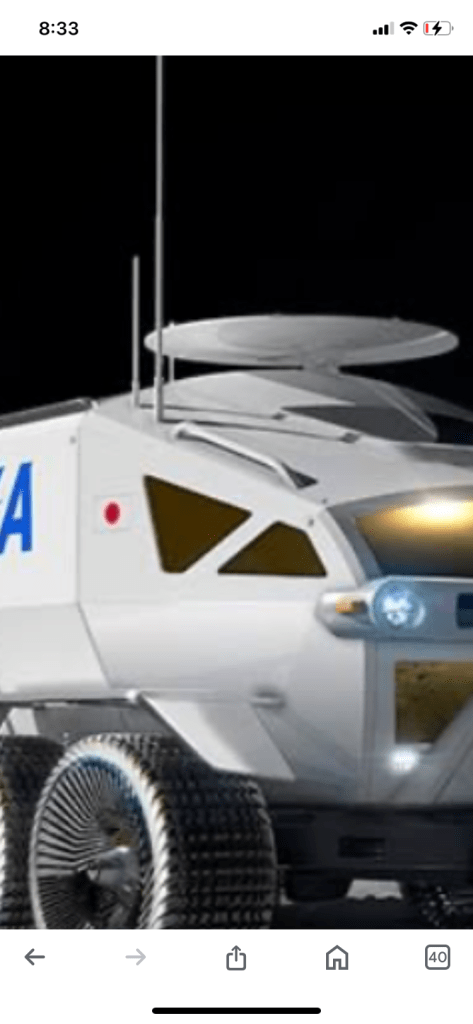
Toyota is developing a pressurized rover called the Lunar Cruiser, designed to support extended lunar stays. It’s part of the Artemis program and is expected to be ready for launch in 2029.
The Lunar Cruiser is a nod to the iconic Land Cruiser, known for its durability and reliability. It’s designed to accommodate two astronauts and has a claimed range of almost 10,000 km.
The Toyota Lunar Cruiser is a pressurized rover being developed by Toyota and the Japan Aerospace Exploration Agency (JAXA) for use on the Moon. It’s designed to accommodate astronauts and support extended lunar stays.
Key features and goals:
- Pressurized cabin: Allows astronauts to operate without bulky spacesuits inside the rover.
- Long range: Designed for long-distance travel on the Moon, enabling exploration of vast areas.
- Life support system: Provides a backup life support system for astronauts.
- Durability: Built to withstand the harsh lunar environment, including extreme temperatures and radiation.
- Collaboration: A joint project between Toyota and JAXA, combining expertise in automotive and space technology.
Expected launch and timeline: - Launch: Expected no earlier than 2032.
- Development: Ongoing, with various tests and prototypes being developed.
Significance:
The Lunar Cruiser represents a significant step forward in lunar exploration, enabling astronauts to travel farther and stay longer on the Moon. It builds upon the legacy of the iconic Land Cruiser, known for its reliability and off-road capabilities, and promises to be a crucial tool in future lunar missions.
Lunar rovers are robotic vehicles designed to explore the surface of the Moon. They have been instrumental in expanding our understanding of lunar geology, collecting samples, and paving the way for future human missions.
Key features and capabilities:
- Mobility: Equipped with wheels or tracks, lunar rovers can traverse the lunar surface, including challenging terrains like craters and slopes.
- Scientific instruments: Carry a variety of scientific instruments, such as cameras, spectrometers, and ground-penetrating radar, to study the lunar environment.
- Sampling: Some rovers are equipped with robotic arms or drills to collect soil and rock samples for analysis.
- Remote control: Operated from Earth or in autonomous mode, allowing scientists to control their movements and gather data.
Notable lunar rovers: - Apollo Lunar Roving Vehicle (LRV): Used during the final three Apollo missions (15, 16, and 17) from 1971 to 1972, significantly expanding the range and scientific yield of the missions.
- Yutu 2: A Chinese rover part of the Chang’e 4 mission, the first to land on the far side of the Moon in 2019.
- Pragyan: An Indian rover part of the Chandrayaan-3 mission, successfully landed on the lunar surface in 2023.
Future of lunar rovers: - Increased autonomy: Future rovers will likely have greater autonomy, allowing them to navigate and make decisions independently.
- Advanced instruments: Equipped with more sophisticated instruments to study the lunar environment in greater detail.
- Long-range exploration: Designed to travel longer distances and explore more remote regions of the Moon.
- Supporting human missions: Play a crucial role in supporting future human missions to the Moon, such as establishing lunar bases and conducting scientific research.
Lunar rovers are vital tools in lunar exploration, enabling us to delve deeper into the mysteries of our celestial neighbor and pave the way for future human missions.
Moon colonization is a long-term goal of space exploration, aiming to establish a permanent human presence on the Moon. While still in the early stages of planning and development, several nations and private companies have expressed interest in this ambitious endeavor.
Potential benefits of Moon colonization:
- Scientific research: The Moon offers a unique environment for conducting scientific research in various fields, including astronomy, geology, and astrobiology.
- Resource extraction: The Moon may contain valuable resources, such as helium-3, which could be used for future energy production.
- Space exploration hub: The Moon could serve as a stepping stone for future missions to Mars and other destinations in the solar system.
- Commercial opportunities: The Moon could offer opportunities for new industries, such as space tourism and lunar mining.
Challenges of Moon colonization: - Harsh environment: The Moon’s environment is harsh, with extreme temperatures, radiation, and microgravity, posing significant challenges to human survival and technological systems.
- Technological hurdles: Developing the necessary technologies for sustainable lunar habitation, such as life support systems, transportation, and power generation, will require significant technological advancements.
- Economic costs: Establishing a lunar colony would be an expensive undertaking, requiring substantial investment and international cooperation.
- Ethical considerations: The potential environmental impact of lunar colonization and the long-term implications for humanity need to be carefully considered.
Current progress and future outlook:
Several countries, including the United States, China, and Russia, have ongoing lunar exploration programs, including plans for future crewed missions and the establishment of research bases. Private companies are also actively involved in developing technologies for lunar exploration and colonization.
While Moon colonization remains a distant prospect, ongoing research and development efforts are gradually paving the way for this ambitious goal. The future of lunar exploration and colonization holds the potential to unlock new scientific discoveries, expand human capabilities, and inspire future generations.
Please like subscribe comment your precious thoughts on universe discoveries
Sk-mania-blogs.in
Full article source google
https://www.buymeacoffee.com/Satyam55
Any freinds who love my article can have drink 🍸 me coffee to encourage me I will be obliged that they love my work and I am successful in spreading universe discoveries knowledge and educate new kid’s going in school and become future scientists and contribute in our species become interstellar
 Universe discoveries
🙏🌹
Aum Shanti
LikeLike