
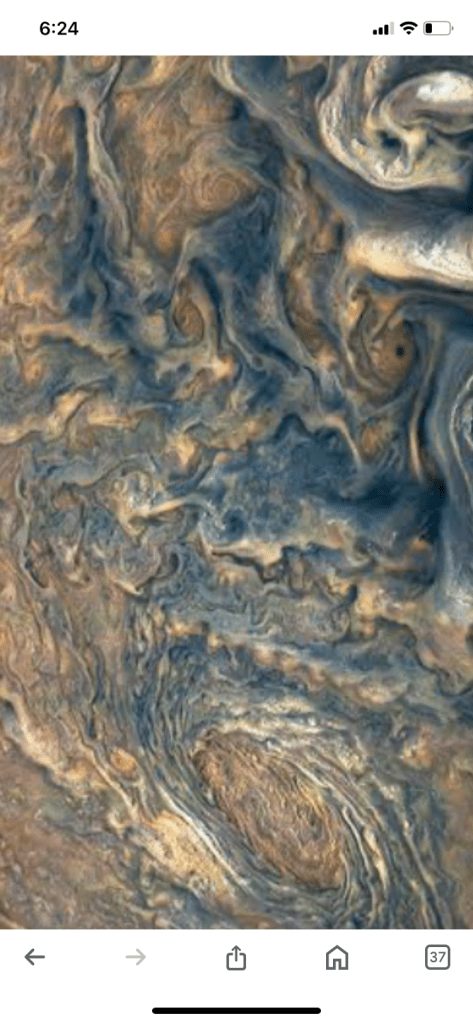
Recent findings from NASA’s Juno mission have revealed that Jupiter’s clouds are far more complex and dynamic than previously thought.
Scientists have long believed that Jupiter’s iconic bands and zones are caused by variations in the depth and temperature of the clouds. However, Juno’s data suggests that the underlying structure of the clouds may be even more intricate, with deep convective storms and powerful jets playing a significant role in shaping the planet’s appearance.
One of the most surprising discoveries is the presence of “mushballs,” massive hailstones made of water and ammonia ice that are thought to form deep within the atmosphere and then rain down on the upper cloud layers. These mushballs can grow to be several kilometers in diameter, and their impact on the cloud structure is still being investigated.
Another key finding is the existence of powerful jets that extend deep into the planet’s interior. These jets are thought to be responsible for driving the planet’s atmospheric circulation and generating the intense vortices and storms that are characteristic of Jupiter’s turbulent atmosphere.
These new findings are challenging our understanding of how giant planets like Jupiter form and evolve. They also highlight the importance of continued exploration and research to unravel the mysteries of our solar system.
Jupiter’s clouds are a mesmerizing spectacle, known for their vibrant colors and swirling patterns. Here’s a breakdown:
- Appearance:
- Bands and Zones: The most striking feature is the alternating bands of light and dark colors that encircle the planet.
- Zones: The lighter bands, typically white or yellowish, are regions of rising air.
- Belts: The darker bands, often brown or reddish, are regions of descending air.
- Great Red Spot: A massive, persistent storm system that has been raging for centuries.
- Composition:
- Primarily composed of ammonia ice crystals in the upper atmosphere.
- Deeper layers likely contain water ice and possibly other compounds.
- The colors are thought to be caused by various chemicals, including sulfur compounds and chromophores (pigments that absorb certain wavelengths of light).
- Dynamics:
- Jupiter’s atmosphere is incredibly dynamic, with strong winds, powerful jet streams, and intense storms.
- The bands and zones are created by these powerful winds, which blow in opposite directions at different latitudes.
- The Great Red Spot is a giant anticyclonic storm, meaning it rotates counterclockwise.
- Recent Discoveries:
- NASA’s Juno mission has provided new insights into Jupiter’s cloud structure, revealing unexpected complexities.
- Findings include:
- “Mushballs”: Large hailstones made of water and ammonia ice that form deep within the atmosphere.
- Deep Jets: Powerful jets that extend far deeper into the planet’s interior than previously thought.
In Summary:
Jupiter’s clouds are a testament to the planet’s immense power and dynamic atmosphere. They continue to fascinate scientists and the public alike, and ongoing research is constantly revealing new details about this giant and enigmatic world.
The possibility of life on Jupiter’s moons, particularly Europa and Ganymede, is one of the most exciting frontiers in astrobiology. Here’s why:
- Europa:
- Subsurface Ocean: Strong evidence suggests a vast ocean of liquid water exists beneath Europa’s icy surface. This ocean could potentially harbor hydrothermal vents, providing a source of energy and nutrients for life.
- Essential Ingredients: Europa likely possesses the key ingredients for life: liquid water, organic molecules, and a source of energy.
- Ganymede:
- Largest Moon: Ganymede is the largest moon in our solar system, and it also harbors a subsurface ocean.
- Magnetic Field: Ganymede is the only moon with its own magnetic field, which could protect any potential life from harmful radiation.
Challenges: - Extreme Environment: The Jovian system is a harsh environment with intense radiation and extreme temperatures.
- Technological Limitations: Reaching and exploring these moons is a significant technological challenge.
Ongoing Research: - Missions: Several missions are planned to explore these moons, including NASA’s Europa Clipper and the European Space Agency’s JUICE (JUpiter ICy moons Explorer). These missions will gather crucial data to assess the potential for life.
In Summary:
While we don’t have definitive proof of life on Jupiter’s moons, the possibility remains a compelling scientific pursuit. The discovery of life beyond Earth would have profound implications for our understanding of the universe and our place within it.
Would you like to know more about a specific aspect of this topic, such as the Europa Clipper mission or the potential types of life that could exist on these moons? - https://thoughtfultakes.com/ethics-of-space-exploration-and-human-responsibility-in-the-cosmos/
Please like subscribe comment your precious thoughts on universe discoveries
sk-mania-blogs.in
Full article source google
https://www.buymeacoffee.com/Satyam55
If you like my work please donate me a coffee freinds
 Universe discoveries
🙏🌹
Aum Shanti
LikeLike
Nice Post
LikeLike