
Recent scientific breakthroughs have demonstrated the ability to “split” electrons in nanoscale circuits, opening up exciting possibilities for the future of quantum computing. This discovery, published in Physical Review Letters, was led by Professor Andrew Mitchell from University College Dublin and Dr. Sudeshna Sen from the Indian Institute of Technology in Dhanbad.
The Concept of Split Electrons
Quantum mechanics reveals that under specific conditions, electrons can behave as if they are split into two halves. This peculiar behavior is linked to a theoretical particle known as a Majorana fermion, first proposed in 1937.
The Breakthrough
The researchers utilized quantum interference, a phenomenon where electrons can take multiple paths and interfere with themselves, to create these “split-electron” effects. By confining electrons within nanoscale circuits, they were able to manipulate their behavior, leading to patterns that mimic the splitting of a single electron into two.
Implications for Quantum Computing
This discovery has significant implications for the development of topological quantum computers, a promising approach to quantum computing that relies on the properties of Majorana fermions. These split-electrons could potentially serve as qubits, the fundamental units of information in quantum computers, offering enhanced stability and resilience to errors.
The Future of Quantum Computing
The ability to create and manipulate split-electrons represents a crucial step toward realizing the potential of topological quantum computers. While significant challenges remain, this breakthrough brings us closer to a future where quantum computers can revolutionize fields such as drug discovery, materials science, and artificial intelligence.
Yes, scientists have created split electrons, which can be used to develop topological quantum computers:
- Quantum interferenceElectrons can appear to split into two halves when they interfere with each other in nanoelectronic circuits. This is possible because electrons can choose different paths in the circuit and interfere with themselves.
- Majorana fermionThe splitting of electrons is linked to the Majorana fermion, a theoretical particle first proposed in 1937. If the Majorana fermion can be created and manipulated in electronic devices, it could be a key ingredient for topological quantum computers.
- Fractional quantum Hall effectElectrons can split into fractions under a strong magnetic field.
- Fractional quantum anomalous Hall effectElectrons can split into fractions in graphene without a magnetic field. This effect was discovered by MIT professor of physics Senthil Todadri.
Scientists have long understood electrons as indivisible, fundamental particles. However, groundbreaking research reveals that a peculiar feature of quantum mechanics can create states that mimic the behavior of half an electron. These so-called “split-electrons” could be pivotal in advancing quantum computing
What is electron splitting?
An electron has been observed to decay into two separate parts, each carrying a particular property of the electron: a spinon carrying its spin — the property making the electron behave as a tiny compass needle — and an orbiton carrying its orbital moment — which arises from the electron’s motion around the nucleus
Quantum Mechanics Redefines Miniaturized Electronics
“The miniaturization of electronics has reached the point now where circuit components are just nanometers across. At that scale, the rules of the game are set by quantum mechanics, and you have to give up your intuition about the way things work,” said Dr. Sen. “A current flowing through a wire is actually made up of lots of electrons, and as you make the wire smaller and smaller, you can watch the electrons go through one-by-one. We can now even make transistors which work with just a single electron.”
When a nanoelectronic circuit is designed to give electrons the ‘choice’ of two different pathways, quantum interference takes place. Professor Mitchell explained: “The quantum interference we see in such circuits is very similar to that observed in the famous double-slit experiment.”
The Double-Slit Experiment’s Wave-Like Insights
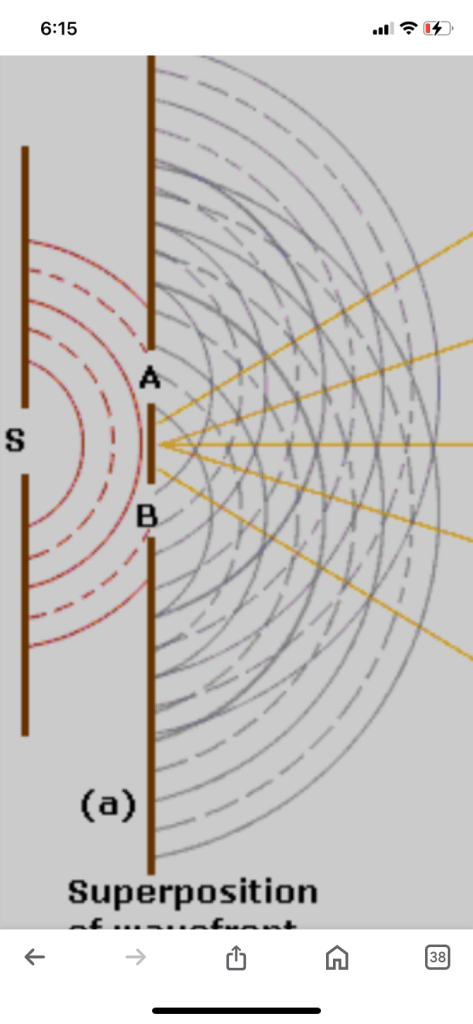
The double-slit experiment demonstrates the wave-like properties of quantum particles like the electron, which led to the development of quantum mechanics in the 1920s. Individual electrons are fired at a screen with two tiny apertures, and the place they end up is recorded on a photographic plate on the other side. Because the electrons can pass through either slit, they interfere with each other. In fact, a single electron can interfere with itself, just like a wave does when it passes through both slits at the same time. The result is an interference pattern of alternating high and low-intensity stripes on the back screen. The probability of finding an electron in certain places can be zero due to destructive interference – think of the peaks and troughs of two waves colliding and canceling each other out.
Quantum computing is a revolutionary technology that leverages the principles of quantum mechanics to perform calculations that are impossible for classical computers. Unlike classical computers, which use bits to represent information as either 0 or 1, quantum computers use qubits, which can exist in multiple states simultaneously due to a phenomenon called superposition. This allows quantum computers to explore a vast number of possibilities in parallel, leading to exponentially faster computations for certain types of problems.
Here’s a breakdown of the key aspects of quantum computing:
- Superposition: Qubits can exist in a superposition of states, meaning they can represent both 0 and 1 simultaneously. This allows quantum computers to explore multiple possibilities at once.
- Entanglement: Qubits can become entangled, meaning their states become correlated regardless of the distance between them. This creates a powerful link between qubits that can be exploited for computation.
- Quantum Algorithms: These algorithms are specifically designed to take advantage of the unique properties of quantum mechanics, such as Shor’s algorithm for factoring large numbers and Grover’s algorithm for searching unsorted databases.
Future of Quantum Computing:
The future of quantum computing holds immense potential, with the technology poised to revolutionize various fields: - Drug Discovery: Quantum computers can simulate molecular interactions with unprecedented accuracy, accelerating the development of new drugs and therapies.
- Materials Science: Quantum computers can model the properties of materials at the atomic level, leading to the discovery of new materials with superior properties.
- Financial Modeling: Quantum computers can analyze complex financial data and make more accurate predictions, optimizing investment strategies and risk management.
- Artificial Intelligence: Quantum computers can enhance machine learning algorithms, enabling faster training and more accurate predictions.
- Cryptography: Quantum computers can break many of the encryption algorithms currently in use, but they can also be used to develop new, quantum-resistant encryption methods.
Challenges and Considerations:
While quantum computing offers immense promise, there are significant challenges that need to be overcome: - Building Stable Qubits: Maintaining the delicate quantum states of qubits is extremely difficult, as they are highly susceptible to noise and decoherence.
- Scaling Up: Building large-scale quantum computers with a sufficient number of stable qubits is a major engineering challenge.
- Developing Quantum Algorithms: Creating efficient quantum algorithms for specific problems is an ongoing area of research.
- Ethical Considerations: The potential for quantum computers to break encryption raises concerns about data security and privacy.
Despite these challenges, the field of quantum computing is rapidly advancing, with researchers making significant progress in building more powerful and stable quantum computers. As the technology matures, we can expect to see a wide range of applications that will transform various industries and revolutionize our understanding of the world. - https://aog6k4.seminaris.fr/fr/yum764awe8iov0xqkcfs5zn
- https://crunchytech.net/emerging-technologies-overview/
- https://thecymes.com/article/summer-tech-trends-2023-embracing-innovation-and-transformation
- https://dev.to/deeprite/quantum-computing-2989
Please like subscribe comment your precious thoughts on universe discoveries
sk-mania-blogs.in
Full article source google
https://www.buymeacoffee.com/Satyam55
If you like my website universe discoveries freinds please donate me a coffee
 Universe discoveries
🙏🌹
Aum Shanti
LikeLike
“The splitting of electrons is linked to the Majorana fermion” is a bit vague. Majorana means it is its own anti-particle, but it doesn’t say that, instead it says “a spinon carrying its spin — and an orbiton carrying its orbital moment”. So does that mean that electron is not a Majorana fermion, but some other way linked to Majorana fermions?
LikeLike
Yes it’s possibly Thomas as we are advancing in technology old theories are replaced by new theories🌅
LikeLiked by 1 person