
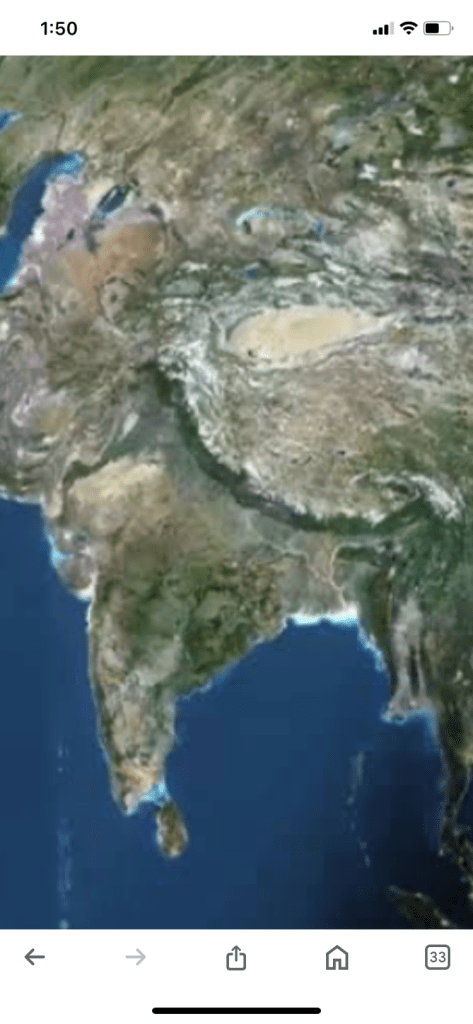
Recent scientific research suggests that the Indian tectonic plate might be undergoing a process called “delamination.” This means that the lower part of the plate is detaching from the upper part as it slides beneath the Eurasian plate. This process is similar to what is happening in East Africa, where the continent is splitting into two.
However, it is important to note that this is a complex process that is still not fully understood. It is also happening very slowly, over millions of years. So, while India may eventually split into two, it is not something that is going to happen overnight.
In the meantime, there is no need to worry about India splitting into two. The process is happening very slowly, and there is no immediate danger to anyone.
By recording waves at numerous seismic stations, researchers were able to construct images of subsurface structures. One image revealed two distinct blobs, suggesting that the lower part of the Indian Plate was detaching from the upper section
While you might picture a tectonic plate breaking into two pieces and separating sideways, scientists are claiming that the change is happening horizontally and the plate is splitting into separate layers.
There’s been much debate in the scientific community about what could be behind the formation of the Tibetan Plateau.
Simon Klemperer of Stanford University and co-authors on the study drew their arguments after studying levels of helium present in the Tibetan springs.
According to their research in the study, which has yet to be peer reviewed and is available on ESS Open Archive, a pattern was discovered which suggested the mantle was close enough to the Earth’s surface for the rare helium-3 to emerge through the springs in northern Tibet.
southern Tibet, though, the more abundant Helium-4 is more apparent, which suggests that the plate has not split there yet.
Speaking to Science Magazine, Professor Douwe van Hinsbergen of Utrecht University spoke about the concept. Van Hinsbergen, who is not an author on the study, said: “We didn’t know continents could behave this way and that is, for solid earth science, pretty fundamental
Is India starting to split into two?
Recent research in 2023 suggests that the Indian tectonic plate, which forms the base of the Himalayas, may be splitting in two due to an unusual process
For decades, geologists have known that the Himalayas owe their towering presence to the collision of the Indian and Eurasian continental plates. This process, which began around 60 million years ago, has been likened to the crumpling of a car’s hood in a head-on collision, with the Indian plate being driven beneath its northern neighbor by the currents of molten rock within the Earth’s mantle.
This new model of tectonic activity was pieced together by a team led by Ocean University of China geophysicist Lin Liu. By combining ‘up-and-down’ S-wave and shear-wave splitting data from 94 broadband seismic stations across southern Tibet with ‘back-and-forth’ P-wave data, the researchers have provided a nuanced view of the subterranean dynamics at play.
The implications of this study are profound, not only for our understanding of mountain formation but also for earthquake prediction methods. With a clearer three-dimensional image of how tectonic plates interact, scientists can better comprehend the Earth’s surface evolution and potentially forecast seismic events with greater accuracy.
Please like subscribe comment your precious thoughts on universe discoveries
sk-mania-blogs.in
Full article source google
https://www.buymeacoffee.com/Satyam55
If you like my website universe discoveries please donate me a coffee freinds
 Universe discoveries
🙏🌹
Aum Shanti
LikeLike