
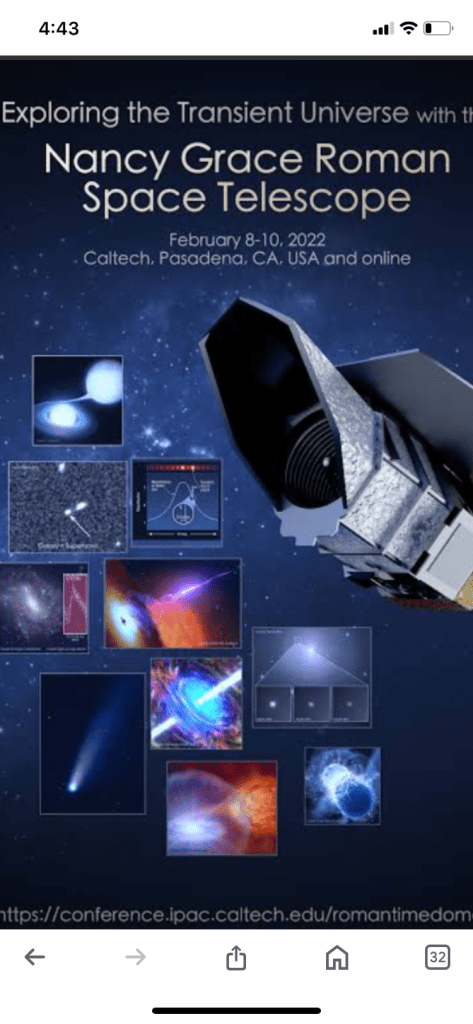
The Nancy Grace Roman Space Telescope, often referred to as the Roman Space Telescope or simply Roman, is a NASA infrared space telescope currently in development. It’s scheduled to launch to a Sun-Earth L2 orbit by May 2027.
Key features and objectives:
- Wide Field of View: Roman boasts a field of view 100 times larger than Hubble’s, allowing it to survey the sky much faster.
- Infrared Capabilities: It observes in infrared wavelengths, enabling it to see through dust and study objects that are too cool or distant to be observed in visible light.
- Exoplanet Exploration: Roman will use gravitational microlensing to detect and characterize exoplanets, including those in the habitable zones of their stars.
- Dark Energy Research: It will investigate the nature of dark energy by studying the expansion of the universe.
- Galaxy Formation and Evolution: Roman will study the formation and evolution of galaxies over cosmic time.
Scientific Instruments: - Wide Field Instrument (WFI): A 300.8-megapixel camera that will capture high-resolution images and spectra of celestial objects.
- Coronagraphic Instrument (CGI): A technology demonstration instrument designed to directly image exoplanets by blocking out the glare of their host stars.
Significance:
The Roman Space Telescope is expected to revolutionize our understanding of the universe by providing unprecedented insights into exoplanets, dark energy, and galaxy formation. Its wide field of view and infrared capabilities will enable it to make groundbreaking discoveries in these areas. - https://medium.com/@moizbombaywala63/the-james-webb-space-telescope-jwst-is-a-highly-anticipated-and-advanced-space-telescope-set-to-67876c9f59a0?responsesOpen=true&sortBy=REVERSE_CHRON
The Nancy Grace Roman Space Telescope (Roman) and the James Webb Space Telescope (JWST) are both powerful infrared space telescopes, but they have key differences that make them suited for different types of astronomical observations:
- Field of View:
- Roman: Has a much wider field of view, allowing it to survey large areas of the sky quickly.
- JWST: Has a narrower, more focused field of view, ideal for detailed observations of specific targets.
- Primary Mission:
- Roman: Primarily focused on:
- Exoplanet detection and characterization: Using gravitational microlensing to find and study exoplanets, including those in habitable zones.
- Dark energy research: Investigating the nature of dark energy by studying the expansion of the universe.
- Galaxy formation and evolution: Studying how galaxies form and evolve over cosmic time.
- JWST: Primarily focused on:
- Early universe studies: Observing the first stars and galaxies that formed after the Big Bang.
- Exoplanet atmospheres: Studying the atmospheres of exoplanets to search for signs of life.
- Star and planet formation: Observing the formation of stars and planetary systems.
- Observing Wavelengths:
- Roman: Primarily observes in the near-infrared range.
- JWST: Observes in a wider range of infrared wavelengths, including the mid-infrared, allowing it to see through dust clouds and observe cooler objects.
In Summary: - Roman: A wide-field surveyor for large-scale studies of exoplanets, dark energy, and galaxy evolution.
- JWST: A high-resolution observatory for detailed studies of the early universe, exoplanet atmospheres, and star formation.
Think of it this way: - Roman: Like a wide-angle lens on a camera, capturing a broad view of the cosmos.
- JWST: Like a telephoto lens, zooming in for detailed observations of specific celestial objects.
While they have distinct strengths, Roman and JWST are complementary missions that will work together to advance our understanding of the universe.
The Nancy Grace Roman Space Telescope (Roman) has three primary scientific objectives:
- Investigating Dark Energy:
- Roman will use its wide field of view to map the large-scale structure of the universe and measure how it has expanded over time.
- By studying the distribution of galaxies and supernovae, it will help scientists understand the nature of dark energy, a mysterious force accelerating the expansion of the universe.
- Discovering and Characterizing Exoplanets:
- Roman will employ a technique called gravitational microlensing to detect and characterize exoplanets, including those in the habitable zones of their stars.
- This method can find planets that are difficult to detect with other techniques, such as small, rocky planets.
- Studying Galaxy Formation and Evolution:
- Roman will observe galaxies across cosmic time, from the present day back to when the universe was young.
- This will provide insights into how galaxies form, grow, and interact with each other.
These objectives are ambitious and will require cutting-edge technology and innovative data analysis techniques. However, the Roman Space Telescope has the potential to revolutionize our understanding of the universe by providing unprecedented insights into these fundamental questions.
The Nancy Grace Roman Space Telescope is not designed to directly detect aliens. However, it will play a crucial role in the search for extraterrestrial life by:
- Finding habitable exoplanets: Roman’s primary mission is to find and characterize exoplanets, including those in the habitable zones of their stars. This means planets that could potentially support liquid water, a key ingredient for life as we know it.
- Studying exoplanet atmospheres: While Roman won’t directly analyze exoplanet atmospheres, it will provide valuable data that can inform future missions designed to do so.
So, while Roman won’t be looking for little green men, it will significantly expand our understanding of potentially habitable worlds, bringing us closer to answering the question: Are we alone in the universe?
Please like subscribe comment your precious thoughts on universe discoveries
sk-mania-blogs.in
Full article source google
https://www.buymeacoffee.com/Satyam55
If you like my website universe discoveries please donate me a coffee freinds
 Universe discoveries
🙏🌹
Aum Shanti
LikeLike
What will we do with all we see from these telescopes?
LikeLike