

Yes, Mark Zuckerberg has predicted that the mobile era will end soon and be replaced by a new device that will be in everyone’s hands. According to Zuckerberg, that device is smart glasses. He believes that within ten years, smart glasses will become more popular and useful than smartphones.
Smart glasses are wearable devices that incorporate a miniature computer display into a pair of eyeglasses. They offer augmented reality (AR) or mixed reality (MR) capabilities, transforming users’ perceptions of the world around them.
Uses of Smart Glasses:
- Industrial Applications:
- Remote Assistance: Experts can provide real-time guidance to field technicians through video calls and AR overlays.
- Training and Education: Hands-free access to instructions and visual aids enhances learning experiences.
- Warehouse and Logistics: Streamlined inventory management and order fulfillment through AR-guided picking and packing.
- Healthcare:
- Surgical Procedures: Surgeons can access patient data and real-time imaging during operations.
- Telemedicine: Remote consultations and patient monitoring are made more efficient.
- Rehabilitation: AR-based exercises and therapies can aid in patient recovery.
- Entertainment and Gaming:
- Immersive Gaming Experiences: AR overlays transform real-world environments into interactive game worlds.
- 360-Degree Video and Virtual Tours: Explore virtual environments and historical sites through immersive experiences.
- Accessibility:
- Visual Impairment Assistance: Real-time object recognition and navigation aids for visually impaired individuals.
- Language Translation: Instantaneous translation of text and speech for enhanced communication.
- Other Potential Uses:
- Tourism and Navigation: AR-guided tours and real-time navigation assistance.
- Retail and Marketing: Interactive product demonstrations and personalized shopping experiences.
- Military and Defense: Enhanced situational awareness and communication for soldiers.
Key Features of Smart Glasses: - Head-Mounted Display (HMD): A transparent display that overlays digital information onto the user’s field of view.
- Camera: Captures the user’s surroundings for AR applications and video calls.
- Sensors: Accelerometer, gyroscope, and magnetometer for motion tracking and gesture control.
- Processor and Memory: Enables the device to run applications and store data.
- Connectivity: Wi-Fi, Bluetooth, and cellular connectivity for data transfer and communication.
- Voice Control: Hands-free operation through voice commands.
Smart glasses are still evolving, but their potential to revolutionize various industries and aspects of daily life is immense. As technology advances, we can expect to see even more innovative and integrated applications of smart glasses in the future.
Google Glass was a pioneering project by Google that aimed to create a wearable computer in the form of eyeglasses. It featured a small display that projected information directly into the wearer’s field of vision, allowing for hands-free interaction with technology.
Key features of Google Glass:
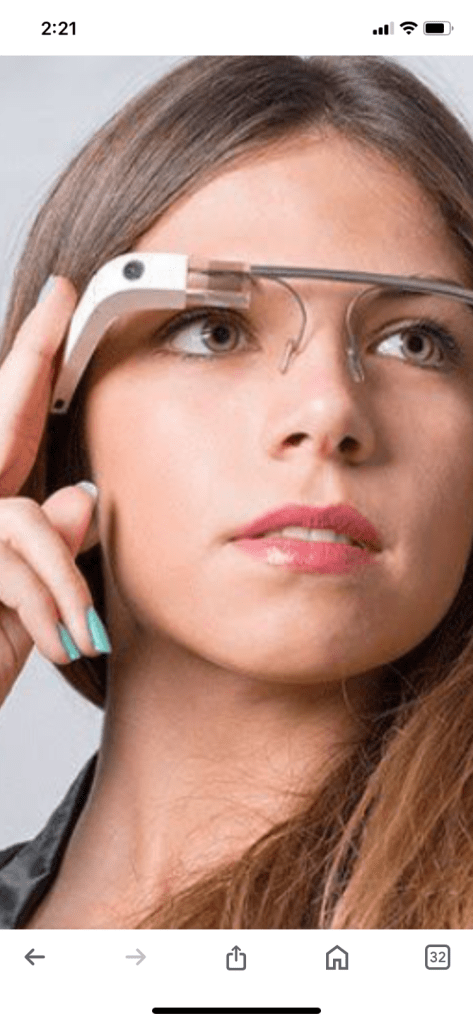
- Head-up display: A small, transparent display that overlays digital information onto the wearer’s view.
- Voice control: Interact with the device using voice commands.
- Camera: Capture photos and videos with a simple voice command.
- Internet connectivity: Access information and applications online.
- Notifications: Receive alerts and messages discreetly.
Applications of Google Glass: - Industrial: Remote assistance, training, and hands-free access to information.
- Healthcare: Surgical procedures, telemedicine, and patient monitoring.
- Entertainment: Immersive gaming experiences and virtual tours.
- Accessibility: Aids for visually impaired individuals and language translation.
Challenges and Discontinuation:
While Google Glass showed promise, it faced several challenges that led to its initial discontinuation in 2015: - High price: The initial cost of Google Glass was prohibitive for most consumers.
- Privacy concerns: The ability to record video discreetly raised privacy concerns.
- Social stigma: The “Glasshole” phenomenon, where people were seen as intrusive for using Glass in public, created a negative image.
Relaunch and Current Status:
In 2017, Google relaunched Glass as an enterprise-focused product called Google Glass Enterprise Edition. This version is designed for specific industries and applications, such as healthcare, manufacturing, and logistics. It addresses some of the previous concerns by focusing on practical use cases and improving privacy features.
While Google Glass may not have achieved the mainstream success initially envisioned, it remains a significant milestone in the development of wearable technology. Its innovations have paved the way for future advancements in augmented reality and smart eyewear.
Several companies are currently developing and producing smart glasses:

- Meta (formerly Facebook):
- Released Ray-Ban Stories, smart glasses with built-in cameras and audio features.
- Also developing more advanced AR/VR glasses.
- Google:
- Offers Google Glass Enterprise Edition, focused on industrial applications.
- Vuzix:
- A leading provider of smart glasses for various industries, including enterprise and healthcare.
- Microsoft:
- Developed HoloLens, a mixed reality headset with advanced holographic capabilities.
- Epson:
- Produces Moverio smart glasses, known for their high-quality displays.
- Snap:
- Developing augmented reality glasses through its Vergence Labs subsidiary.
- Xiaomi:
- Released Xiaomi Smart Glasses, a wearable AR device.
- TCL:
- Introduced RayNeo smart glasses with various features, including translation and navigation.
- Lenovo:
- Developing smart glasses for enterprise and consumer markets.
- LUCYD EYEWEAR:
- Focuses on smart glasses for everyday use, including audio and health monitoring features.
This is not an exhaustive list, and many other companies are entering the smart glasses market. The field is constantly evolving, with new innovations and advancements emerging regularly.
Please like support comment your precious thoughts on universe discoveries
sk-mania-blogs.in
Full article source google

https://www.buymeacoffee.com/Satyam55
If you like my website universe discoveries please donate me a coffee freinds
 Universe discoveries
🙏👍🌹
Aum Shanti
LikeLike
Interesting idea. Thanks for sharing.
LikeLike
How do you write or type with your eyes? If you are driving won’t they distract you?
LikeLike
Smart glasses 👓 work on voice command freind so you have to simply give voice command and typing will be done second option they offer is virtual keyboard and the inbuilt AI 🤖 will work for you
LikeLiked by 1 person
I don’t think I could use voice command, half the time when I speak to computers they don’t understand me and would I have to write it out first as I tend to ranmble
LikeLike