
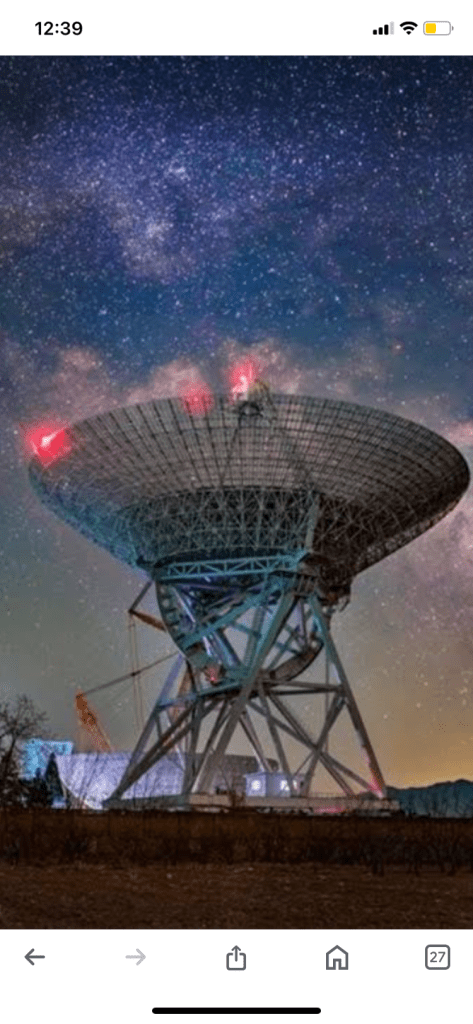
Recent reports suggest that a network of 40 radio telescopes and the James Webb Space Telescope have detected a potential alien signal originating from Proxima Centauri b, the closest exoplanet to Earth. However, it’s important to note that this signal is still being investigated and has not been confirmed as originating from an extraterrestrial intelligence.
In a groundbreaking achievement for astronomy, researchers have successfully detected emissions from one of the most distant galaxies known, located over 13 billion light-years away.
This remarkable feat was made possible through a collaboration between the Atacama Large Millimeter/submillimeter Array (ALMA) and the James Webb Space Telescope (JWST).
The observations focused on the galaxy GHZ2, also known as GLASS-z12, which dates back to just 400 million years after the Big Bang.
January 2025, astronomers used the Atacama Large Millimeter Array (ALMA) and the James Webb Space Telescope (JWST) to detect emissions from distant galaxies. The detection was the first time emissions from excited hydrogen and oxygen atoms were identified in galaxies more than 13 billion light-years away.
What was detected?
- Emissions from excited hydrogen and oxygen atoms in distant galaxies
- The [OIII] 88μm transition from doubly ionized oxygen
- A redshift of z=12.333 for GHZ2
What does this discovery mean?
- It provides insights into the conditions of the early universe
- It suggests that GHZ2 is undergoing intense bursts of star formation
- It confirms and characterizes distant objects, which helps test theories of galaxy formation and evolution
Jorge Zavala, an astronomer at the East Asian ALMA Regional Center, explained, “We pointed the more than forty 12-m antennas of ALMA and the 6.5-m JWST at a seemingly empty sky position for several hours to catch a signal from this distant astronomical object
The study builds on initial findings from JWST’s first extragalactic observations in 2022, which revealed a surprising number of bright galaxy candidates. Confirming and characterizing these distant objects is crucial for testing theories of galaxy formation and evolution
Further analysis indicated that this galaxy has a relatively low metallicity compared to most studied galaxies, with a stellar population characterized by short-lived, massive stars.
The total mass of GHZ2 is estimated to be several hundred million times that of the Sun, concentrated in a surprisingly small region.
Tom Bakx, a researcher at Chalmers University, emphasised the significance of these findings, stating that they pave the way for future investigations into primordial objects and enhance our understanding of galaxy formation in the early universe.
This collaboration between ALMA and JWST exemplifies the power of advanced astronomical techniques in unraveling cosmic mysteries.
Please like subscribe comment your precious thoughts on universe discoveries
sk-mania-blogs.in
Full article source google
https://www.buymeacoffee.com/Satyam55
If you like my website universe discoveries please donate me a coffee freinds
 Universe discoveries
wow!
LikeLiked by 1 person
🙏🌹
Aum Shanti
LikeLike