
The Mars Sample Return (MSR) mission is a complex, multi-step process involving multiple spacecraft and rovers. Here’s the basic plan:
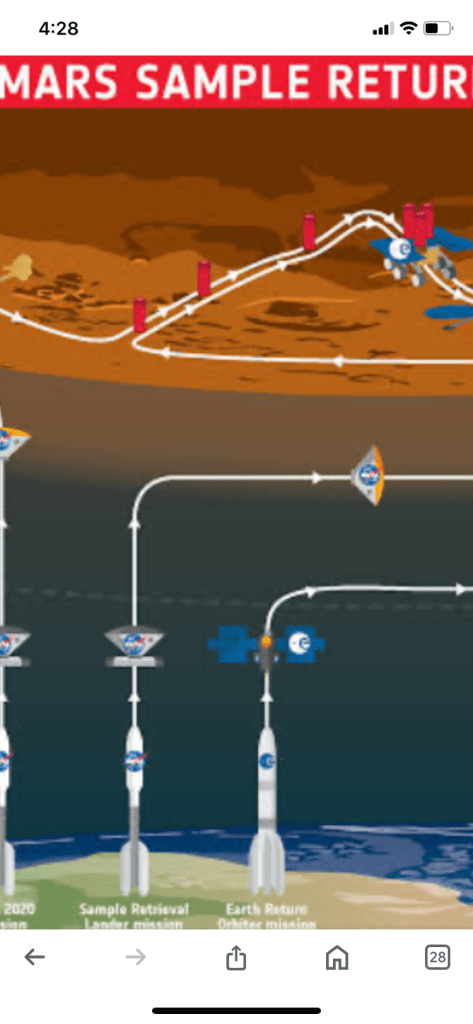
- Sample Collection: The Perseverance rover is already collecting rock and soil samples on Mars and storing them in special tubes.
- Sample Retrieval: A future mission will involve a lander that will deploy a small, robotic rover. This rover will collect the sample tubes left by Perseverance.
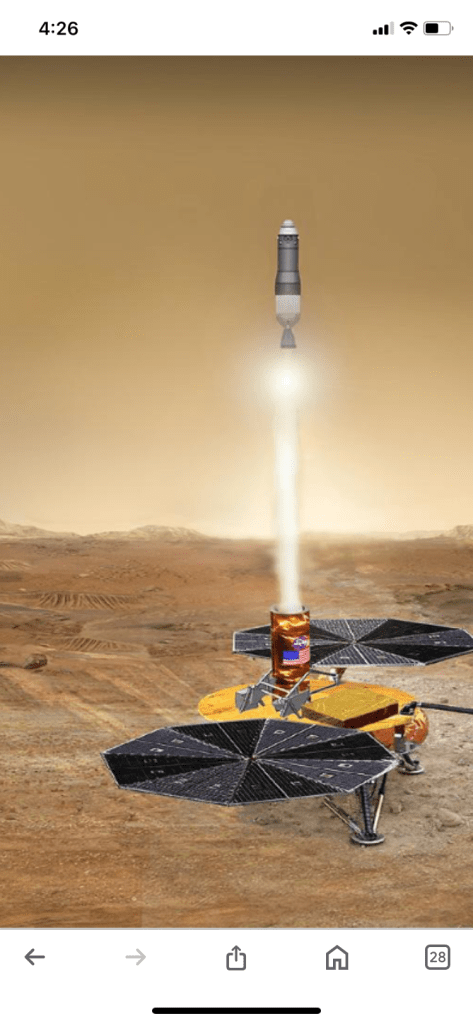
- Mars Ascent Vehicle: The collected samples will then be loaded into a small rocket, called a Mars Ascent Vehicle (MAV). This rocket will launch from the Martian surface.
- Earth Orbit Rendezvous: In Mars orbit, a spacecraft will be waiting. This spacecraft will capture the MAV and its precious cargo of Martian samples.
- Return to Earth: The spacecraft will then begin the long journey back to Earth.
- Earth Entry: Upon reaching Earth, the spacecraft will release a capsule containing the Martian samples. This capsule will re-enter the Earth’s atmosphere and land safely in a designated location (likely in the Utah desert).
This ambitious plan involves a series of intricate maneuvers and technologies, making it one of the most challenging space missions ever attempted.
The primary objectives of the Mars Sample Return (MSR) mission are:
- Scientific Investigation:
- Search for Past Life: To analyze Martian rocks and soil for evidence of past microbial life. This includes looking for biosignatures, or chemical or geological evidence that could indicate past life.
- Understand Mars’ History: To investigate the geological and geochemical history of Mars, including its formation, evolution, and potential for past habitability.
- Characterize the Martian Environment: To study the composition and properties of Martian rocks, soil, and atmosphere, which can provide insights into the planet’s current state and potential for future human exploration.
- Technological Advancement:
- Develop and Test New Technologies: MSR will involve the development and demonstration of several cutting-edge technologies, such as:
- Sample acquisition and handling systems on Mars
- A Mars Ascent Vehicle (MAV) capable of launching from the Martian surface
- Precise rendezvous and docking maneuvers in Mars orbit
- Safe Earth entry and sample recovery procedures
By successfully returning samples from Mars, scientists hope to gain a deeper understanding of our neighboring planet and potentially revolutionize our knowledge of planetary evolution and the potential for life beyond Earth.
The Mars Sample Return mission offers the best chance yet to find evidence of past life on Mars. Here’s why:
- Sophisticated Analysis: Bringing samples back to Earth allows scientists to use the most powerful and advanced laboratory equipment available. This includes instruments that can detect incredibly subtle signs of past life, such as:
- Organic molecules: These are the building blocks of life, and their presence in Martian rocks could be a significant clue.
- Isotopic signatures: Certain isotopes of elements are more common in living organisms than others.
- Biomarkers: These are specific molecules or structures that are only produced by living organisms.
- Multiple Lines of Evidence: By analyzing the samples with a variety of techniques, scientists can cross-reference their findings and increase the confidence in any potential discoveries.
However, it’s important to note: - Past Life, Not Present: The mission is primarily focused on searching for evidence of past life, as the chances of finding extant life on the Martian surface are considered low.
- Challenges Remain: Even with advanced technology, detecting signs of ancient life will be incredibly challenging.
In summary:
While the Mars Sample Return mission offers the best hope yet for finding evidence of past life on Mars, it’s crucial to maintain realistic expectations. The search will be complex and may not yield definitive answers. However, even if no definitive proof of life is found, the mission will significantly advance our understanding of Mars’ history and the potential for life elsewhere in the universe.
Please like subscribe comment your precious thoughts on universe discoveries
sk-mania-blogs.in
Full article source google
https://www.buymeacoffee.com/Satyam55
If you like my website universe discoveries please donate me a coffee freinds
 Universe discoveries
Interesting post.
LikeLike
🙏🌹
Aum Shanti
LikeLike