
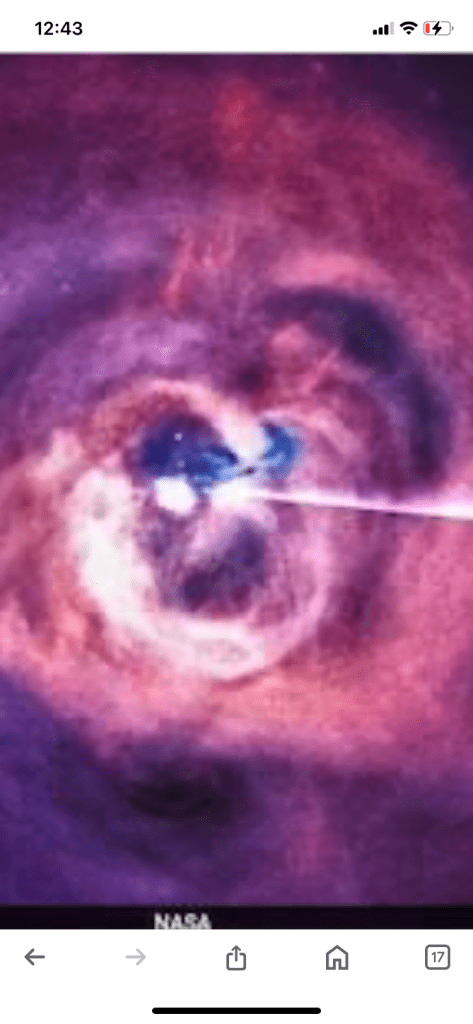
NASA has recently made it possible to hear the sounds of the black hole present in the center of the Perseus Galaxy Cluster. When common people heard this sound, they felt very scary. However, in reality these sounds are so faint that humans cannot hear them.
NASA: NASA has recently heard a scary sound of the universe, which has come from a huge black hole. This black hole is present in the center of the Perseus Galaxy Cluster. Scientists detected these sound waves for the first time in 2003. These waves were so slow that humans could not hear them. The lowest pitched sound, a B-flat, was 57 octaves below middle C and had a frequency of 10 million years. This is considered to be the slowest pitch ever recorded in the universe.
NASA has ‘sonified’ these waves i.e. made them audible. He increased the pitch of these sounds to 57 and 58 octaves, so that humans could hear them. When NASA’s effort was successful, a scary experience was experienced and it came out in the form of a mysterious sound, which after listening seemed as if it was a cosmic scream.
This process shows that while sound cannot travel in a vacuum, it can travel through the dense cloud of gas that surrounds a black hole. Now, these eerie sounds from the Perseus Cluster are captivating the imagination of scientists and ordinary people
According to NASA, in this sonification, scientists extracted pre-existing sound waves and made them audible for the first time. These waves were taken in the ‘radial direction’ outwards from the center of the black hole. These signals were then boosted up to 57 and 58 octaves to bring them within the range of human hearing ability. In simple words, the original frequency of these sounds was intensified by 144 quadrillion and 288 quadrillion times.
NASA has designed this sound as a “radar scan”, which gives an opportunity to hear the waves in different directions. There is also a visual image of this data. Which shows blue and violet X-ray rays captured by the Chandra telescope. This discovery provides a unique opportunity to understand the mysteries of the universe and feel its depths.
https://youtu.be/ioR5np1fmEc?si=Ei2VgEVJSdDsR-9g
Please click the above link to watch the Vedio
Perseus galaxy cluster
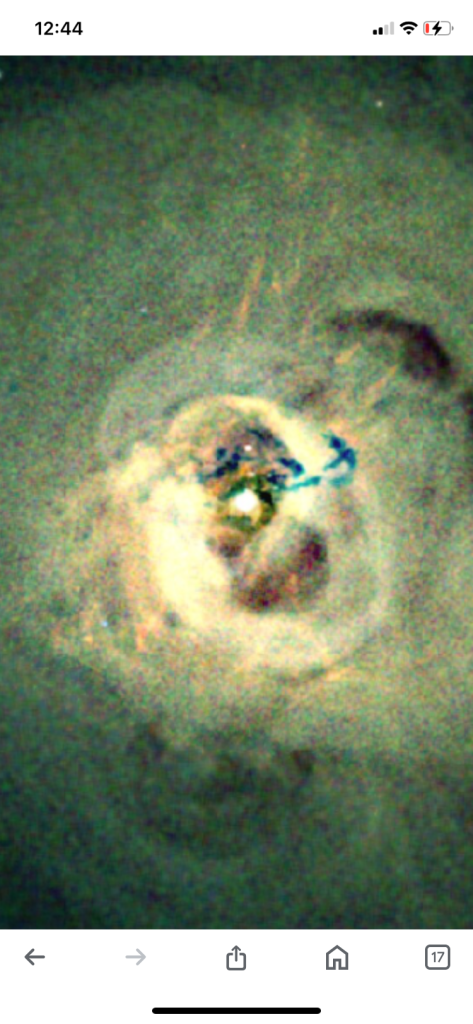
The Perseus galaxy cluster is a fascinating and important object in the universe. Here’s some information about it:
- What it is: A massive collection of galaxies, one of the largest known structures in the universe. It contains thousands of galaxies bound together by gravity, all immersed in a vast cloud of superheated gas.
- Where it is: Located in the constellation Perseus.
- Distance: About 240 million light-years from Earth.
- Notable Features:
- It’s the brightest cluster in the sky when observed in X-rays.
- Contains the radio source 3C 84, which is creating giant “bubbles” of relativistic plasma in the cluster’s core.
- At the center of the cluster lies the galaxy NGC 1275.
Here’s a recent highlight: - The Perseus galaxy cluster was one of the first targets observed by the Euclid space telescope. Euclid’s observations are helping to unravel mysteries about the distribution of diffuse light within the cluster.
If you want to learn more, I recommend checking out the Wikipedia page on the Perseus Cluster or searching for images and information from sources like NASA’s Chandra X-ray Observatory or the European Space Agency’s Euclid mission.
Chandra telescope
Ah, the Chandra X-ray Observatory! It’s a truly remarkable instrument. Here’s some information about it:
- What it is: Chandra is a space telescope designed to observe X-rays from celestial objects. Unlike visible light, X-rays are blocked by Earth’s atmosphere, so we need telescopes in space like Chandra to study them.
- Launched: July 23, 1999, aboard the Space Shuttle Columbia.
- Named after: Subrahmanyan Chandrasekhar, a Nobel Prize-winning astrophysicist.
- Why it’s important:
- X-ray vision: Chandra allows us to see the universe in a whole new light. X-rays reveal extremely hot and energetic phenomena, like black holes, supernova remnants, and quasars.
- High resolution: Chandra has incredibly sharp vision for an X-ray telescope, allowing it to capture detailed images.
- Great Observatory: It’s one of NASA’s “Great Observatories” (along with Hubble, Spitzer, and the now-deorbited Compton), a group of powerful telescopes designed to observe the universe across different wavelengths of light.
- Some of its discoveries:
- Provided evidence for the existence of dark matter.
- Imaged the supermassive black hole at the center of the Milky Way galaxy.
- Studied the hot gas in galaxy clusters, helping us understand their structure and evolution.
If you’re interested in learning more, I recommend visiting the Chandra X-ray Observatory website (chandra.harvard.edu) or checking out NASA’s website for more information and images.
Please like subscribe comment your precious comment on universe discoveries
Full article source google
https://www.buymeacoffee.com/Satyam55
If you like my website universe discoveries please donate me a coffee freinds
 Universe discoveries
🙏🌹
Aum Shanti
LikeLike