

It’s fascinating to see how our understanding of evolution continues to deepen. Here’s a breakdown of what this new research suggests:
- Evolvability:
- The core concept is “evolvability,” which refers to the capacity of organisms to evolve.
- The research indicates that this ability itself can evolve over generations. In essence, evolution can become more efficient.
- How it Works:
- Studies are showing that organisms can enhance their ability to adapt to changing environments.
- This may involve things like changes in mutation rates, allowing for a broader range of potential adaptations.
- It is being shown that there are multiple pathways to evolvability.
- Implications:
- This challenges the traditional view of evolution as a purely reactive process.
- It suggests that evolution can actively refine itself, leading to greater adaptability.
- This has significant implications for understanding how life has diversified and persisted over billions of years.
- Key Findings:
- The research is showing that populations can respond to both recurring and novel challenges by increasing mutation rates, and shaping the genetic neighborhood.
- That the process of evolution can get better at evolving in the face of environmental change.
In essence, the research is demonstrating that the very mechanisms of evolution are themselves subject to evolutionary change.
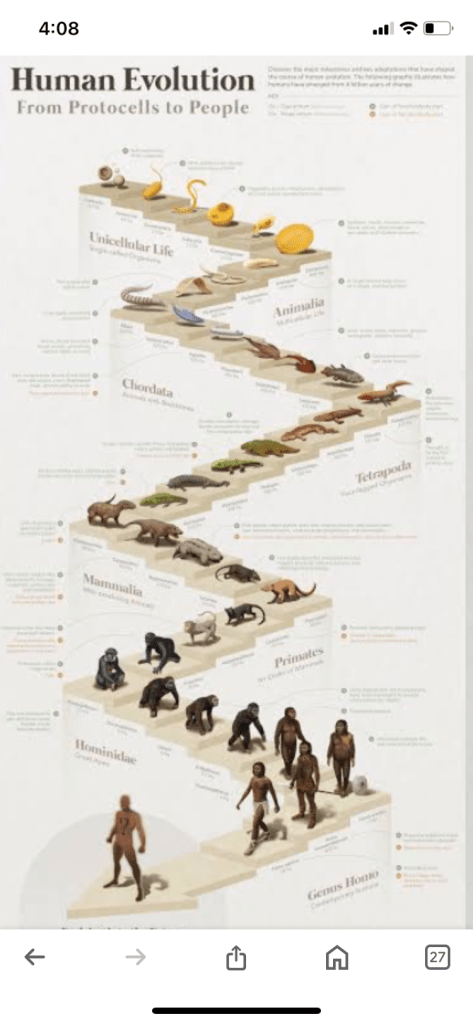
In the mid-19th century, Charles Darwin unveiled a revolutionary idea. Darwin’s On the Origin of Species crashed through the existing dogma like a storm surge, proposing that life’s staggering diversity arose not from a creator’s whim but from a relentless, blind process: evolution by natural selection.
It was a radical idea that rippled far beyond biology, seeping into philosophy, religion, even our sense of self — suddenly, humans weren’t apart from nature, but a thread in its tangled weave.
Since then, scientists have refined and enriched the mechanisms of evolution. The most seismic addition came with the integration of Gregor Mendel’s genetics in the early 20th century, birthing the “Modern Synthesis,” which fused natural selection with the mechanics of heredity — showing how traits are passed through genes, not just vague “variations.” Molecular biology later revealed DNA as the raw material of evolution, unveiling mechanisms like genetic drift, gene flow, and mutations as key players alongside selection.
Darwin didn’t know about plate tectonics or mass extinctions, which we now recognize as sculptors of life’s diversity, nor could he foresee epigenetics, where environmental factors tweak gene expression without altering the code itself.
Another thing that Darwin likely didn’t foresee is that evolution itself could evolve. But what does that mean?
A new study, suggests just that. Evolutionary biologists have found evidence that the ability to evolve — a concept known as “evolvability” — can improve over generations. It’s another thread in a web of evolutionary complexity that may explain how life becomes so remarkably diverse.
Yes, new research suggests that evolution itself can evolve over time. This means that the process of evolution improves its ability to adapt to environmental changes.
How does evolution evolve?
- Mutational neighborhoodsMutations are more likely to produce beneficial traits in certain regions of the genetic landscape.
- Higher mutation ratesIn environments that change, populations evolve to have higher mutation rates, which increases the chances of finding beneficial changes.
- Localizing on boundariesEvolving populations tend to localize on the boundaries between different phenotypic regions, allowing them to switch rapidly between traits.
What does this mean?
This research suggests that evolution can refine itself over time, becoming more efficient in adapting to changing environments. It challenges the traditional view of evolution as a purely reactive process.
Implications
This research opens new possibilities for understanding the complexity of life. It also raises new questions about how life has persisted and diversified over billions of years.
Please like subscribe comment your precious comment on universe discoveries
Full article source google
https://www.amazon.in/b?_encoding=UTF8&tag=555101-21&link
This is Amazon link if you want to buy anything from Amazon you can click on that it will help my website grow freinds
https://www.buymeacoffee.com/Satyam55
Please donate me a coffee freinds to help my website grow if you like my website universe discoveries
 Universe discoveries
It is a very interesting article.
LikeLike
Incredible to think that evolution itself can evolve. This research really challenges the traditional view and opens up new possibilities for how life adapts over time. It’s fascinating how science continues to uncover layers of complexity in nature.
LikeLike