
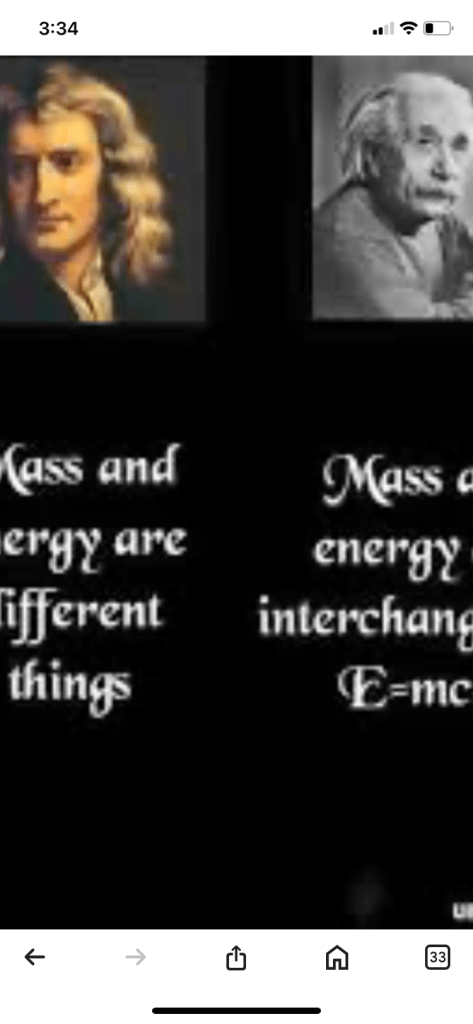
The question of whether Newton or Einstein was the “greatest genius” is a complex one, as both made revolutionary contributions to our understanding of the universe. It’s less about declaring a winner and more about appreciating the distinct nature of their genius and the contexts in which they worked. Here’s a breakdown:
Isaac Newton:
- Revolutionized Classical Physics:
- He laid the foundation for classical mechanics with his laws of motion and universal gravitation.
- He invented calculus, a mathematical tool essential for modern science.
- His work in optics, including the discovery that white light is composed of a spectrum of colors, was groundbreaking.
- Impact:
- Newton’s laws provided a framework for understanding the physical world that remained dominant for centuries.
- He essentially created the modern scientific method.
Albert Einstein: - Revolutionized Modern Physics:
- He developed the theory of relativity, which dramatically changed our understanding of space, time, gravity, and the universe.
- His work on the photoelectric effect contributed significantly to the development of quantum mechanics.
- His famous equation E=mc² revealed the relationship between energy and mass.
- Impact:
- Einstein’s theories have had a profound impact on fields ranging from cosmology to nuclear physics.
- He changed our perception of reality.
Key Considerations: - Context:
- Newton built the foundation upon which Einstein built. Einstein then advanced that foundation.
- Each scientist worked within the context of the scientific knowledge available in their time.
- Nature of Genius:
- Newton’s genius was characterized by his ability to synthesize and formalize existing knowledge, as well as to develop powerful new mathematical tools.
- Einstein’s genius was characterized by his radical imagination and ability to challenge fundamental assumptions.
- Subjectivity:
- Ultimately, “greatest” is subjective. Both Newton and Einstein were titans of science, and their contributions have shaped the world in profound ways.
In conclusion, both Newton and Einstein were extraordinary geniuses who profoundly impacted scientific thought. It is more productive to appreciate their unique contributions than to try to rank them.
Albert Einstein life
Albert Einstein’s life is a fascinating story of a revolutionary thinker who reshaped our understanding of the universe. Here’s a concise overview:
Early Life and Education:
- Birth: Born on March 14, 1879, in Ulm, Germany.
- Early Interests: Displayed a strong curiosity about the natural world from a young age.
- Education:
- Attended schools in Munich, Switzerland, and eventually the Swiss Federal Polytechnic School in Zurich.
- Initially struggled with formal education, but excelled in physics and mathematics.
Scientific Breakthroughs: - “Miracle Year” (1905):
- Published four groundbreaking papers that revolutionized physics:
- The photoelectric effect (for which he received the Nobel Prize in 1921).
- Brownian motion.
- Special relativity.
- Mass-energy equivalence (E=mc²).
- General Relativity (1915):
- Developed the theory of general relativity, which explained gravity as the curvature of spacetime.
Later Life and Legacy: - Nobel Prize: Awarded the 1921 Nobel Prize in Physics for his explanation of the photoelectric effect.
- Immigration to the United States: Fled Nazi Germany in 1933 and settled in Princeton, New Jersey.
- Contributions to Atomic Energy:
- Wrote a letter to President Franklin D. Roosevelt warning of the potential for atomic weapons.
- Pacifism and Social Activism: Advocated for peace and social justice.
- Death: Died on April 18, 1955, in Princeton, New Jersey.
Key Aspects of His Life: - His revolutionary theories transformed physics.
- He was a symbol of intellectual brilliance.
- He was also a social activist who spoke out against injustice.
Einstein’s impact on science and society is immeasurable. He remains one of the most influential figures in history.
Newton life
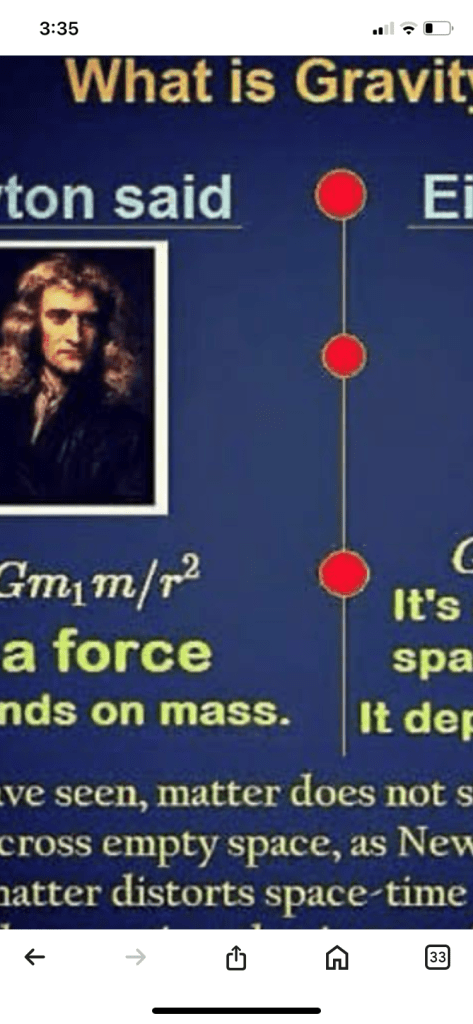
Isaac Newton’s life was one of extraordinary intellectual achievement, marked by groundbreaking contributions to mathematics, physics, and astronomy. Here’s a summary of his life:
Early Life:
- Birth: Isaac Newton was born on January 4, 1643 (December 25, 1642, Old Style), in Woolsthorpe, Lincolnshire, England.
- He was born prematurely and his father had died three months before his birth.
- His early education took place at The King’s School in Grantham.
Education and Scientific Breakthroughs: - Cambridge University: He attended Trinity College, Cambridge, beginning in 1661.
- “Annus Mirabilis” (1665-1666): During the Great Plague, Newton returned to Woolsthorpe, where he made some of his most significant discoveries, including:
- The development of calculus.
- The formulation of his laws of motion.
- The beginning of his work on the theory of universal gravitation.
- Optics: He conducted groundbreaking work on optics, discovering that white light is composed of a spectrum of colors.
- “Philosophiæ Naturalis Principia Mathematica” (1687): This masterpiece laid the foundation for classical mechanics and presented his law of universal gravitation.
Later Life: - Royal Mint: He served as Warden and then Master of the Royal Mint, where he played a key role in reforming the British currency.
- Royal Society: He was elected President of the Royal Society in 1703.
- Death: Isaac Newton died on March 31, 1727 (March 20, 1727, Old Style), in London.
Key Aspects: - Newton’s work revolutionized our understanding of the physical world.
- He was a key figure in the Scientific Revolution.
- His contributions to mathematics, physics, and astronomy have had a lasting impact.
Newton’s legacy as one of the greatest scientific minds in history is undeniable.
Please like subscribe comment your precious comment on universe discoveries
Full article source google
https://www.amazon.in/b?_encoding=UTF8&tag=555101-21&link
This is Amazon link if you want to buy anything from Amazon you can click on that it will help my website grow freinds
https://www.buymeacoffee.com/Satyam55
Please donate me a coffee freinds to help my website grow if you like my website universe discoveries
4742822
 Universe discoveries
🙏🌹
Aum Shanti
LikeLike
LikeLike
Very interesting discussion. I might come out on the side of Newton because so much did not exist at his time including calculus. Einstein got some help getting started. The Lorentz transforms existed already but in a different context and he got some help with the math. But they were both amazing geniuses.
LikeLike