
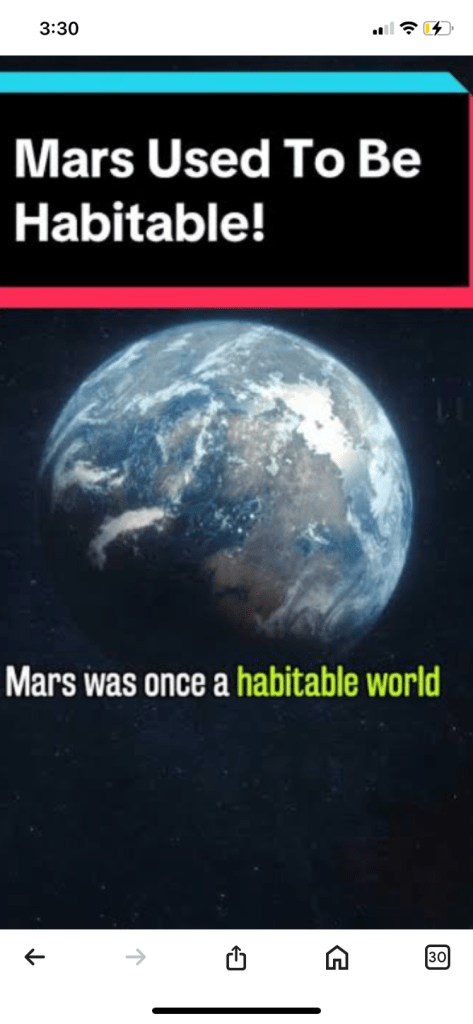
It’s widely accepted within the scientific community that Mars was once far more habitable than it is today. Here’s a breakdown of the key evidence:
- Evidence of Liquid Water:
- One of the most compelling pieces of evidence is the abundance of geological features that suggest the past presence of liquid water. These include:
- Ancient riverbeds and valley networks.
- Dried-up lake basins.
- Minerals that form in the presence of water.
- Past Atmosphere:
- Scientists believe that early Mars had a much thicker atmosphere than it does now. This thicker atmosphere would have created a warmer climate, allowing liquid water to exist on the surface.
- Organic Molecules:
- Rovers like Curiosity and Perseverance have detected organic molecules on Mars. While these molecules don’t necessarily indicate life, they are the building blocks of life and suggest that the necessary chemistry for life could have existed.
- Habitable Conditions:
- Taken together, the evidence suggests that early Mars had the key ingredients for life: liquid water, organic molecules, and a suitable climate.
It’s important to note: - While we have strong evidence of past habitability, we have not yet found definitive proof of past or present life on Mars.
- Ongoing missions like Perseverance are continuing to explore Mars and gather data that will help us better understand its past and potential for life.
Essentially, the overwhelming amount of scientific data points to the fact that billions of years ago, Mars was a much more Earth-like world, with conditions that could have supported microbial life.
How were the martians in the past

It’s important to distinguish between fictional depictions of “Martians” and the scientific search for potential past or present life on Mars.
Here’s a breakdown:
Fictional “Martians”:
- Popular culture is rich with imaginative depictions of Martians, often influenced by:
- H.G. Wells’ “The War of the Worlds”: This iconic novel portrayed Martians as intelligent, technologically advanced beings with a distinct, and often terrifying, physiology.
- Other science fiction works have contributed to a variety of Martian archetypes, ranging from humanoid to entirely alien.
- These are products of human imagination, not scientific discoveries.
Scientific Perspective: - When scientists discuss past life on Mars, they’re primarily considering the possibility of microbial life.
- Evidence suggests that early Mars had conditions that could have supported such life forms:
- Liquid water: Geological features indicate the presence of ancient rivers, lakes, and oceans.
- Organic molecules: Building blocks of life have been detected.
- If life did exist on early Mars, it was likely to be simple, single-celled organisms, similar to early life on Earth.
- Therefore, when speaking about past “Martians” from a scientific viewpoint, it is highly likely that they would have been microscopic.
- It is important to remember that the search for past, or present, life on mars is on going.
In summary, while fictional Martians have captured our imaginations, the scientific pursuit focuses on the potential for microbial life in Mars’s past.
Did in the past martians seeded life on earth

The idea that life on Earth might have originated on Mars, a concept known as “panspermia,” is a fascinating and actively debated scientific hypothesis. Here’s a breakdown:
- Panspermia:
- This theory suggests that life can be distributed throughout the universe via meteoroids, asteroids, and other celestial bodies.
- In the context of Mars, it proposes that microbial life could have been ejected from Mars by asteroid impacts and then traveled to Earth.
- Evidence and Arguments:
- Early Mars: Evidence indicates that Mars had potentially habitable conditions earlier than Earth. Therefore, life could have originated there first.
- Meteorites: Martian meteorites have been found on Earth, demonstrating that material can travel between the two planets.
- Organic Molecules: The presence of organic molecules on Mars strengthens the possibility that life could have existed there.
- Molybdenum: Some scientists have pointed to the importance of oxidized molybdenum in the early development of life, and have stated that this form of molybdenum would have been more readily available on early mars, than early earth.
- Important Considerations:
- While the idea is intriguing, it’s essential to remember that it’s still a hypothesis.
- Even if life did originate on Mars, it doesn’t necessarily mean that “Martians” intentionally seeded Earth. It could have been a natural process.
- The search for conclusive proof of past or present life on Mars is ongoing, and any findings will contribute to our understanding of this question.
In essence, the possibility that life on Earth originated on Mars is a valid scientific consideration, but it remains a topic of ongoing research and debate.
Please like subscribe comment your precious comment on universe discoveries
Full article source google
https://www.amazon.in/b?_encoding=UTF8&tag=555101-21&link
This is Amazon link if you want to buy anything from Amazon you can click on that it will help my website grow freinds
https://www.buymeacoffee.com/Satyam55
Please donate me a coffee to help grow my website universe discoveries freinds
 Universe discoveries
👌👍🌷
LikeLike
🙏🌹
Aum Shanti
LikeLiked by 1 person