
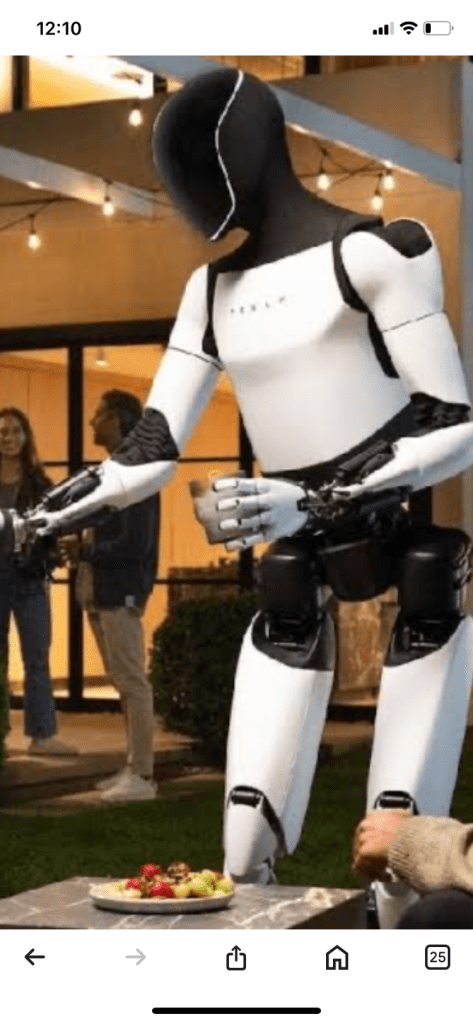
The idea of Tesla’s Optimus robots playing a role in the colonization of Mars has gained attention due to Elon Musk’s statements. Here’s a breakdown of the key points:
- Musk’s Vision:
- Elon Musk has expressed his intention to send Tesla’s Optimus robots to Mars aboard SpaceX’s Starship.
- The goal is for these robots to prepare the Martian environment for future human habitation.
- He has indicated a potential timeline of Starship missions carrying Optimus robots to Mars as early as the end of 2026.
- Optimus’s Potential Role:
- The Optimus robots are envisioned to perform tasks such as:
- Setting up solar panels.
- Preparing habitats.
- Conducting surveys.
- Assembling equipment.
- These capabilities could be crucial for establishing initial infrastructure on Mars.
- Challenges and Skepticism:
- Experts have expressed skepticism about the feasibility of the proposed timeline.
- The Martian environment poses significant challenges, including:
- Extreme temperatures.
- High radiation.
- A thin atmosphere.
- The robots would need to have a high level of autonomous function, due to the time delays in communication between earth and mars.
- The Big Picture:
- This is part of a larger plan to make humanity a multiplanetary species.
- The use of robots could be a vital step in making human colonization of Mars more viable.
In essence, the concept involves using advanced robotics to lay the groundwork for human presence on Mars, but it’s an extremely ambitious plan that faces many technical and logistical hurdles.
What are Optimus robots

Tesla’s Optimus, also known as the Tesla Bot, is a general-purpose humanoid robot being developed by Tesla, Inc. Here’s a breakdown of what it is:
- Purpose:
- Optimus is designed to perform tasks that are considered unsafe, repetitive, or boring for humans.
- The goal is for it to be a versatile robot capable of assisting with various everyday tasks.
- Features:
- It’s a humanoid robot, meaning it’s designed to resemble a human in form.
- It utilizes artificial intelligence (AI) similar to that used in Tesla’s autonomous vehicles, enabling it to perceive and interact with its environment.
- Tesla is developing it to have capabilities for walking, manipulating objects, and performing various actions.
- Development:
- The concept was announced at Tesla’s AI Day event in 2021.
- Tesla has been actively developing and showcasing prototypes, with improvements in its capabilities being demonstrated.
- Vision:
- Elon Musk envisions Optimus playing a significant role in the future, potentially in various industries and even in space exploration, such as preparing habitats on Mars.
In essence, Optimus is Tesla’s effort to create a general-purpose humanoid robot that can perform a wide range of tasks, leveraging the company’s expertise in AI and robotics.
Robots role in colonisation of mars
Robots are poised to play a crucial role in the colonization of Mars, serving as essential precursors and partners to human explorers. Here’s a breakdown of their potential contributions:
- Precursor Missions and Site Preparation:
- Exploration and Surveying:
- Robots like rovers (e.g., Perseverance, Curiosity) can conduct detailed surveys of the Martian surface, analyzing soil composition, identifying potential resources (water ice, minerals), and mapping terrain.
- This data is vital for selecting suitable locations for future human settlements.
- Habitat Construction:
- Robots could be deployed to construct initial habitats and infrastructure before human arrival.
- This includes assembling prefabricated structures, preparing landing sites, and establishing power generation systems (e.g., solar arrays).
- Resource Extraction:
- Robots can be used to extract and process Martian resources, such as water ice and regolith (Martian soil), to produce essential supplies like water, oxygen, and building materials.
- Supporting Human Colonization:
- Maintenance and Repair:
- Robots can perform routine maintenance and repairs on habitats, equipment, and infrastructure, reducing the risk to human life.
- Hazardous Tasks:
- They can undertake tasks that are dangerous for humans, such as exploring hazardous areas or working in extreme conditions.
- Scientific Research:
- Robots can conduct ongoing scientific experiments and collect data, expanding our understanding of Mars.
- Resource Management:
- Robots with AI, can manage resource usage, and adapt to changing conditions, insuring the best use of limited resources.
Key Advantages of Using Robots: - Resilience:
- Robots can withstand the harsh Martian environment, including extreme temperatures and radiation.
- Endurance:
- They can operate for extended periods without the need for life support.
- Efficiency:
- Robots can perform repetitive and laborious tasks with greater efficiency than humans.
In essence, robots are seen as essential for preparing Mars for human colonization, ensuring the safety and sustainability of future settlements.
Please like subscribe comment your precious thoughts on universe discoveries
Full article source google
This is Amazon link if you want to buy anything from Amazon you can click on link to help my website universe discoveries grow freinds
https://www.amazon.in/b?_encoding=UTF8&tag=555101-21&link
https://www.buymeacoffee.com/Satyam55
Please donate me a coffee to help grow my website universe discoveries freinds
 Universe discoveries
🤝👍🎉
LikeLike