

We are referring to the recent findings about the ultra-diffuse galaxy FCC224. This galaxy has indeed generated excitement in the astronomy community because it appears to be significantly deficient in dark matter.
Here’s what we know about FCC224 and why it’s considered a “gravity-less” galaxy in a loose sense:
- Ultra-Diffuse Galaxy (UDG): FCC224 is classified as an ultra-diffuse galaxy. These galaxies are characterized by their large size (comparable to the Milky Way) but very low luminosity, meaning they have far fewer stars than typical galaxies of their size.
- Lack of Dark Matter: Recent studies, particularly using the Keck Observatory, have analyzed the movement of star clusters within FCC224. These measurements indicate that the clusters are moving slower than expected if the galaxy had a significant amount of dark matter. This suggests that FCC224’s gravitational pull is primarily due to its visible matter (stars and gas), with very little contribution from dark matter.
- Unusual Globular Clusters: Hubble Space Telescope observations have revealed that FCC224 hosts a surprisingly large number of bright and massive globular clusters for a galaxy of its size and apparent lack of dark matter. This is another puzzling aspect of this galaxy.
- Formation Theories: Scientists are exploring various scenarios to explain how FCC224 could have formed without the expected dark matter. Some possibilities include:
- High-velocity collisions: A collision between gas-rich galaxies might have separated the gas from the dark matter, leading to the formation of a galaxy primarily composed of the expelled gas.
- Intense star formation: A period of rapid and intense star formation with overmassive star clusters might have expelled dark matter from the galaxy.
- Tidal stripping: Interactions with other galaxies in the Fornax Cluster (where FCC224 resides) might have stripped away its dark matter halo.
It’s crucial to understand that FCC224 is not entirely without gravity. All matter possesses gravity. However, the observed gravitational effects in FCC224 seem to be accounted for by its visible matter alone, with little to no need for the extra gravitational pull that dark matter is typically thought to provide in galaxies.
Therefore, while the term “gravity-less galaxy” is a simplification that captures the surprising lack of dark matter’s influence, it’s more accurate to describe FCC224 as a dark matter-deficient galaxy. Its existence challenges our standard models of galaxy formation and highlights the complexity and diversity of galaxies in the universe. Scientists are eager to study FCC224 further to unravel the mysteries of its formation and evolution.
FCC 224, a dwarf galaxy discovered in 2024, has surprised scientists as it did not show any concrete evidence of dark matter. Images taken from the Hubble Space Telescope made this ultradiffuse galaxy the center of discussion. This discovery challenges our understanding of the universe, as until now dark matter was considered the glue that held galaxies together.
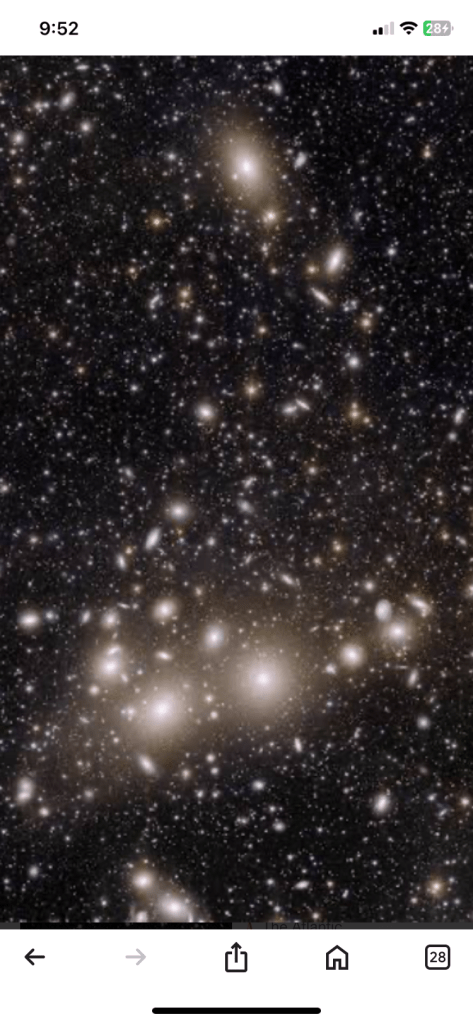
FCC 224 is at the edge of the Fornax cluster, 65 million light-years from Earth. Its shape and location set it apart from previously discovered galaxies without dark matter (such as DF2 and DF4). This suggests that such galaxies may be a new class, deepening the mysteries of the universe.
FCC 224 contains bright star clusters, which are usually found in large galaxies with dark matter. But surprisingly, the speed of these clusters is very slow. Data taken from the Keck Observatory show that there is no gravitational effect of dark matter on them, which has put scientists into thinking
Australian astronomer Maria Buzzo and her team led the discovery of FCC 224. They analyzed the motion of star clusters from the Keck Observatory in Hawaii. Their research suggests that this galaxy is stable without dark matter, which challenges existing models of cosmology.
Yimeng Tang’s team at the University of California believes that FCC 224 may have been formed by the collision of two gas-rich galaxies. In this collision, the gas was separated from the dark matter, which led to the formation of a galaxy without dark matter. This theory matches galaxies like DF2 and DF4, which are in the NGC 1052 group.( twin galaxy FCC -240)
FCC 224 has a twin galaxy, FCC 240, which has a similar size, shape, and direction. If further observations confirm this similarity, the collision theory will be strengthened. This discovery could be important in understanding the formation of galaxies without dark matter.
Another possibility is that FCC 224 once experienced intense star formation. During this time, massive star clusters released so much energy that dark matter was pushed out of the galaxy. This theory suggests that internal forces of the galaxy may account for the absence of dark matter
Questions on Big Bang
Galaxies like FCC 224 are raising questions about the Big Bang theory and dark matter models. If galaxies can remain stable without dark matter, what is the force that holds the universe together? This discovery is forcing scientists to re-examine existing theories
Maria Buzzo says that galaxies like FCC 224 are important for understanding the role of dark matter. The more such galaxies we find, the more deeply we will be able to understand how important dark matter is. This discovery is opening the way for new research in astronomy
The future quest of science
The discovery of FCC 224 has given a new direction to astronomers. Institutions like NASA and Keck Observatory are doing further studies on such galaxies. This discovery will not only help in understanding the structure of the universe, but can also start a new chapter in the world of science.
Please like subscribe comment your precious thoughts on universe discoveries
Full article source google
This is Amazon link if you want to buy anything from Amazon you can click on link to help my website universe discoveries grow freinds
https://www.amazon.in/b?_encoding=UTF8&tag=555101-21&link
https://www.buymeacoffee.com/Satyam55
Please donate me a coffee to help grow my website universe discoveries freinds
 Universe discoveries
🙏🌹
Aum Shanti
LikeLike