

The recent attack in Pahalgam, which occurred on April 22, 2025, was a horrific incident where terrorists opened fire on a group of tourists in the Baisaran Valley, near Pahalgam in the Anantnag district of Jammu and Kashmir.
Here’s a summary of what we know so far:
- Casualties: At least 26 people were killed, and more than 20 others were injured, making it one of the deadliest attacks on civilians in the region in recent years. The victims included tourists from various parts of India and at least one local Kashmiri and one foreign national.
- Targeting: Eyewitness accounts suggest the terrorists specifically targeted Hindu men, forcing some to recite Islamic verses and killing those who couldn’t.
- Responsibility: A relatively unknown group called The Resistance Front (TRF), believed to be an offshoot of the Lashkar-e-Taiba (LeT), a Pakistan-based terrorist organization, has claimed responsibility for the attack.
- Perpetrators: The attackers are believed to be a group comprising mostly foreign terrorists with support from local militants and overground workers. Sketches of some suspects, identified as Pakistani nationals, have been released.
- Motive: While the investigation is ongoing, initial reports suggest the attack may have been aimed at resisting perceived demographic changes in the Kashmir Valley due to the settlement of non-Kashmiris.
- Reactions and Aftermath:
- The attack has been widely condemned both nationally and internationally, with many expressing outrage and demanding strong action against the perpetrators.
- Prime Minister Narendra Modi and Home Minister Amit Shah have vowed that the perpetrators will be brought to justice.
- Security forces have launched extensive operations to hunt down the terrorists involved.
- The houses of at least two Lashkar-e-Taiba terrorists linked to the attack have been demolished.
- There are concerns about the impact of the attack on the tourism industry in Kashmir.
- Tensions between India and Pakistan have escalated, with India accusing Pakistan of having “cross-border links” to the attack, a charge Pakistan denies. India has also taken measures such as downgrading diplomatic ties and suspending a water-sharing treaty.
It’s important to note that this is a developing situation, and more details may emerge as the investigation progresses.
Regarding a “Pahalgam attack” in 1998, there were indeed significant terror-related incidents in Jammu and Kashmir that year, though not specifically labeled as the “Pahalgam attack.” Some notable massacres in 1998 include the Wandhama massacre in Srinagar where 23 Kashmiri Pandits were killed (January 26, 1998) and the Prankote and Dakikote massacre in Udhampur district where 29 Hindus were killed (April 17, 1998). It’s possible you might be thinking of one of these events.
The terrorist attacks on Kashmir from 1947 to 2025
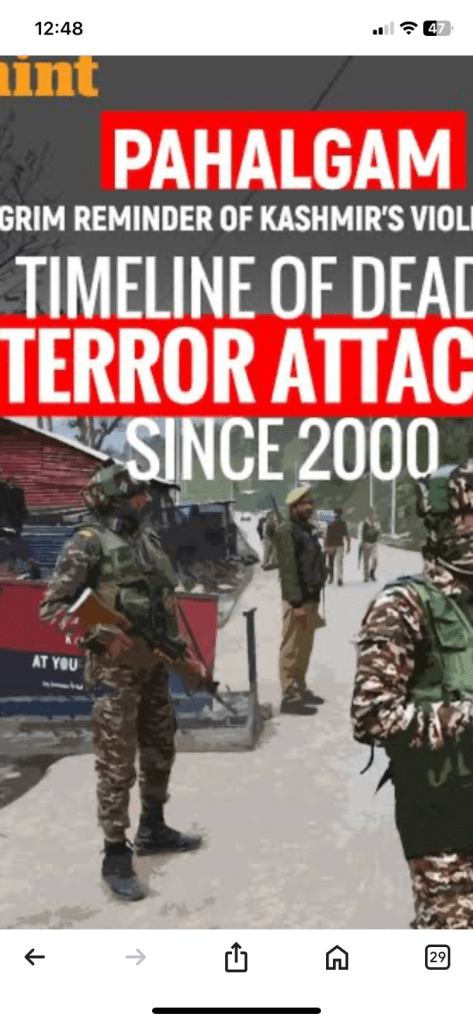
The history of terrorist attacks in Kashmir is long and complex, dating back to the aftermath of the 1947 partition of India and the subsequent conflict over the region. Here’s a breakdown of the key periods and some notable incidents:
1947 – Early 1980s: Initial Instability and Seeds of Insurgency
- The period following the first Indo-Pakistani War (1947-1948) saw simmering discontent and sporadic violence.
- The focus was more on political instability and the establishment of the Line of Control (LoC). However, the seeds of future separatist movements and armed struggle were being sown.
Late 1980s – 2004: The Rise of Militancy - This period witnessed a significant surge in militancy, fueled by various factors including political grievances, alleged rigging of elections, and the influence of the Afghan Mujahideen after the Soviet-Afghan War.
- Numerous militant groups emerged, some advocating for independence and others for accession to Pakistan.
- Key Events:
- 1989: The kidnapping of Rubaiya Sayeed, daughter of the then Home Minister of India Mufti Mohammad Sayeed, marked a significant turning point and the rise of militancy.
- 1990: The exodus of Kashmiri Hindus (Pandits) began, following targeted killings and threats by militant groups.
- Early to late 1990s: A series of massacres targeting civilians, including Kashmiri Pandits and other communities, occurred. Notable incidents include the Wandhama massacre (1998) and the Prankote massacre (1998).
- 1995: Kidnapping of Western tourists in Pahalgam by the Al-Faran group. One was beheaded, one escaped, and four others remain missing.
- 2000: The Amarnath pilgrimage massacre, where militants killed around 30 Hindu pilgrims.
- 2001: Suicide attack on the Jammu and Kashmir State Legislature Complex in Srinagar.
2004 – Present (April 2025): Shifting Dynamics and Continued Violence - While there have been periods of relative calm, militancy has persisted, often with a change in tactics and the emergence of new groups.
- Counter-insurgency operations by Indian security forces have intensified.
- Cross-border terrorism from Pakistan-based groups remains a significant concern for India.
- Key Events:
- 2008: Amarnath land transfer row led to widespread protests and violence.
- 2010: Large-scale protests and civilian casualties.
- 2016: The killing of Hizbul Mujahideen commander Burhan Wani triggered widespread unrest.
- 2019: The Pulwama attack, a suicide bombing on a CRPF convoy, led to heightened tensions with Pakistan.
- 2019: The revocation of Article 370 and the reorganization of Jammu and Kashmir into Union Territories led to further resentment and security challenges.
- June 2024: Terrorists ambushed a bus carrying Hindu pilgrims in the Reasi district, killing 9 people.
- April 22, 2025: A major terrorist attack in Pahalgam resulted in the killing of at least 26 tourists. The Resistance Front (TRF), believed to be an offshoot of Lashkar-e-Taiba, claimed responsibility. This attack has led to a diplomatic crisis between India and Pakistan, with India taking measures such as downgrading diplomatic ties and suspending a water-sharing treaty.
General Observations: - The nature of terrorist attacks has evolved over time, including targeted killings of civilians, attacks on security forces, and suicide bombings.
- Various militant groups, with different ideologies and affiliations, have been active in the region.
- The involvement of foreign militants, particularly from Pakistan, has been a persistent issue.
- Terrorist attacks have had a devastating impact on the local population, the economy (especially tourism), and the overall security situation in the region.
It is important to remember that each of these events represents a tragic loss of life and has had a profound impact on the people of Kashmir and the broader region. The fight against terrorism continues to be a major challenge for the Indian government.
Terrorist attacks are 😯 the most bad happenings in world 🌎 no body has right to kill innocent people and it should be countered by all global countries and work together we are moving towards interstellar species please make our earth 🌍 a beautiful planet 🌍 and maintain peace and harmony in our beautiful planet
Please like subscribe comment your precious comment on universe discoveries
Full article source google
https://www.amazon.in/b?_encoding=UTF8&tag=555101-21&link
This is Amazon link if you want to buy anything from Amazon you can click on link to help my website universe discoveries grow freinds
https://www.buymeacoffee.com/Satyam55
Please donate me a coffee to help grow my website universe discoveries freinds
 Universe discoveries
🙏🌹
Aum Shanti
LikeLike