
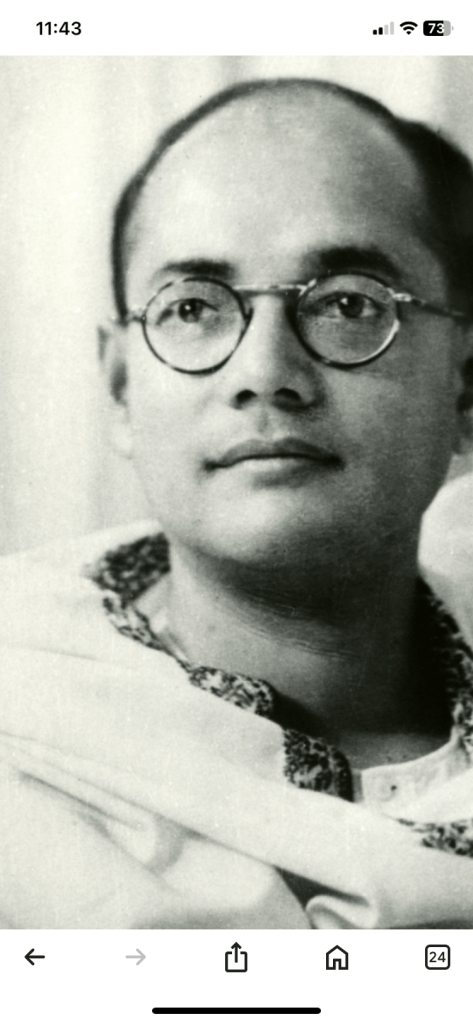
Subhas Chandra Bose (1897-1945?), popularly known as Netaji (“Respected Leader”), was a prominent Indian nationalist leader who played a crucial role in India’s struggle for independence. Here’s a look at his life and contributions:
Early Life and Education:
- Born on January 23, 1897, in Cuttack, Odisha, into a large and affluent Bengali family.
- Studied at Presidency College in Calcutta but was expelled for nationalist activities.
- Graduated from Scottish Church College in 1919.
- Passed the Indian Civil Service examination in England in 1920 but resigned to join the independence movement.
Indian National Congress: - Joined the Indian National Congress (INC) and worked closely with Mahatma Gandhi.
- Became the President of the All India Youth Congress and Secretary of the Bengal State Congress.
- Elected President of the INC in 1938 and again in 1939 but resigned due to ideological differences with Gandhi and other leaders.
- Advocated for a more assertive and militaristic approach to achieving independence.
Forward Bloc and Exile: - In 1939, he formed the All India Forward Bloc, a political party aimed at mobilizing radical elements within the Congress.
- In 1941, he escaped from British surveillance in Calcutta and traveled to Germany via Afghanistan and the Soviet Union.
Indian National Army (INA): - In Germany, he formed the Free India Legion with Indian prisoners of war.
- In 1943, he traveled to Southeast Asia and took over the leadership of the Indian National Army (INA), also known as Azad Hind Fauj.
- The INA comprised Indian prisoners of war and civilian volunteers from Southeast Asian countries.
- He established the Provisional Government of Free India (Azad Hind) in Singapore in 1943.
- The INA, allied with the Axis powers (Japan and Germany), fought against the British in Southeast Asia during World War II.
- Famous slogans associated with him include “Give me blood, and I will give you freedom!” and “Jai Hind!”
Disappearance and Legacy: - Subhas Chandra Bose reportedly died in a plane crash in Taiwan on August 18, 1945, but the circumstances surrounding his death remain a mystery and have been the subject of various theories and controversies.
- Despite the controversies surrounding his wartime alliances and his untimely disappearance, Subhas Chandra Bose is widely regarded as a hero and a powerful symbol of patriotism in India.
- His efforts to mobilize support for India’s independence on an international level and the formation of the INA significantly inspired the nationalist movement.
- His birth anniversary, January 23, is celebrated as Parakram Diwas (Day of Valour) in India.
Subhash was in Russia after 1945 and later as gumnami baba in India

There are persistent theories and claims regarding Subhas Chandra Bose’s whereabouts after his reported death in 1945, including the idea that he was in Russia and later lived in India as Gumnami Baba. However, it’s important to understand the complexities and lack of definitive evidence surrounding these claims:
Subhas Chandra Bose in Russia after 1945:
- The Claim: Some believe that Bose did not die in the alleged plane crash and instead escaped to the Soviet Union seeking refuge and support for India’s independence.
- Lack of Concrete Evidence: Despite numerous investigations and declassified documents, no conclusive evidence has emerged to definitively prove that Subhas Chandra Bose was in Russia after 1945.
- Russian Government Denial: The Russian government has consistently denied that Bose was ever in their territory after August 1945.
- Conflicting Accounts: While some individuals and reports have suggested Bose’s presence in Russia, these accounts often lack verifiable evidence and are contradicted by other findings.
Subhas Chandra Bose as Gumnami Baba: - The Claim: Another prominent theory is that Bose returned to India and lived in disguise as a reclusive ascetic known as Gumnami Baba (or Bhagwanji) in Uttar Pradesh until his death in 1985.
- Similarities and Circumstantial Evidence: Proponents of this theory point to similarities in handwriting, personal belongings found with Gumnami Baba, and accounts from individuals who claimed to have met him and recognized him as Bose.
- Official Rejection: Several inquiry commissions and court rulings have rejected the claim that Gumnami Baba was Subhas Chandra Bose, citing a lack of conclusive proof.
- DNA Evidence: A DNA test conducted on Gumnami Baba’s teeth did not match the DNA profile associated with Bose.
In Conclusion:
While the possibility of Subhas Chandra Bose surviving 1945 and potentially being in Russia or living as Gumnami Baba has captured the imagination of many, these remain unproven theories. There is no definitive evidence to support these claims, and official investigations have largely dismissed them. The officially accepted version, based on the available evidence at the time, is that he died in a plane crash in 1945. However, the mystery surrounding his disappearance continues to intrigue and fuel these alternative narratives.
Please like subscribe comment your precious comment on universe discoveries
Full article source google
https://www.amazon.in/b?_encoding=UTF8&tag=555101-21&link
This is Amazon link if you want to buy anything from Amazon you can click on link to help my website universe discoveries grow freinds
https://www.buymeacoffee.com/Satyam55
Please donate me a coffee to help grow my website universe discoveries freinds
 Universe discoveries
🙏🌹
Aum Shanti
LikeLike