
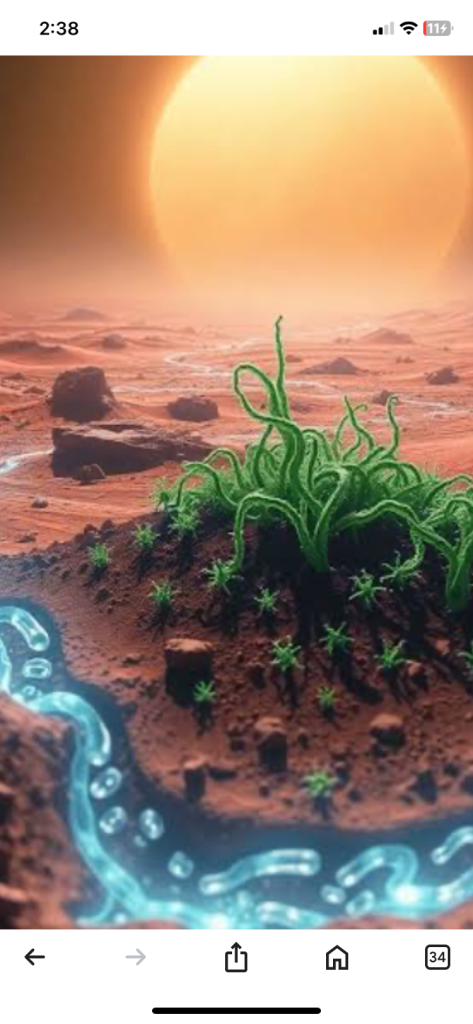
Terraforming Mars would be a monumental undertaking, requiring significant changes to its atmosphere, temperature, and surface conditions. Here’s what it would likely entail:
Key Requirements for Terraforming Mars
- Warming the Atmosphere and Increasing Pressure:
- Greenhouse Gases: Introducing greenhouse gases like carbon dioxide, methane, and CFCs into the atmosphere. This could be achieved by using large orbital mirrors to focus sunlight on the polar caps to release trapped CO2, or by building factories on Mars to produce these gases.
- Asteroid Impacts: Colliding ammonia-rich asteroids with Mars could also introduce greenhouse gases.
- Volcanic Activity: While speculative, triggering volcanic eruptions through nuclear explosions could release trapped gases and contribute to atmospheric thickening.
- Developing a Magnetosphere:
- Mars currently lacks a global magnetic field, which is crucial for protecting a planet’s atmosphere from solar wind and cosmic radiation. Without a protective magnetosphere, any introduced atmosphere would likely be stripped away over time. The science behind creating such a field is still highly speculative.
- Creating Oxygen and Enabling Liquid Water:
- Engineered Microbes: Introducing engineered microbes capable of photosynthesis could slowly convert carbon dioxide into oxygen, gradually building up the oxygen content of the atmosphere.
- Melting Ice: Warming the planet would melt the polar ice caps, leading to the formation of liquid water on the surface, which is essential for life as we know it.
- Transforming the Soil:
- The Martian regolith (soil) is currently nutrient-poor and contains toxic perchlorates. It would need to be treated and enriched to support plant life. This could involve introducing hardy microbes from Earth or genetically engineered organisms to break down perchlorates and add nutrients.
Challenges and Considerations - Timeframe: Initial stages of terraforming could span decades or centuries, with a complete transformation potentially taking several millennia.
- Technological Demands: Current technology is not sufficient for full-scale terraforming. The required infrastructure and energy are immense.
- Maintaining the Atmosphere: Even if an atmosphere were created, sustaining it without a natural magnetosphere presents a significant challenge.
- Resource Availability: The amount of accessible carbon dioxide and other necessary elements on Mars may be insufficient for a complete terraformation.
- Ethical Concerns: Some argue against terraforming, advocating for Mars to remain a pristine wilderness.
Despite the challenges, research into terraforming Mars offers valuable insights into planetary science and could lead to technologies beneficial for Earth, such as desiccation-resistant crops and improved ecosystem modeling.
mars into a second earth
What if we could turn Mars into a second Earth? A group of scientists is revisiting this audacious idea with new eyes, armed with decades of advancements in planetary science, biotechnology, and space engineering.
They explore whether it’s physically and biologically feasible to warm the Red Planet, enrich its atmosphere, and kick-start life-supporting systems — all with a practical eye on the cost, risk, and what needs to happen now
Terraforming Mars: Hype or Hope?
The idea of transforming Mars into a place where humans could one day live has captured both headlines and imaginations. But is this just science fiction, or could it actually happen? A new perspective paper in Nature Astronomy offers a serious look at what it would take to make Mars more Earth-like. The study, led by researchers from Pioneer Research Labs and the University of Chicago, outlines the first steps we would need to take if we hope to someday support life on the Red Planet.
Believe it or not, no one has really addressed whether it’s feasible to terraform Mars since 1991,” said Nina Lanza, a planetary scientist at Los Alamos National Laboratory and a co-author on the paper. “Yet since then, we’ve made great strides in Mars science, geoengineering, launch capabilities, and bioscience, which give us a chance to take a fresh look at terraforming research and ask ourselves what’s actually possible.”
Benefiting Earth Through Martian Innovation
The authors also note that this research could ultimately help maintain “oasis Earth.” They argue that technologies developed for Mars habitation, such as desiccation-resistant crops, efficiently remediating soil, and improved ecosystem modeling, will likely benefit our home planet.
Next Steps to the Final Frontier
Until that research is done, they write, “We don’t even know what’s physically or biologically possible. … If people can learn how to terraform a world such as Mars, this may be the first step to destinations beyond.
Elon musk proposal for terraforming mars

Elon Musk, through his company SpaceX, has been a prominent advocate for the colonization and eventual terraforming of Mars, driven by the belief that humanity needs to become a multi-planetary species to ensure its long-term survival. His proposals, while ambitious and often controversial, outline a vision for making Mars habitable.
Here are the key aspects of Elon Musk’s proposals for terraforming Mars:
- “Nuking Mars” Idea: This is perhaps Musk’s most well-known and often debated idea for quickly warming Mars. He has proposed detonating thermonuclear devices above the Martian poles. The theory behind this is that the heat generated would vaporize and release the significant amounts of frozen carbon dioxide (CO2) trapped in the polar ice caps. This released CO2, a potent greenhouse gas, would then thicken the atmosphere and initiate a runaway greenhouse effect, trapping more solar heat and raising the planet’s temperature. A thicker atmosphere could eventually allow for liquid water to exist on the surface. While scientifically plausible in terms of releasing CO2, the practicality, ethical implications, and the sheer scale of such an endeavor are widely questioned.
- Thickening the Atmosphere: Beyond the “nuking” concept, the core idea is to increase the atmospheric pressure and temperature. This is essential because Mars’ current thin atmosphere cannot support liquid water on its surface for long, nor can it provide significant protection from radiation. A thicker atmosphere, primarily composed of CO2, would also help to warm the planet through the greenhouse effect.
- Creating a Self-Sustaining Colony: Musk’s terraforming vision is intertwined with his goal of establishing a self-sustaining human colony on Mars. This involves:
- Resource Utilization (ISRU): Utilizing local Martian resources. For instance, extracting water ice from beneath the surface and using atmospheric CO2.
- Propellant Production: Producing methane and oxygen from Martian atmospheric nitrogen and carbon dioxide, and subsurface water ice, to fuel return journeys to Earth, making the Mars operation more self-sufficient.
- Habitat and Infrastructure: Developing technologies for building habitats on Mars, potentially using Martian regolith for construction.
- Enclosed Ecosystems: Early stages would likely involve “biodomes” or enclosed habitats with controlled ecosystems to grow food and produce oxygen. Plants would play a crucial role in oxygen production and carbon dioxide sequestration.
- Starship as the Key Enabler: Musk emphasizes the development of SpaceX’s Starship as the crucial transportation system for achieving his Mars ambitions. Starship is designed to be a fully reusable, super heavy-lift launch vehicle capable of transporting large amounts of cargo and hundreds of people to Mars, making the colonization and terraforming efforts economically feasible over time.
- Long-Term Vision: While the initial focus is on establishing a permanent human presence, the ultimate goal is to transform Mars to a point where humans could potentially live there without needing pressurized suits or enclosed habitats, eventually creating a breathable atmosphere.
Challenges and Criticisms of Musk’s Terraforming Proposals: - Insufficient CO2: Many scientists argue that even if all the frozen CO2 on Mars were released, it might not be enough to create a dense enough atmosphere or a strong enough greenhouse effect to sustain liquid water or significantly raise the temperature.
- Lack of Magnetosphere: Mars lacks a global magnetic field to protect its atmosphere from solar wind erosion. Without a protective magnetic field, any newly created atmosphere would likely be stripped away over time. This is a fundamental challenge that Musk’s proposals don’t fully address with current technology.
- Radiation: Even with a thicker atmosphere, the radiation levels on Mars would still be significant without a strong magnetic field, posing a health risk to colonists.
- Time and Cost: The scale and complexity of terraforming Mars are immense, implying a timeframe of centuries or millennia and a cost that is currently unimaginable.
- Ethical Considerations: Detonating nuclear devices on another planet raises significant ethical and legal questions regarding planetary protection and the alteration of celestial bodies.
While Musk’s vision is audacious, it has undeniably fueled public interest and investment in Mars exploration and long-term human spaceflight. Many of his proposals for colonization, particularly those involving resource utilization and advanced propulsion systems, are areas of active research and development within the space industry.
Please like subscribe comment your precious comment on universe discoveries
Full article source google
https://www.amazon.in/b?_encoding=UTF8&tag=555101-21&link
This is Amazon link if you want to buy anything from Amazon you can click on link to help my website universe discoveries grow freinds
https://www.buymeacoffee.com/Satyam55
Please donate me a coffee to help grow my website universe discoveries freinds
 Universe discoveries
🙏🌹
Aum Shanti
LikeLike
Very nice
LikeLike
Thanks ☺️ sir it’s very interesting 🎸
LikeLiked by 1 person