
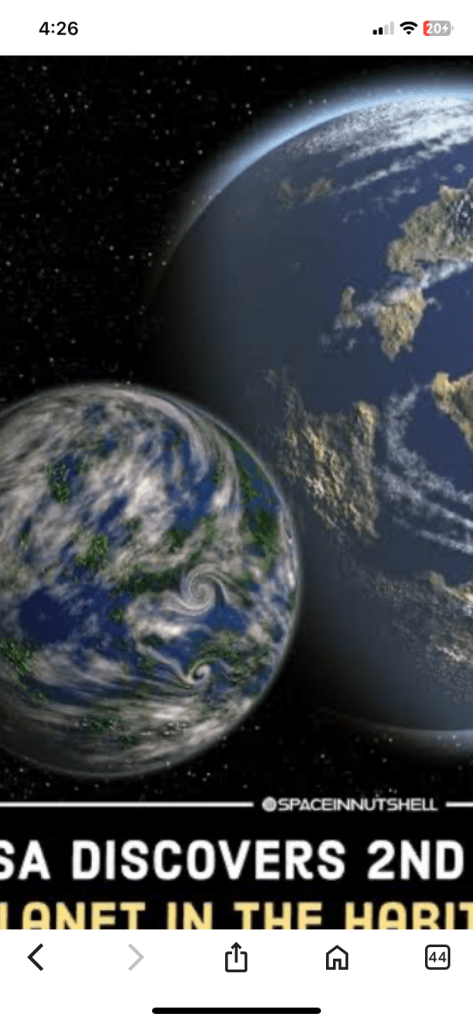
In August 2022, an international team of astronomers, with support from NASA’s Transiting Exoplanet Survey Satellite (TESS), announced the discovery of exoplanet TOI-1452 b, which is considered a strong candidate for an “ocean planet.”
Here’s what we know about TOI-1452 b:
- Discovery: It was initially detected by NASA’s TESS, which identifies exoplanets by observing slight dips in a star’s brightness as a planet passes in front of it. Further characterization was done using instruments like the SPIRou spectropolarimeter on the Canada-France-Hawaii Telescope.
- Location: It’s located about 100 light-years away from Earth in the Draco constellation. It orbits one of two small stars in a binary system.
- Size and Mass: TOI-1452 b is a “super-Earth,” meaning it’s larger and more massive than Earth but smaller than Neptune. It’s approximately 70% larger in diameter than Earth and about five times as massive.
- “Water World” Candidate: The planet’s radius, mass, and density suggest that a significant portion of its mass could be water – potentially as much as 30%. This is a much higher proportion than Earth, where water makes up less than 1% of the planet’s mass. This has led scientists to believe it could be an “ocean planet” entirely covered by a thick layer of liquid water.
- Habitable Zone: Despite its close orbit to its star (completing a “year” in just 11 Earth days), the star it orbits is a red dwarf, which is smaller and cooler than our Sun. This means TOI-1452 b receives a similar amount of light as Venus does from our Sun, placing it within the “habitable zone” where liquid water could exist on its surface.
- Future Observations: TOI-1452 b is a prime target for future observations with the James Webb Space Telescope (JWST). The JWST’s powerful capabilities will allow scientists to further investigate its atmosphere and confirm whether it is indeed a water world.
https://youtube.com/shorts/1eBgX5koZPg?si=TfgbWMWt3mc-PxaC
Click on the link to watch video
Can TOI-1452 b be habitable planet
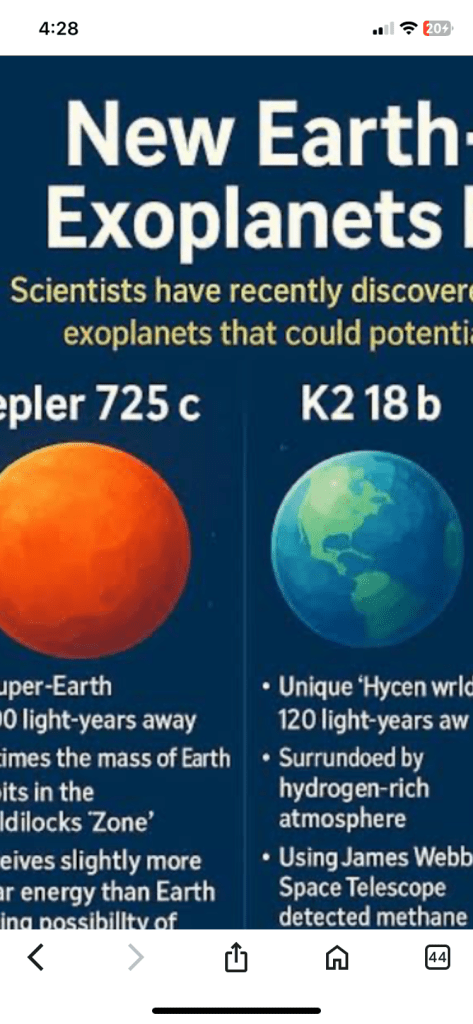
TOI-1452 b is certainly a very exciting candidate when it comes to planetary habitability, and there are several factors that make it a compelling subject for further study:
- Located in the Habitable Zone: The planet orbits a red dwarf star, which is cooler than our Sun. While TOI-1452 b’s orbit is much closer to its star than Earth’s to the Sun, this distance places it within the “habitable zone” of its star. This means that the temperatures on its surface could allow for liquid water to exist, which is a fundamental requirement for life as we know it.
- “Ocean Planet” Candidate: The planet’s estimated density suggests that a significant portion of its mass (potentially up to 30%) could be water. If this is confirmed, it could mean TOI-1452 b is an “ocean planet” entirely covered by a deep, global ocean. On Earth, life originated in the oceans, so the presence of vast amounts of liquid water is a strong indicator of potential habitability.
- Prime Target for JWST: Its relative proximity (about 100 light-years away) and the fact that it transits its star make it an excellent target for the James Webb Space Telescope (JWST). The JWST can analyze the planet’s atmosphere to look for biosignatures – chemical signs that could indicate the presence of life.
However, there are also challenges and unknowns regarding its habitability: - Tidally Locked: Planets orbiting red dwarf stars in their habitable zones are often tidally locked, meaning one side perpetually faces the star (eternal day) and the other side is in eternal night. This can lead to extreme temperature differences, potentially making it difficult for life to thrive across the entire planet. However, a thick atmosphere and ocean could help distribute heat.
- Stellar Activity: Red dwarf stars are known for being prone to powerful flares and bursts of radiation. These flares could potentially strip away a planet’s atmosphere over time, making it inhospitable. The long-term stability of TOI-1452 b’s atmosphere is an important factor.
- Composition and Internal Structure: While it’s thought to be a water world, the exact composition of its interior and the potential for geological activity (like plate tectonics or volcanism, which are important for nutrient cycling on Earth) are still unknown.
- Atmospheric Composition: Even if it has liquid water, the actual composition of its atmosphere (e.g., presence of greenhouse gases that could make it too hot, or protective gases like ozone) will be crucial for determining its true habitability.
In conclusion, TOI-1452 b is a truly fascinating world that checks many of the boxes for potential habitability. Its strong candidate status as an “ocean planet” in the habitable zone makes it one of the most promising exoplanets for further investigation in the search for life beyond Earth. However, only further observations, particularly with telescopes like the JWST, will allow scientists to determine if it truly harbors conditions suitable for life.
Please like subscribe comment your precious comment on universe discoveries
Full article source google
 Universe discoveries
🙏
Aum Shanti
LikeLike
This is nice read.
LikeLike