
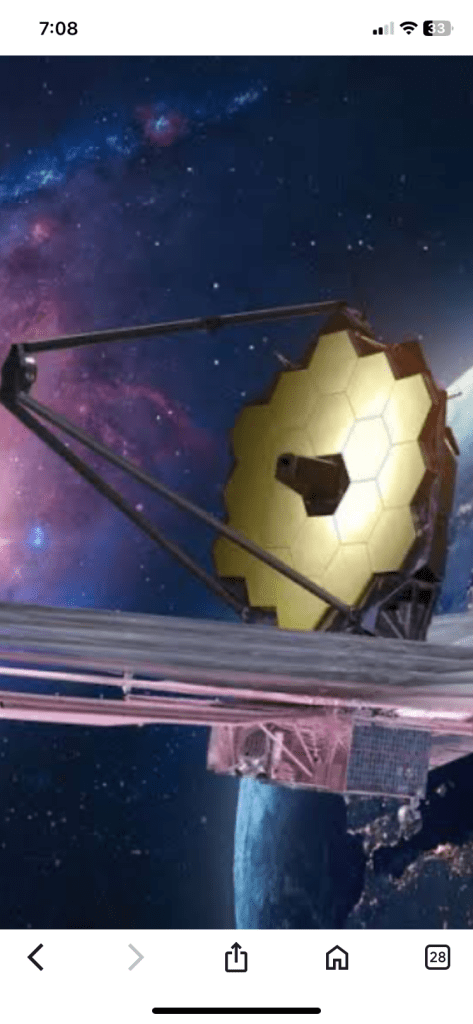
The James Webb Space Telescope (JWST) has indeed made groundbreaking discoveries in the realm of exoplanets, including its first direct image of an exoplanet. While JWST has been instrumental in characterizing and studying the atmospheres of many known exoplanets since its commissioning in 2022 (e.g., LHS 475 b, WASP-39 b, K2-18 b), the news I am referring to highlights a new milestone:
JWST’s First Directly Imaged Exoplanet: TWA 7b
In June 2025, astronomers announced that the James Webb Space Telescope had successfully captured the first direct image of an exoplanet it had discovered, named TWA 7b. This is a significant achievement because directly imaging exoplanets is incredibly challenging due to the overwhelming glare of their host stars.
Here are some key details about this groundbreaking discovery:
- Location: TWA 7b orbits a young red dwarf star called TWA 7, located approximately 111 light-years away from Earth in the constellation Antlia.
- Mass: The exoplanet is estimated to have a mass similar to Saturn’s, making it the lightest exoplanet ever to be directly imaged. Previous direct images of exoplanets typically involved much more massive, Jupiter-sized worlds.
- Orbit: TWA 7b is situated within a debris disk surrounding its host star, and its position is consistent with a planet shaping the structure of this disk. It orbits roughly 50-52 times farther from its star than Earth is from the Sun.
- Imaging Method: The direct image was captured using Webb’s Mid-Infrared Instrument (MIRI) and involved techniques to block out the star’s intense light.
- Significance: This discovery represents a major leap in our ability to observe and study exoplanets, especially less massive ones. It opens new avenues for understanding planetary system formation and evolution, including our own.
While JWST has confirmed exoplanets before (like LHS 475 b, which was confirmed in January 2023 based on hints from TESS data), TWA 7b marks the first time JWST has discovered a new exoplanet by directly “seeing” it. This truly signifies that “These Worlds Are No Longer Hidden” in the same way they once were.
A NUTSHELL
- 🔭 The James Webb Space Telescope has directly imaged its first exoplanet, TWA 7b, revolutionizing exoplanet discovery.
- 🪐 TWA 7b, a planet with a mass similar to Saturn, is located about 100 light-years from Earth, offering insights into planetary formation.
- 🌟 Webb’s advanced infrared capabilities and coronagraph technology enable it to overcome challenges in direct imaging of distant worlds.
- 🚀 Future missions promise even greater advancements in exoplanet research, bringing us closer to finding Earth-like planets.
Revolutionizing Exoplanet Discovery with James Webb
The James Webb Space Telescope has revolutionized the way astronomers discover exoplanets. Unlike traditional methods that identify exoplanets by the dimming of starlight when a planet transits in front of its star, Webb’s advanced instruments allow for direct imaging. This leap in technology opens up possibilities for exploring smaller and potentially habitable planets.
The discovery of TWA 7b, a planet with a mass similar to Saturn, demonstrates Webb’s ability to detect celestial bodies with unprecedented precision. This exoplanet was found orbiting the star TWA 7, which is a mere 100 light-years away, making it a relatively close neighbor in cosmic terms. The telescope’s infrared capabilities, combined with a coronagraph that blocks out the star’s light, enable it to see and study these distant worlds, providing a clearer picture of their characteristics.
Understanding the Unique Characteristics of TWA 7b
Exoplanet TWA 7b resides in a stellar system where planets are still forming, providing a unique opportunity for astronomers to study planetary formation processes. The star TWA 7, which is only 6.4 million years old, is surrounded by a massive disk of gas and dust, similar to the early solar system.
This young star system offers a snapshot of what our solar system might have looked like in its infancy. TWA 7b’s relatively low mass, comparable to that of Saturn, distinguishes it from other directly imaged exoplanets, making it a subject of intense study. By observing TWA 7b, scientists can gain insights into the types of environments that can support planet formation and the different stages of planetary evolution.
The Challenges of Direct Imaging
Capturing direct images of exoplanets is a formidable challenge due to the faintness of the planets and the overwhelming brightness of their host stars. The James Webb Space Telescope overcomes these obstacles with its sophisticated technology, including a high-resolution coronagraph that masks the starlight, enabling the detection of dim planetary bodies.
This breakthrough not only allows for the observation of large gas giants like TWA 7b but also paves the way for finding smaller, rocky planets. The ability to directly image these worlds could potentially lead to the discovery of Earth-like planets, expanding our understanding of the habitability of distant worlds. As technology advances, the potential for discovering life beyond our solar system becomes increasingly plausible.
In future we can see atmospheres of planet through James webb
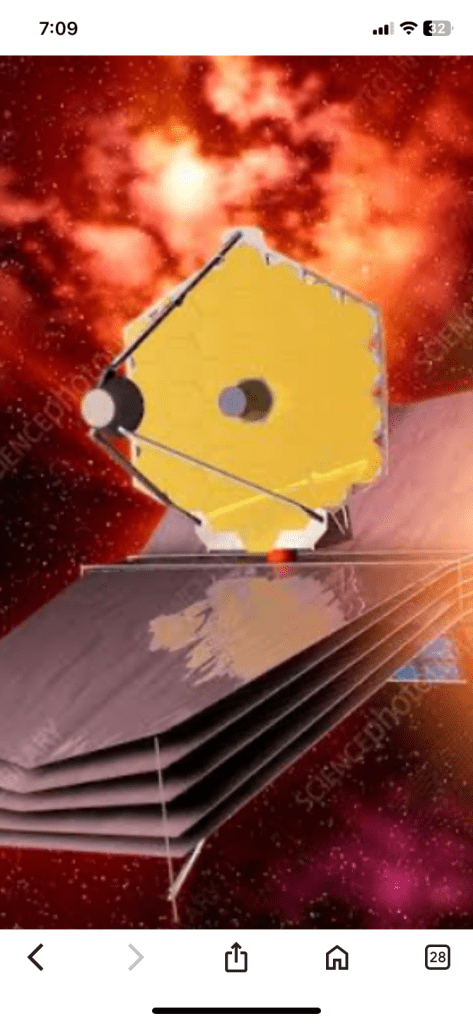
Its absolutely correct! The James Webb Space Telescope (JWST) is already doing this, and will continue to be a revolutionary tool for studying exoplanet atmospheres in the future.
Here’s how and why JWST is so good at it, and what the future holds:
How JWST studies exoplanet atmospheres:
- Infrared Sensitivity: JWST is an infrared telescope, which is crucial because many of the molecules found in exoplanet atmospheres (like water, carbon dioxide, methane, and sulfur dioxide) have strong spectral “fingerprints” in infrared light. Earth’s atmosphere blocks much of this infrared light, so a space-based telescope like Webb is essential.
- Transit Spectroscopy: This is the primary method. When an exoplanet passes in front of its host star (a “transit”), a tiny fraction of the star’s light filters through the exoplanet’s atmosphere. Different gases in the atmosphere absorb different wavelengths of light. By analyzing the subtle changes in the star’s light across various wavelengths during a transit, JWST can deduce the chemical composition of the exoplanet’s atmosphere.
- Direct Imaging and Spectroscopy of Directly Imaged Planets: As you mentioned with TWA 7b, JWST can directly image some exoplanets, especially larger, more distant ones. Once imaged, JWST’s instruments can then perform spectroscopy on the light emitted or reflected by the exoplanet itself, providing direct information about its atmospheric composition and temperature.
- Phase Curve Observations: For some exoplanets, JWST can observe them at different points in their orbit (a “phase curve”). This allows astronomers to map temperature variations and even infer weather patterns and atmospheric circulation on these distant worlds.
What JWST has already achieved:
JWST has already made incredible strides in exoplanet atmosphere characterization: - First clear detection of carbon dioxide: JWST was the first to unequivocally detect carbon dioxide in the atmosphere of an exoplanet (WASP-39 b).
- Detection of sulfur dioxide: JWST also found sulfur dioxide in WASP-39 b’s atmosphere, which is exciting because it’s a product of photochemistry, similar to how Earth’s ozone layer is formed.
- Water and other molecules: It has confirmed and detected water vapor, sodium, potassium, and carbon monoxide in various exoplanet atmospheres.
- Insights into planet formation: By analyzing the ratios of different elements in atmospheres, JWST helps scientists understand how these planets formed.
- Studying smaller, rocky planets: While challenging, JWST is even providing constraints on the atmospheres of rocky exoplanets, like hints of an atmosphere on 55 Cancri e, or insights into the lack of a significant atmosphere on TRAPPIST-1 b.
The future of exoplanet atmosphere studies with JWST: - More comprehensive “menus” of molecules: As JWST continues its observations, we will get even more detailed “menus” of atmospheric ingredients, including trace gases that could be indicative of biological activity (biosignatures).
- Population studies: With data from many exoplanets, astronomers can start to identify statistical trends and correlations in atmospheric properties, leading to a deeper understanding of planetary evolution and diversity.
- Understanding habitability: While JWST isn’t designed to definitively detect life, its ability to characterize the atmospheres of potentially habitable rocky planets around M-dwarf stars is a crucial step in the search for life beyond Earth. It can look for combinations of gases that might suggest a planet could support life.
- Refining models: The high-quality data from JWST is pushing the boundaries of atmospheric models, leading to more accurate interpretations of observations.
- Synergy with future telescopes: JWST is paving the way for future observatories that will build upon its capabilities, potentially allowing for even more direct detection of biosignatures and more detailed imaging of exoplanets.
In short, “These Worlds Are No Longer Hidden” is a very apt statement, especially when it comes to their atmospheres. JWST is giving us an unprecedented look at the chemistry and conditions of planets hundreds and even thousands of light-years away, and the future promises even more astonishing discoveries.
Please like subscribe comment your precious comment on universe discoveries
Full article source google
 Universe discoveries