
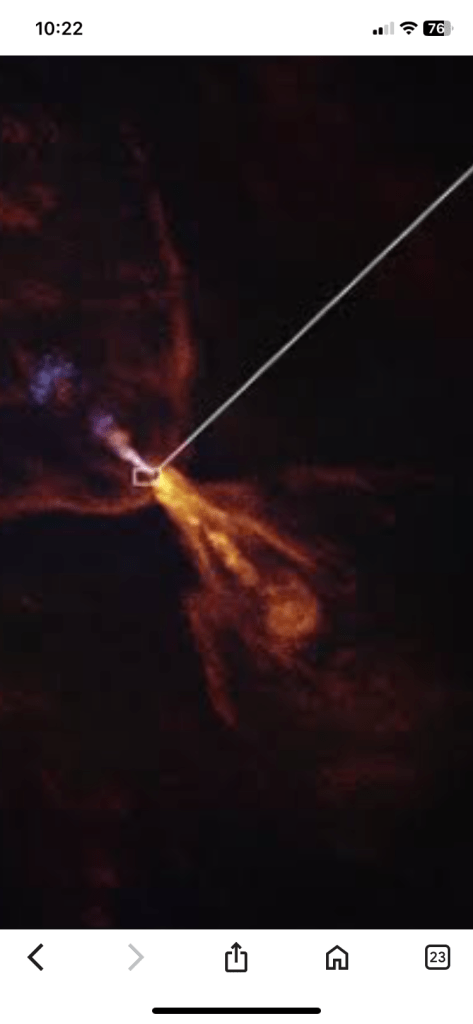
Astronomers have recently announced a groundbreaking discovery: they have witnessed the birth of a planetary system for the first time. This unprecedented observation offers a direct glimpse into the very earliest stages of planet formation, similar to how our own solar system came into being 4.6 billion years ago.
The focus of this discovery is a young, Sun-like star named HOPS-315, located approximately 1,300 light-years away. Using a combination of the James Webb Space Telescope (JWST) and the Atacama Large Millimeter/submillimeter Array (ALMA), an international team of researchers detected the moment when specks of material, destined to become planets, began to form around this infant star.
Specifically, the astronomers found traces of hot minerals condensing in the protoplanetary disk swirling around HOPS-315. They detected silicon monoxide (SiO), both as a gas and in crystalline materials. This indicates that the solidification process, a crucial first step in planet formation, has just begun around HOPS-315.
While astronomers have previously observed protoplanetary disks and even young, massive planets within them, this is the first time they have pinpointed the precise moment when the solid building blocks of planets begin to form. This breakthrough provides invaluable insights into the universal processes of planet formation and can help scientists understand whether Earth-like planets are common throughout the universe.
What is the significance of studying planetary system and watching it new born
Studying planetary systems, especially observing them in their nascent stages, holds immense significance for several profound reasons:
- Understanding Our Origins:
- The Birth of Our Solar System: By watching new planetary systems form, we gain a direct “baby picture” of what our own solar system might have looked like 4.6 billion years ago. This helps us piece together the puzzle of how the Earth, other planets, and even the Sun itself came to be.
- Fundamental Processes: Observing the condensation of minerals and the initial clumping of matter (like the silicon monoxide observed around HOPS-315) reveals the universal physical and chemical processes that govern planet formation. This is akin to watching a building being constructed from its very first brick.
- Deciphering Planetary Diversity:
- Beyond Our Backyard: We’ve discovered thousands of exoplanetary systems, and many of them look drastically different from our own. Observing systems in their early stages helps us understand why there’s such a vast diversity in planetary architectures (e.g., why some systems have “hot Jupiters” close to their stars, or super-Earths not found in our solar system).
- Testing Theories: There are numerous theoretical models for planet formation. Direct observation of newborn systems allows astronomers to test these theories, refine them, and develop a more accurate understanding of how planets evolve from a protoplanetary disk.
- The Search for Life Beyond Earth:
- Conditions for Habitability: Understanding how planets form, and the conditions present in young planetary systems, is crucial for identifying which types of planets might be habitable. The presence of water, organic molecules, and suitable temperatures all depend on the planet formation process.
- Frequency of Earth-like Planets: If we can understand the common pathways of planet formation, we can better estimate how frequently Earth-like planets (and thus potentially life) might arise in the universe. This directly addresses one of humanity’s most fundamental questions: “Are we alone?”
- Insights into Planetary Evolution:
- From Dust to Worlds: The process of tiny dust grains coalescing into planetesimals, and then into full-fledged planets, is incredibly complex. Observing this in action provides real-time data on how matter survives and evolves in these early, dynamic environments.
- Atmospheric Development: The composition of the protoplanetary disk directly influences the initial atmospheres of forming planets. Studying these early stages can offer clues about how planetary atmospheres develop and change over billions of years.
- Technological Advancement:
- Pushing Observational Limits: Witnessing these faint, distant events requires cutting-edge telescopic technology like the James Webb Space Telescope and ALMA. These discoveries push the boundaries of what’s possible in astronomical observation, leading to further technological innovation.
In essence, studying newborn planetary systems is like getting to see the blueprint and construction of countless unique homes. Each one tells us a little more about the architectural possibilities, the materials used, and ultimately, helps us understand the design and potential of our own cosmic dwelling.
Please like subscribe comment your precious comments on universe discoveries
Full article source google
 Universe discoveries
Very interesting read.
LikeLike
🙏🌹
Aum Shanti
LikeLike