
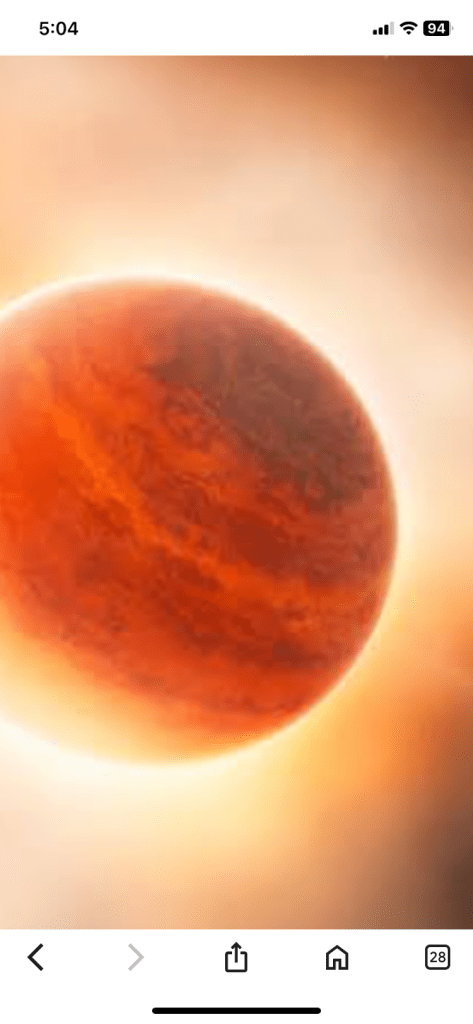
Recent observations by the James Webb Space Telescope (JWST) have challenged our understanding of how planetary systems form. Traditionally, it was believed that planets primarily form around a central star, like our own Solar System. However, new research suggests that giant, free-floating exoplanets, sometimes referred to as “rogue planets,” may be capable of forming their own “planetary friends” without a parent star.
This groundbreaking discovery, based on JWST’s examination of young, isolated objects with masses between five and ten times that of Jupiter, indicates that the building blocks for forming planets can be found even around these lonely, starless worlds. Six of the observed free-floating planets exhibited extended infrared emission from warm dust immediately surrounding them. This excess radiation is a signature of circumplanetary disks, which are flattened rings of dust and gas known to be nurseries for planet formation around stars. The detection of silicate grain emission within these disks further supports this idea.
This implies that planetary formation is not exclusive to stars, and that miniature planetary systems, scaled down significantly in mass and size, could exist around these giant rogue planets. This challenges long-held beliefs and opens up new avenues for understanding the diversity of planetary systems in our galaxy.
While the exact mechanisms for the formation of these rogue planetary systems are still being investigated, this finding from the James Webb Space Telescope provides compelling evidence for a more varied and complex universe than previously imagined. Future observations will aim to detect such systems directly and further unravel the mysteries of planet formation in the absence of a central star.
The right stuff to spot planetary rogues
Believed to be the lowest mass bodies that can form from isolated clouds of gas and dust, free-floating planets are difficult to spot and study due to the fact that they emit very little light of their own. But the electromagnetic radiation free-floating planets do emit is mostly infrared light, the wavelength of light that the JWST is sensitive to.
As such, the study team honed in on eight young, free-floating planets with the powerful infrared space telescope.
The observations conducted between August and October of 2024 revealed detailed characteristics of the bodies, indicating that they have masses around that of Jupiter. Six of the free-floating planets exhibited an extended infrared emission generated by warm dust immediately around them. That indicated surrounding disks of gas and dust, the kind of structures that gather around infant stars to spawn planets
Even more exciting than this was the detection of grains of silicates in these disks. That is an early indication of dust collecting together and crystallizing — and that, in turn, is the first stage in the formation of “rocky,” or terrestrial, planets like Earth.
Traces of silicates have been seen around stars and even brown dwarfs before, but this is the first time these fingerprints have been found around much smaller free-floating planets. The team’s finding backs prior research, which suggested that protoplanetary disks forming around free-floating planets could survive for several million years.
That is a period of time long enough to allow planets to form.
“Taken together, these studies show that objects with masses comparable to those of giant planets have the potential to form their own miniature planetary systems,” team leader and University of St. Andrews astronomer Aleks Scholz said. “Those systems could be like the solar system, just scaled down by a factor of 100 or more in mass and size.”
With the plausibility of these starless mini-planetary systems established and early fingerprints of their formation detected, the next step for astronomers will be to detect such a system
How is the starless solar system

The concept of a “starless solar system” has become a fascinating new frontier in astrophysics, thanks in large part to recent observations by the James Webb Space Telescope (JWST). While the term “solar system” traditionally implies a central star, the discovery of circumplanetary disks around giant, free-floating exoplanets suggests that these rogue worlds can indeed host their own miniature planetary systems.
Here’s how we understand these “starless solar systems” and their formation:
- What are these “parent planets”?
- These are giant, free-floating exoplanets (also called rogue planets, orphan planets, or nomad planets). They are planetary-mass objects that do not orbit a star.
- They typically have masses comparable to or slightly larger than Jupiter (around 5-10 times Jupiter’s mass in the recent JWST discoveries).
- Unlike stars, they lack sufficient mass to ignite nuclear fusion in their cores. They are more massive than typical planets but less massive than brown dwarfs (often called “failed stars”).
- How do they form?
There are two primary theories for the origin of these free-floating objects:
- Ejection from existing star systems: Many rogue planets are thought to have formed within a conventional star-planet system but were later gravitationally ejected during chaotic early stages of system evolution, often due to close encounters with other massive planets or the central star.
- Direct collapse from gas clouds: Some evidence suggests that some free-floating planetary-mass objects, particularly the more massive ones, may form directly from the gravitational collapse of small, isolated gas clouds, similar to how stars form, but without accreting enough mass to become a star. This is akin to a very low-mass version of star formation. The JWST findings lend support to this theory for the observed objects.
- The “starless solar system” aspect: Circumplanetary Disks
The key to these “starless solar systems” is the presence of circumplanetary disks around these rogue planets.
- What are they? These are flattened, torus-shaped accumulations of gas, dust, and other material that orbit around a forming or young planet. They are essentially miniature versions of the protoplanetary disks that form around young stars.
- How they form around rogue planets: If a free-floating giant planet forms directly from a collapsing gas cloud, or perhaps even retains some material after being ejected, it can gather enough surrounding gas and dust to form its own circumplanetary disk.
- Evidence from JWST: The JWST detected excess infrared emission from warm dust around six of the observed free-floating planets. This infrared signature is characteristic of circumplanetary disks. Furthermore, the detection of silicate grains within these disks, showing signs of growth and crystallization, is a strong indicator of the initial steps of rocky planet (or moon) formation.
- What kind of “friends” can they make?
- Within these circumplanetary disks, moons or even smaller planets (exomoons or subsatellites) can form.
- These “starless solar systems” would be significantly scaled down in mass and size compared to a star-centric system like our own, perhaps by a factor of 100 or more.
- The properties of these disks (like their mass and temperature) would determine the nature of the moons or planets that could eventually coalesce from them.
- Significance of the discovery:
- Challenges traditional views: This finding fundamentally challenges the long-held belief that a central star is a prerequisite for planetary formation. It suggests that planet formation is a more universal process than previously thought.
- New avenues for research: It opens up new possibilities for understanding the diversity of planetary systems and the conditions under which planets can form.
- Implications for habitability: While unlikely to harbor life as we know it without a star for energy, the presence of moons with their own internal heat sources or tidal heating could potentially create environments for liquid water, making them intriguing targets for future study regarding the conditions for life.
In essence, a “starless solar system” refers to a giant rogue planet that, by virtue of its formation process or retained material, has its own disk of gas and dust from which smaller celestial bodies (likely moons or very small planets) can form, orbiting the rogue planet itself rather than a star. This is a truly exciting and relatively new concept in our understanding of the cosmos.
Please like subscribe comment your precious comment on universe discoveries
Full article source google
 Universe discoveries
Very nice
LikeLiked by 1 person
Thanks sir 🙏
LikeLike
🙏🌹
Aum Shanti
LikeLiked by 2 people