
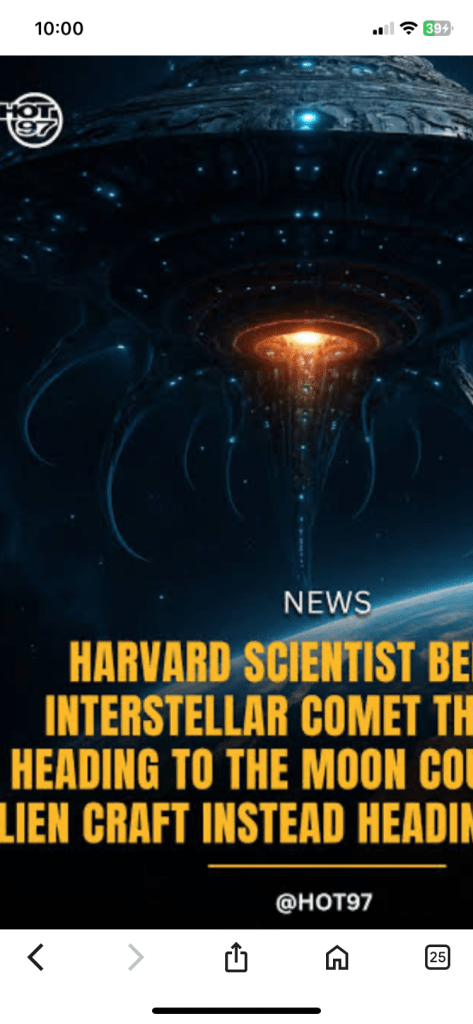
Dr. Avi Loeb, a Harvard theoretical physicist, has proposed that a newly discovered interstellar object, designated 3I/ATLAS, could be an alien probe. This follows a similar and controversial hypothesis he put forward about the first-ever interstellar object detected, ‘Oumuamua, in 2017.
Here’s a breakdown of his arguments and the broader scientific context:
- The Object: 3I/ATLAS is the third interstellar object known to have entered our solar system. It was discovered on July 1, 2025, and is moving at a very high speed on a hyperbolic trajectory, meaning it will not remain in orbit around the sun.
- Loeb’s Hypothesis: Loeb suggests that the object’s unusual trajectory, speed, and lack of typical cometary features could indicate that it is not a natural celestial body but rather a piece of “alien technology.” He speculates that its path might be “optimized for reconnaissance” and that its alignment with Venus, Mars, and Jupiter is a statistically improbable coincidence.
- Scientific Debate: This suggestion has been met with skepticism by many in the scientific community. Planetary astronomers, for example, have offered more conventional explanations, such as the object behaving like a comet, and have called Loeb’s claims “irresponsible.”
- ‘Oumuamua and the Precedent: Loeb’s theory about 3I/ATLAS is not his first. In 2017, when the interstellar object ‘Oumuamua was discovered, he also proposed that its highly unusual shape and non-gravitational acceleration could be explained by it being a “lightsail” from an alien civilization. While the mainstream scientific consensus is that ‘Oumuamua was a natural object, likely a comet composed of exotic ice, Loeb has continued to advocate for his hypothesis and even launched the Galileo Project to search for technosignatures from such objects.
In essence, Dr. Loeb’s claims are an outlier in the scientific community, but they have sparked considerable public discussion and highlight the ongoing search for extraterrestrial life. Most astronomers believe the interstellar objects are natural phenomena, but Loeb argues that a more open-minded approach is necessary to consider all possibilities, even the most extraordinary ones.
The point of view
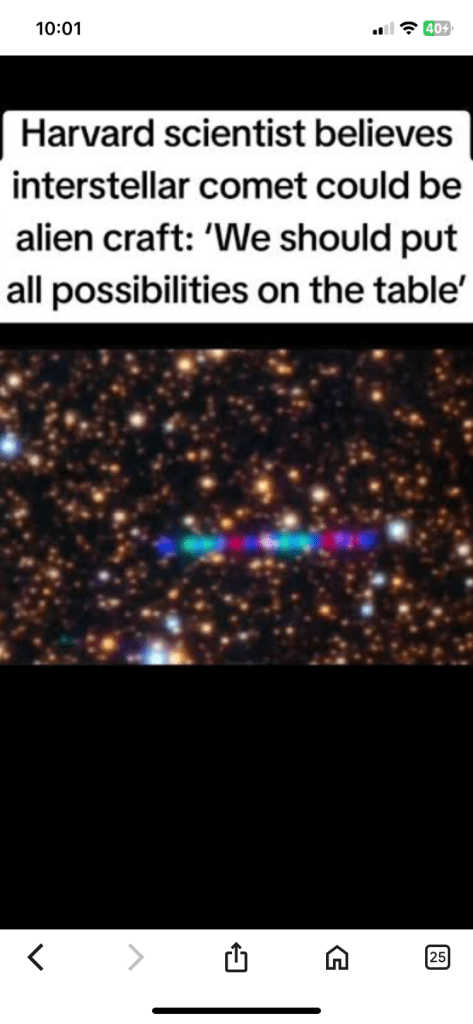
Scientists are watching a newly discovered object in space, and most of them agree it’s a comet, but not all of them. A Harvard scientist, who believes he’s seen proof of alien lifebefore, suspects this object may instead have alien origins.
Professor Avi Loeb said there are clear signs that the comet known as “3I/ATLAS” could be an alien craft.
“We should put all possibilities on the table that it’s a rock, a comet, or something else until we get the evidence, the data that will tell us what it is,” Loeb said in an interviewwith WBZ-TV.
Professor Loeb and his team say the interstellar object is on an extremely unusual course for a comet, one that will take it close Venus, Mars and Jupiter.
Loeb said the object appears to be “intelligently” directed and if it is alien, the world should prepare
Blind date from a visitor”
“I think that when we have a blind date from a visitor from another star, all bets are off,” said Loeb. “We shouldn’t assume anything, and we should assess the risk given the data that we have.”
Loeb said the risk should be assessed using something like the Richter scale for earthquakes.
“Zero would be a natural object like a comet,” Loeb said. “Ten would be an object that maneuvers as if it has an engine that is definitely technological, and then there should be some policymakers deciding how to respond to that.”
Professor Loeb says the object will pass closest to the sun on October 29.
Professor on aliens
“We see a lot of houses on the cosmic street that look just like ours, analogs of the Earth’s sun system,” Loeb said. “And I think it’s very arrogant of us to assume that they don’t have residents.”
Please like subscribe comment your precious comments on universe discoveries
Full article source google
https://youtu.be/4GjwRpclUN8?si=EQl0aXkHR9EytF1S
Click on the link to watch the video on interstellar object
 Universe discoveries
🙏🌹
Aum Shanti
LikeLiked by 1 person
Very interesting information.
LikeLiked by 1 person