
Remembering Father Of Indian Space: How Vikram Sarabhai Built Indian Space Research Organisation From Scratch

Dr. Vikram Sarabhai, often hailed as the “Father of the Indian Space Program,” was a visionary physicist and institution builder who laid the foundation for the Indian Space Research Organisation (ISRO). His relentless efforts and forward-thinking approach transformed India’s space ambitions from a nascent idea into a world-renowned program.
Here’s a look at how Vikram Sarabhai built ISRO from scratch:
- A Vision for a Developing Nation:
- Sarabhai believed that space technology was not a luxury for a developing nation but a necessity. He envisioned its use for solving real-world problems in areas like communication, education, and resource management.
- He famously stated, “There are some who question the relevance of space activities in a developing nation. To us, there is no ambiguity of purpose. We are convinced that if we are to play a meaningful role nationally, and in the community of nations, we must be second to none in the application of advanced technologies to the real problems of man and society.”
- The Genesis: INCOSPAR and TERLS:
- In 1962, he convinced the Indian government of the importance of a space program, leading to the formation of the Indian National Committee for Space Research (INCOSPAR) under the Department of Atomic Energy.
- Sarabhai, with the support of Homi J. Bhabha, chose Thumba, a small fishing village near Thiruvananthapuram, Kerala, as the site for the country’s first rocket launch station. This location was ideal due to its proximity to the geomagnetic equator.
- The Thumba Equatorial Rocket Launching Station (TERLS), established in a former church and a bishop’s house, became the humble birthplace of India’s space program. In 1963, India launched its first sounding rocket from this site, a modest start that marked the country’s entry into the space age.
- The Birth of ISRO:
- Under Sarabhai’s leadership, INCOSPAR expanded its activities and was reconstituted into the Indian Space Research Organisation (ISRO) on August 15, 1969.
- Sarabhai became ISRO’s first chairman and continued to guide the organization with his vision of self-reliance and technological advancement.
- Key Contributions and Institutions:
- Physical Research Laboratory (PRL): Even before ISRO, Sarabhai’s passion for scientific research led him to establish the PRL in Ahmedabad in 1947. This laboratory became the cradle of space science in India.
- Satellite Instructional Television Experiment (SITE): He initiated a dialogue with NASA in 1966, which led to the Satellite Instructional Television Experiment (SITE) in 1975-76. This experiment used satellite technology to broadcast educational programs to remote villages, demonstrating the potential of space technology for social development.
- First Indian Satellite, Aryabhata: Sarabhai started the project to build and launch an Indian satellite. Though he passed away before its completion, the first Indian satellite, Aryabhata, was launched in 1975 from a Russian launchpad, a testament to his foresight.
- Institution Building: Sarabhai was not just a scientist but also a great institution builder. Beyond ISRO and PRL, he was instrumental in establishing institutions like the Indian Institute of Management (IIM) Ahmedabad and the Vikram A Sarabhai Community Science Centre.
Sarabhai’s legacy lives on in ISRO’s successful missions and its continued commitment to using space technology for the benefit of humankind. The Vikram Sarabhai Space Centre (VSSC) in Thiruvananthapuram, a premier ISRO research and development center, is named in his honor.
On August 12
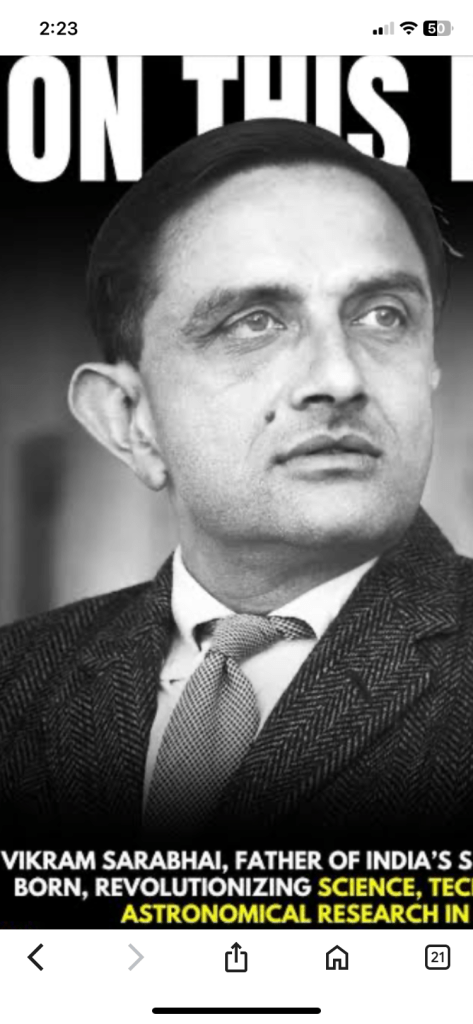
On August 12, the nation remembered and celebrated the 106th birth anniversary of Dr Vikram Sarabhai, the legendary physicist, and widely known as Father of India’s Space Programme. From pioneering cosmic ray research to laying the foundations of Indian Space Research Organisation (ISRO), his contributions continue to inspire India’s journey of space and technology.
The ISRO paid tributes to Dr Sarabhai and shared video on Social media platform X, celebrating his legacy.
“On his 106th birth anniversary, we celebrate Dr. Vikram Sarabhai, the visionary who ignited India’s space journey. His belief in applying space science for societal benefit continues to shape the nation’s space programme. As we approach National Space Day, his legacy endures,” ISRO wrote on X.
Speaker of the 18th Lok Sabha Om Birla in a post on X said, “Respectful salutations on the birth anniversary of Dr. Vikram Sarabhai, the pioneer of Indian space programme, great scientist, Padma Vibhushan awardee. With the establishment of the Physical Research Laboratory, he made the country self-reliant in space technology through the establishment of ISRO. Due to his inspiration, today India is touching new heights in space.”
Calling Dr Sarabhai “a true nation builder,” Dr. S Somanath, former ISRO Chairman said, “Remembering the 106th birth anniversary of Dr. Vikram Sarabhai – the visionary who built institutions in space, atomic energy, management, textiles & arts. A true nation builder whose contributions continue to inspire us. Though I never met him, his legacy shaped our journey at Vikram Sarabhai Space Centre since the 80s.”
Maharashtra Chief Minister Devendra Fadnavis wrote on X, “Remembering the legendary scientist and founder of ISRO, Padma Vibhushan Dr. Vikram Sarabhai, on his Birth Anniversary! His vision launched India into the orbit of global space research.”
Dr. Vikram Sarabhai is remembered not just for his title as the “Father of India’s Space Programme,” but for being a driving force behind India’s scientific awakening post-independence. In 1947, at just 28 years old, he founded the Physical Research Laboratory (PRL) in Ahmedabad.
Sarabhai played a significant role in establishing major Indian institutions, including the ISRO in 1969 and the Indian Institute of Management Ahmedabad (IIMA), in collaboration with local industrialists. He also chaired the Atomic Energy Commission, succeeding his mentor, Dr. Homi Bhabha.
Birth Of India’s Space Dream
After the launch of the Soviet Sputnik in 1957, Sarabhai advocated for a dedicated Indian space programme. He stated, “There are some who question the relevance of space activities in a developing nation. To us, there is no ambiguity of purpose. We do not have the fantasy of competing with the economically advanced nations in the exploration of the moon or the planets or manned space-flight. But we are convinced that if we are to play a meaningful role nationally, and in the community of nations, we must be second to none in the application of advanced technologies to the real problems of man and society.”
ISRO: From Vision To Reality
Sarabhai’s chairmanship of the Indian National Committee for Space Research (INCOSPAR) in 1962 marked a new era. By 1969, INCOSPAR evolved into ISRO, India’s premier space agency. Sarabhai’s groundwork laid the path for India’s later achievements: Indian National Satellite System (INSAT) Series in 1983, Chandrayaan-1 in 2008, Mars Orbiter Mission (MOM) in 2014, Chandrayaan-3, and beyond.
Please like subscribe comment your precious thoughts on universe discoveries
Full article source google
https://www.buymeacoffee.com/Satyam55
https://www.amazon.in/b?_encoding=UTF8&tag=555101-21&link
https://youtube.com/shorts/0zaLt5eKl3E?si=jfdK1NEdSlV3XXca
Click on the above link to see sarabhai video
 Universe discoveries
🙏🌹
Aum Shanti
LikeLiked by 1 person
This is an inspiring and well-researched tribute that beautifully captures the genius, vision, and humanity of Dr. Vikram Sarabhai. You’ve not only highlighted his pioneering role in building ISRO from scratch but also conveyed how deeply he connected space technology with the real needs of a developing nation. The narrative flows seamlessly from his early initiatives to his lasting legacy, giving readers a sense of both his monumental achievements and his enduring influence. It’s a fitting homage to a leader whose dreams continue to shape India’s place in the global space community.
LikeLike