
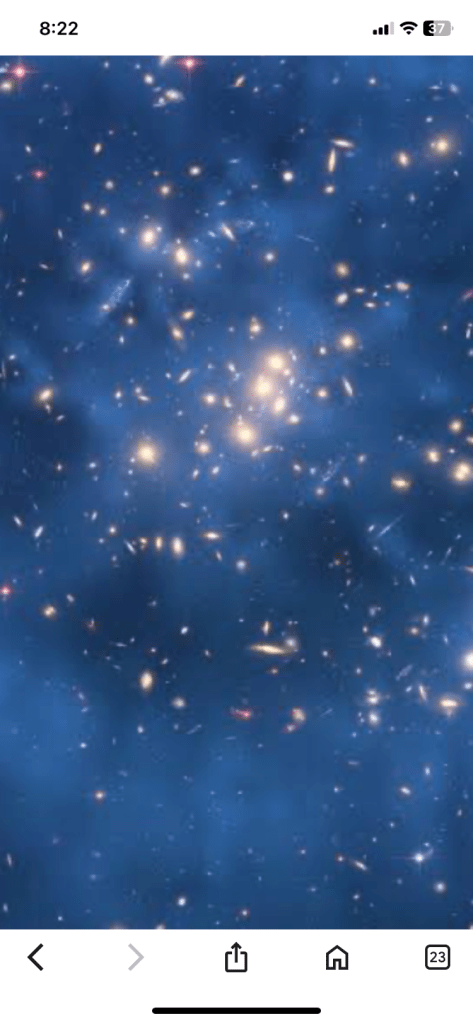
Astronomers use distant galaxies to search for dark matter primarily through its gravitational effects on light and matter. The two main methods are gravitational lensing and studying galaxy rotation curves or other celestial motions. Since dark matter doesn’t emit, absorb, or reflect light, its presence can only be inferred through the gravity it exerts on visible objects.
Gravitational Lensing 💫
Gravitational lensing is a key method for mapping dark matter. According to Einstein’s theory of general relativity, massive objects, including galaxy clusters, warp the fabric of spacetime. This warping causes light from objects behind them to bend, similar to how a lens focuses light. This phenomenon, known as gravitational lensing, creates distorted and magnified images of the background galaxies.
By observing the degree of distortion and magnification, astronomers can calculate the total mass of the foreground object, including both visible matter (stars, gas, dust) and invisible matter (dark matter). The bending of light is often much greater than can be accounted for by visible matter alone, providing strong evidence for the presence of a vast, invisible dark matter halo surrounding galaxy clusters.
Galaxy Rotation Curves 🌌
Another way astronomers infer dark matter is by observing the motion of stars and gas within galaxies. Stars at the outer edges of a galaxy are expected to slow down, just as planets farther from the Sun orbit at a slower speed. However, observations show that stars in the outer regions of many galaxies orbit at roughly the same speed as those closer to the center. This indicates that the gravitational force keeping them in orbit is much stronger than what can be provided by the visible matter of the galaxy.
This consistent, high-speed rotation suggests that a massive, invisible halo of dark matter surrounds the galaxy, providing the extra gravitational pull needed to keep the outer stars from flying off into space. By measuring the rotational speeds of distant galaxies, astronomers can create rotation curves that reveal the distribution and amount of dark matter.
History
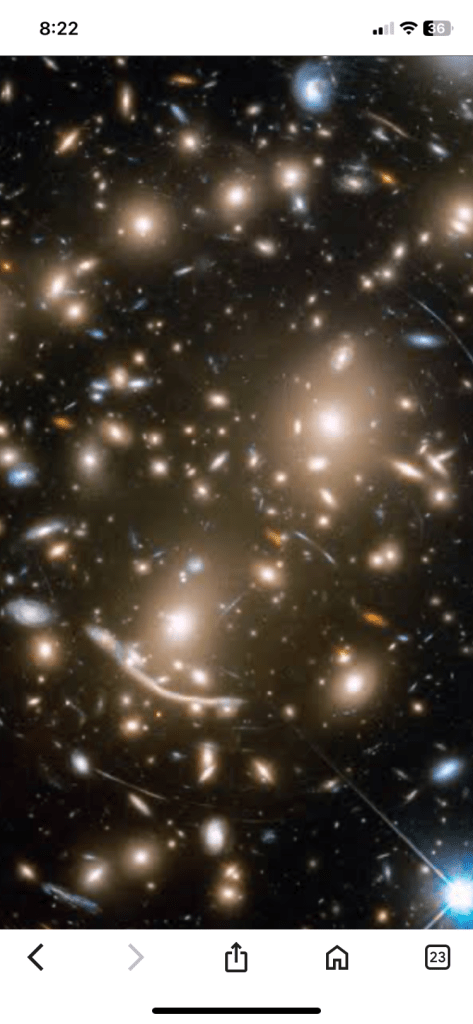
In the 1960s, astronomers theorized that the Universe was filled with a mysterious mass that did not interact normally with light, which they named “Dark Matter.” This theoretical matter is believed to constitute 80% of the Universe’s mass, largely in the form of “halos” surrounding galaxies and galaxy clusters. However, even after six decades of searching, scientists have still not found the particle that constitutes this mass. Many candidates have been proposed in that time, including Weakly-Interacting Massive Particles (WIMPs), primordial black holes, and ultralight particles known as “axions.”
Axions have emerged as a leading candidate in recent years, though scientists have yet to find evidence for their existence. However, physicists from the University of Copenhagenhave devised a new method using distant galaxies that may lead to a breakthrough. Their proposed method involves using Active Galactic Nuclei (AGN), which are caused by supermassive black holes (SMBH) at their centers, as particle accelerators. By observing electromagnetic radiation emitted by these bright galactic cores as it passes through the magnetic fields of galaxy clusters, scientists may discover how axions are produced.
Typically, scientists search for elementary particles using particle accelerators, like the European Organization for Nuclear Research’s (CERN) Large Hadron Collider (LHC) in Geneva, Switzerland. However, such facilities are incredibly expensive and take years to build. In the meantime, astronomers and physicists have proposed using cosmological phenomena as particle accelerators, ranging from neutron stars and black holes to colliding stellar remnants. In this latest proposal paper, Prof. Ruchayskiy and his colleagues propose using AGNs and galactic magnetic fields.
This represents a challenge, given that any axions produced in the process would appear as tiny, random fluctuations drowned out by cosmic background noise. To overcome this, the team observed 32 SMBHs in distant galaxies, which were visible thanks to the gravitational lenses created by galaxy clusters in the foreground. They then combined the data from their observations, which produced a pattern that resembled the signature of axion-like particles (ALPs).
Normally, the signal from such particles is unpredictable and appears as random noise. But we realized that by combining data from many different sources, we had transformed all that noise into a clear, recognizable pattern. It shows up like a unique step-like pattern that shows what this conversion could look like. We only see it as a hint of a signal in our data, but it is still very tantalizing and exciting. You could call it a cosmic whisper, now loud enough to hear.
This method has greatly increased what we know about axions. It essentially enabled us to map a large area that we know does not contain the axion, which narrows down the space where it can be found. We are so excited, because it is not a one-time advancement. This method allows us to go beyond previous experimental limits and has opened a new path to studying these elusive particles. The technique can be repeated by us, by other groups, across a broad range of masses and energies. That way, we can add more pieces to the puzzle of explaining dark matter.
What is actually dark matter and dark energy and could aliens be made of dark matter
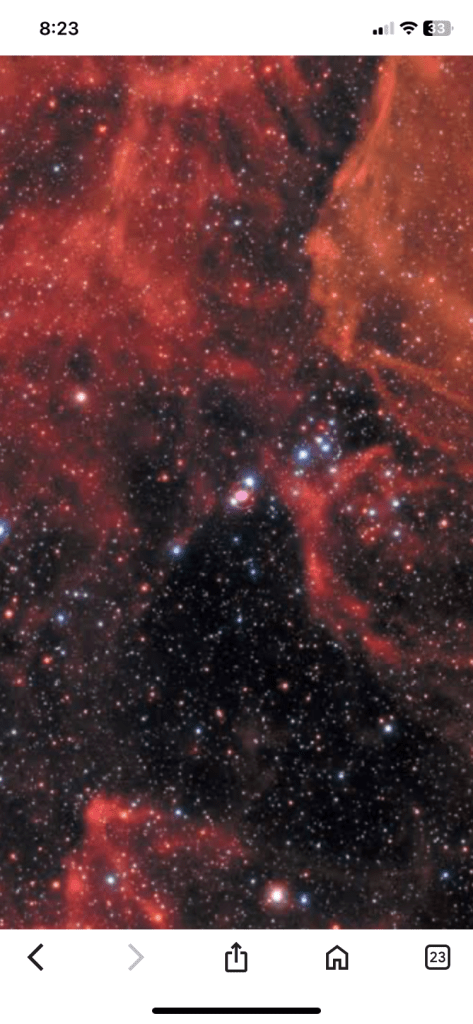
Dark matter and dark energy are two mysterious components of the universe that scientists can’t directly see but infer from their effects on visible matter and the universe’s expansion.
Dark Matter 👻
Dark matter is a hypothetical form of matter that doesn’t interact with light or other electromagnetic radiation, which is why it’s “dark.” It’s believed to make up about 27% of the universe’s total mass-energy content. We know it exists because of its gravitational influence on visible matter. For instance, galaxies spin faster than they should if they were only made of the stars and gas we can see. This suggests an invisible gravitational force—provided by dark matter—is holding them together.
Scientists think dark matter is composed of undiscovered, non-baryonic particles, meaning they aren’t made of protons and neutrons like normal matter. Candidates for these particles include WIMPs (Weakly Interacting Massive Particles) and axions.
Dark Energy 💥
Dark energy, which makes up about 68% of the universe, is a mysterious force or property of space itself that is causing the universe’s expansion to accelerate. Before the late 1990s, scientists thought the universe’s expansion was slowing down due to gravity. However, observations of distant supernovae showed the expansion was speeding up, suggesting a repulsive force was at play.
Unlike dark matter, which clumps together in halos around galaxies, dark energy is thought to be evenly distributed throughout space. Its effect only becomes significant on a cosmic scale, pushing galaxies away from each other.
Dark Matter Aliens? 👽
It’s highly unlikely that aliens could be made of dark matter. The current understanding of dark matter is that it doesn’t interact with itself or with normal matter in a way that would allow for complex structures like atoms, molecules, or living organisms to form. Chemistry, which is the foundation of life as we know it, relies on electromagnetic interactions between particles, and dark matter does not interact electromagnetically. While we don’t know everything about dark matter, its known properties make the formation of life from it improbable.
Please like subscribe comment your precious comment on universe discoveries
Full article source google
https://www.buymeacoffee.com/Satyam55
https://www.amazon.in/b?_encoding=UTF8&tag=555101-21&link
https://youtube.com/shorts/QCivpE0X9r4?si=h6gQvOHuNCmaQIX2
Click on above link to know about dark matter
 Universe discoveries
🙏🌹
Aum Shanti
LikeLike