

Exoplanet magnetic fields can be detected by observing the radio emissions they generate, which are caused by the interaction of the planet’s magnetosphere with stellar wind particles. This process, known as electron-cyclotron maser instability (CMI), is a key method for inferring the presence and strength of a magnetic field. 🔭
Challenges of Terrestrial Observation
Detecting these emissions from Earth is particularly challenging due to two primary factors:
- Earth’s Ionosphere: Our planet’s ionosphere acts as a natural barrier, blocking or distorting the low-frequency radio signals (below 10 MHz) that are expected to be emitted by smaller, more Earth-like or Neptune-like exoplanets.
- Radio Frequency Interference (RFI): Terrestrial radio transmissions and other human-made radio “chatter” create significant noise that can interfere with and mask the faint radio signals coming from distant exoplanets.
The Lunar Advantage
Placing radio telescopes on the Moon offers a solution to these challenges. The far side of the Moon, which always faces away from Earth, is considered the most radio-quiet location in our solar system. Key advantages of a lunar-based radio observatory include: - Lack of an Atmosphere: The Moon’s lack of a substantial atmosphere means there is no ionospheric barrier to block low-frequency signals. This allows for the detection of emissions from a wider range of exoplanets, including smaller, Earth-sized ones.
- Shielding from Earth: The Moon itself acts as a shield, blocking the RFI from Earth that plagues ground-based observatories. This provides an incredibly clear “radio sky” for astronomers.
- Uninterrupted Observation: The Moon’s slow rotation allows for long, uninterrupted observation periods, which is crucial for detecting the often faint and periodic signals from exoplanets.
Several missions, such as the proposed FarView Observatory and FARSIDE, are being considered to take advantage of the lunar environment for exoplanet research, and could potentially revolutionize our understanding of planetary habitability.
Exoplanets habitability
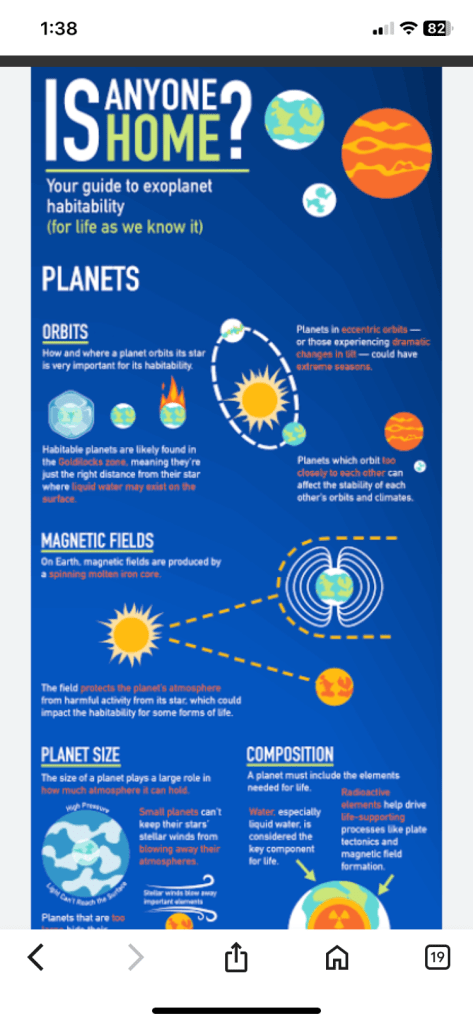
Exoplanet habitability depends on a whole host of factors, with liquid water at the top of the list. It also needs a stable atmosphere, the right chemistry, and possibly even things like plate tectonics or other geological activity. Planetary magnetic fields are a critical part of the formula, too, but detecting them from Earth’s surface is difficult.
The problem is Earth’s ionosphere. This atmospheric layer creates a barrier or ceiling that blocks some radio frequencies from reaching Earth’s surface. Astronomers think that the most detectable signals from exoplanet atmospheres are below 10 MHz, but this is below the barrier created by the ionosphere.
The Moon is barren, and has neither a thick atmosphere nor an ionosphere. It has only an extremely thin atmosphere called an exosphere, which is made up of sparse molecules held in place by the Moon’s gravity. This is why Turner and his colleagues have their sights set on the Moon
Despite decades of searching, there is still no conclusive detection of an exoplanet’s magnetic field,” the authors write, while noting that some promising hints have begun to emerge. In 2021, Turner and co-researchers detected hints of a magnetosphere at Tau Bootis b, an exoplanet about 51 light-years away.
The search for exoplanet magnetic fields comes down to auroral emissions. “Observing planetary auroral radio emission is one of the most promising methods to detect exoplanetary magnetic fields,” the researchers explain in their white paper. “An exoplanet’s magnetic field can be detected through radio emission from the planet generated by the electron-cyclotron maser instability (CMI).” In our Solar System, all of the magnetized planets and moons emit radio emissions through the same mechanism
Most of these emissions were detected by satellite; only Jupiter’s were strong enough to detect from the ground. This is simply not possible when it comes to exoplanets, since they’re much further away and their emissions are much weaker when they reach us. An array of radio antennae on the Moon is what’s needed to study exoplanet magnetic fields according to the authors
There are already so-called pathfinder missions in this regard. The Lunar Surface Electromagnetics Experiment (LuSEE-Night) is a robotic radio telescope in the planning stages. If completed, it will land on the lunar far side as early as 2026, by Commercial Lunar Payload Services (CLPS). Lu-SEE Night will make all-sky radio observations from the far side by using the Moon to block Earth’s interfering radio emissions
FARSIDE (Farside Array for Radio Science Investigations of the Dark Ages and Exoplanets) is another concept for a lunar farside radio telescope. It would consist of an array of 128 dual-polarization antennas covering 10 square km. It would image the available sky every minute.
“FarView and FARSIDE5 will revolutionize the study of exoplanetary magnetospheres,” the authors write. FarView can detect weaker signals, so should be able to study the magnetic fields of everything from Earth-size terrestrial planets to gas giants like Jupiter. “Interestingly, the available target-list for FarView within the 5-10 MHz frequency range includes a handful of super-Earths and Neptune-like planets,” the researchers explain. That means that FarView will refine the dynamo modelling for habitable planets in preparation for FARSIDE’s eventual operation.
What will happen if we put telescope on the far side of the moon 🌑 and starting detecting magnetic fields of exoplanets

Placing a radio telescope on the far side of the Moon to detect exoplanet magnetic fields would be a significant step forward for astronomy. This location is an ideal spot for a radio observatory because it would be shielded from Earth’s radio frequency interference (RFI) and would not have to deal with the atmospheric and ionospheric distortion that plagues ground-based telescopes.
What Will Happen
Using a telescope on the far side of the Moon, astronomers could:
- Detect a wider range of exoplanets: The Moon’s lack of an atmosphere means there’s no ionospheric barrier. This allows for the detection of low-frequency radio signals that are blocked on Earth. These are the frequencies expected from smaller, more Earth-like or Neptune-like exoplanets, which are currently undetectable from the ground.
- Confirm exoplanet habitability: Magnetic fields are thought to be crucial for a planet’s habitability, as they can protect its atmosphere from being stripped away by stellar winds. Directly detecting a magnetic field on an exoplanet would be a powerful indicator of its potential to support life.
- Study planetary formation and evolution: Detecting and characterizing the magnetic fields of various exoplanets would provide valuable data for understanding how these planets form and evolve. The strength and characteristics of a magnetic field can offer clues about a planet’s internal structure and its history.
- Achieve unprecedented sensitivity: The radio-quiet environment of the lunar far side allows for much greater sensitivity than is possible on Earth. This would enable the detection of fainter signals from more distant exoplanets and provide a more complete picture of their magnetic activity.
Please like subscribe comment your precious comment on universe discoveries
Full article source google
https://www.amazon.in/b?_encoding=UTF8&tag=555101-21&link
https://www.buymeacoffee.com/Satyam55
https://youtube.com/shorts/KXdQoddlXsA?si=-eu28OcS5BUgodoC
Click on the above link to see farside telescope on moon
 Universe discoveries
🙏🌹
Aum Shanti
LikeLike