

Reports have emerged, notably from Harvard astrophysicist Avi Loeb, suggesting that the interstellar object 3I/ATLAS might be nuclear-powered
.
Key points
- Loeb bases his hypothesis on an image captured by the Hubble Space Telescope on July 21st, showing a glow at the front of 3I/ATLAS, indicating it’s emitting its own light.
- He argues against the glow being due to reflected sunlight or rare interstellar nuclear material.
- Loeb proposes that 3I/ATLAS could be a spacecraft powered by nuclear energy, with the emitted dust potentially being debris accumulated during its interstellar journey.
- He suggests that the object’s unusual trajectory, including close approaches to Earth and Jupiter, and the absence of a visible tail, cast doubt on the theory that it’s merely a comet.
- Loeb recommends utilizing the Mars Reconnaissance Orbiter’s HiRISE camera to observe 3I/ATLAS during its close approach to Mars in October.
- NASA, however, has classified 3I/ATLAS as a comet.
It’s important to note that the nuclear-powered spacecraft hypothesis remains a conjecture and requires further evidence for validation.
31/atlas is a interesting interstellar object
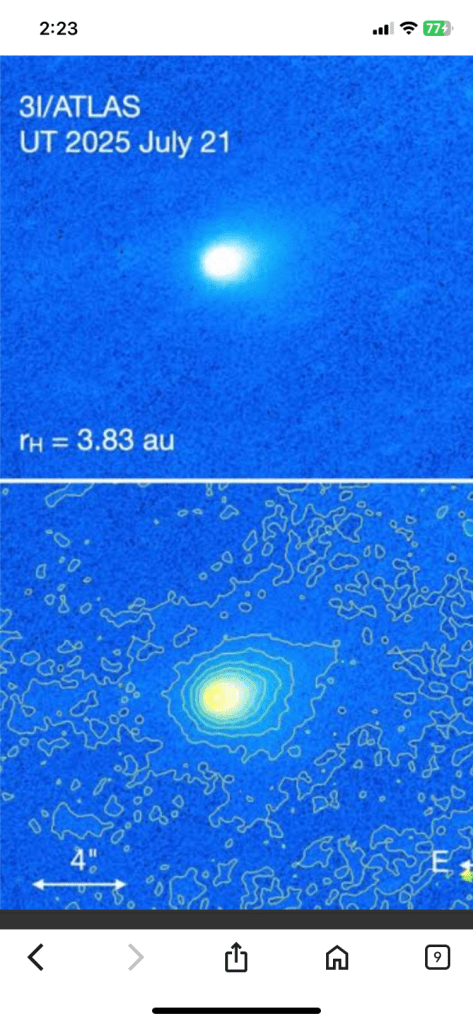
Interesting facts about interstellar object 3I/ATLAS
- Interstellar origin: 3I/ATLAS is only the third confirmed object to have originated from outside our solar system.
- Fastest recorded object: It’s traveling at approximately 210,000 kilometers per hour, making it the fastest object ever observed entering our solar system.
- Likely older than our sun: Analysis suggests 3I/ATLAS could be over 7 billion years old, predating the sun by billions of years, making it potentially the oldest comet we’ve ever observed.
- Cometary behavior: Unlike asteroids, 3I/ATLAS exhibits characteristics of a comet, including a coma (cloud of gas and dust) and a developing tail, according to ScienceAlert.
- Studying other star systems: These interstellar objects offer a unique opportunity to study materials formed in distant star systems, providing valuable insights into the formation of planets and other celestial bodies in our galaxy and beyond, according to NASA Science.
- Size: Early estimations placed the object at around 20 kilometers, but further observations suggest a diameter between 0.32 to 5.6 kilometers.
- Future Observations: Telescopes like the Hubble Space Telescope and the James Webb Space Telescope are slated to observe the comet in the coming months, providing further insight into its composition and behavior.
Ongoing debate
While most astronomers believe 3I/ATLAS is a comet, some, like Harvard astrophysicist Avi Loeb, have suggested that its unusual brightness and trajectory could indicate an artificial origin or even be nuclear-powered. This theory remains speculative and requires further evidence for confirmation.
Please like subscribe comment your precious comment on universe discoveries
Full article source google
https://www.buymeacoffee.com/Satyam55
https://www.amazon.in/b?_encoding=UTF8&tag=555101-21&link
https://youtu.be/swRKXOeNs_Q?si=vMaoRvhnakJ-nyAb
Please click on the above link to watch 31/atlas video
 Universe discoveries
Interesting and useful information.
LikeLike
🙏🌹
Aum Shanti
LikeLike
Whether it is artificial in origin is pretty wild speculation but it is certainly a very interesting object.
LikeLiked by 1 person