
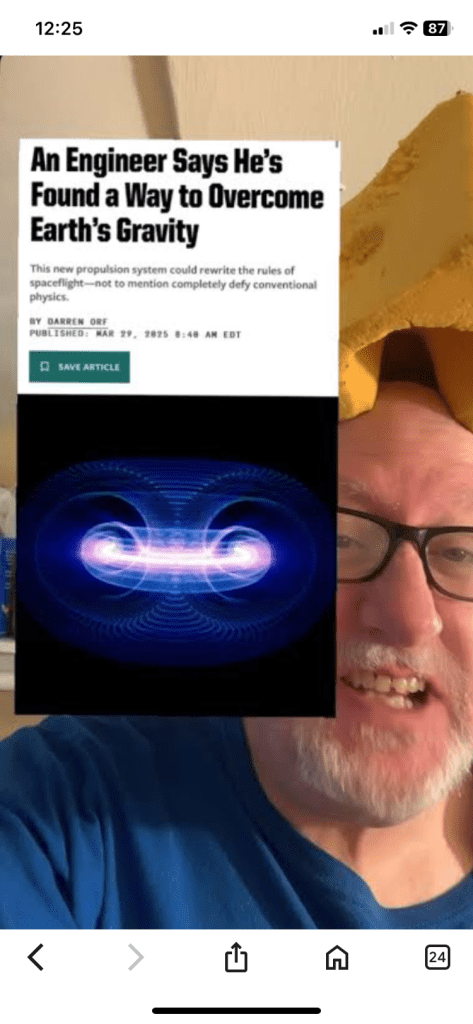
Former NASA engineer Charles Buhler, the co-founder of Exodus Propulsion Technologies, claims to have created a drive that can overcome gravity using a “New Force” derived from electric fields. The system is designed to generate a sustained force on an object without expelling mass, which would violate the conservation of momentum as we understand it in physics. Buhler has presented his findings at the Alternative Propulsion Energy Conference (APEC), and his company claims to have generated enough thrust to counteract Earth’s gravity in tests.
The idea of a propellant-less drive has been met with skepticism within the scientific community, as similar claims, like those for the EmDrive, have been debunked. The success of Buhler’s device would depend on its ability to be independently verified and replicated through rigorous peer review.
A Secret Project to Counter the Force of Gravity
New propulsion system
This new propulsion system could rewrite the rules of spaceflight—not to mention completely defy conventional physics
Here’s what you’ll learn when you read this story:
- Discovering a machine that could somehow produce thrust without releasing propellant would be a game-changer for human space travel. There’s just one problem—such a device would defy the laws of physics.
- This limitation has not stopped people from investigating the possibility, and the latest addition to the propellant-less club is an electrostatic design developed by a former NASA engineer.
- While the company behind the drive, Exodus Propulsion Technologies, says that the drive can achieve a thrust to counteract Earth’s gravity, such a claim still needs independent verification and a healthy dose of skepticism.
In 2001, British Electrical Engineer Roger Shawyer first introduced the “impossible drive,” known as the EmDrive. It was called “impossible” because its creator purported that the drive was reactionless, meaning no propellant required—in other words, it defied the known laws of physics (specifically, the conservation of momentum).
As with anything that appears to thumb its nose at Newton and Einstein, scientists raised more than a few eyebrows, and two decades of testing eventually boiled down to an inevitable (and somewhat predictable) conclusion in 2021: the EmDrive was bunk. But that’s the nature of the scientific method—take a seemingly impossible idea, put it through rigorous testing, and hopefully get to an unassailable conclusion (or new discoveries that lead in other directions
The not-based-in-physics dream of a propellant-less machine, however, didn’t die with the EmDrive. Instead, a new challenger approaches, and this one has a former NASA scientist backing it up.
While at NASA, Charles Buhler helped establish the Electrostatics and Surface Physics Laboratory at Kennedy Space Center in Florida—a very important lab that basically ensures rockets don’t explode. Now, as co-founder of the space company Exodus Propulsion Technologies, Buhler told the website The Debrief that they’ve created a drive powered by a “New Force” outside our current known laws of physics, giving the propellant-less drive enough boost to overcome gravity.
In an interview with APEC’s co-founder Tim Ventura, Buhler explained how his background in electrostatics led to the discovery. He says his team—made up of people from NASA, Blue Origin, and the Air Force—investigated propellant-less drives for decades before arriving at electrostatics. For years, their devices produced negligible thrust, but saw increases with each new iteration. This culminated in 2023, when this “New Force”-powered drive generated enough thrust to overcome Earth’s gravity.
What will happen if a spacecraft defy earth gravity and it can excel space exploration
If a spacecraft could truly defy Earth’s gravity, it would be a game-changer for space exploration 🚀. It would dramatically change how we launch and travel through space, leading to significant advancements and cost reductions.
Impact on Launch and Travel
- No More Rockets: The most significant change would be the end of traditional rocket launches. Rockets are designed to produce immense thrust to overcome Earth’s gravity and atmospheric drag. A spacecraft that could nullify gravity would not need this. It could simply lift off and ascend with minimal energy, eliminating the need for vast amounts of fuel and complex, multi-stage launch systems.
- Cost Reduction: The cost of space travel is overwhelmingly tied to the expense of launching a payload into orbit. By eliminating the need for massive rockets and fuel, a gravity-defying spacecraft would drastically reduce these costs. This would make space exploration and commercial ventures, such as satellite deployment and space tourism, far more accessible.
- Increased Payload: The mass of a spacecraft’s fuel and launch structure currently limits the amount of payload it can carry. Without this limitation, spacecraft could be much larger and carry more instruments, supplies, and people, enabling more ambitious missions.
Human Health in Space - Mitigation of Microgravity Effects: Long-term exposure to microgravity in space has severe negative effects on the human body, including bone density loss, muscle atrophy, and vision problems. A spacecraft that could generate its own gravity would be able to create a comfortable, Earth-like environment for astronauts, protecting their health and enabling much longer missions, such as travel to Mars or beyond.
Challenges to Overcome
While the benefits are immense, the technology would require a fundamental shift in our understanding of physics. The concept of “defying gravity” as described by the engineer Charles Buhler, a “New Force” that operates outside the known laws of physics, remains to be independently verified. To be a true breakthrough, the technology would need to be: - Replicable: The results of the propulsion system must be consistently reproduced by independent researchers.
- Scalable: The technology must be able to be scaled up from a small prototype to a size capable of lifting a large spacecraft and its payload.
- Controllable: The force would need to be precisely controlled to allow for maneuvering, acceleration, and deceleration.
Essentially, a gravity-defying spacecraft would revolutionize space exploration by making it cheaper, safer, and more efficient, but the discovery of a new fundamental force is required to make it a reality.
Please like subscribe comment your precious comment on universe discoveries
Full article source google
https://www.amazon.in/b?_encoding=UTF8&tag=555101-21&link
https://www.buymeacoffee.com/Satyam55
https://youtube.com/shorts/88-ZeGTNLlg?si=47vkd30mkEhbh1-9
Click on the above link to watch video
 Universe discoveries
🙏🌹
Aum Shanti
LikeLiked by 1 person
I am thankful for brilliant minds.
LikeLiked by 2 people