
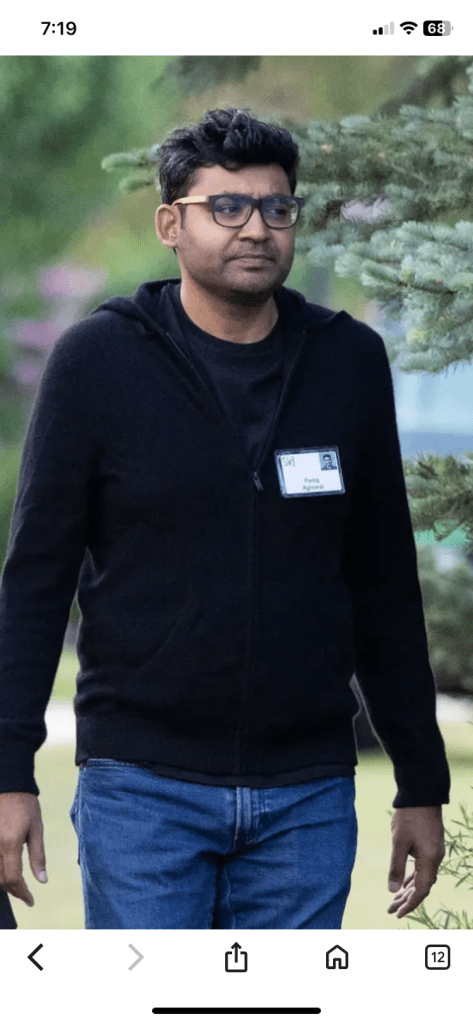
Parag Agrawal is an Indian-American software engineer and businessman who rose from a distinguished engineer at Twitter to become its CEO in 2021. After a dramatic ousting by Elon Musk in 2022, he founded the AI startup Parallel Web Systems.
Early life and education
- Childhood: Born in Ajmer, Rajasthan, in 1984 and raised in Mumbai, Agrawal’s father was a senior official in the Department of Atomic Energy and his mother was a retired economics professor.
- Academic excellence: Agrawal excelled in science and mathematics, achieving an All-India Rank of 77 in the IIT JEE in 2000 and winning a gold medal at the International Physics Olympiad in 2001.
- Higher education: He earned a Bachelor of Technology from IIT Bombay in 2005 and a Ph.D. in Computer Science from Stanford University in 2012.
Career at Twitter
- Early career: Before Twitter, Agrawal held research internships at Microsoft Research, Yahoo! Research, and AT&T Labs.
- Rising through the ranks: Joining Twitter in 2011, he applied machine learning to improve the platform. He became CTO in 2017 and oversaw Project Bluesky in 2019.
- CEO of Twitter: Agrawal was appointed CEO on November 29, 2021, at age 37, becoming the youngest CEO of an S&P 500 company.
Ousting by Elon Musk
- Acquisition and termination: His time as CEO ended in October 2022 when Elon Musk acquired Twitter. Agrawal was among the first executives fired.
- Legal action: Agrawal and other executives later sued Musk over alleged unpaid severance.
Post-Twitter and new venture
- Founding Parallel Web Systems: In 2023, Agrawal founded the AI startup Parallel Web Systems.
- Focus on Agentic AI: The company is developing tools for AI systems to perform reliable research on the web and address AI hallucination.
- Successful funding: The startup has secured $30 million in funding from firms like Khosla Ventures and Index Ventures.
Parallel web systems
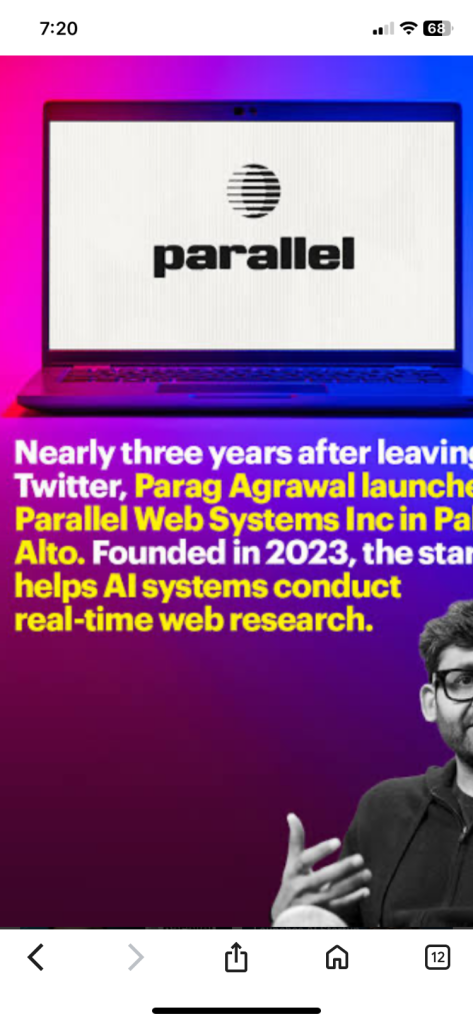
While Parag Agrawal’s new company, Parallel Web Systems, has made an impressive debut in 2025, it is still very early to assess its full “success story”
. However, the venture has already demonstrated significant traction and garnered attention for its novel approach to building a “web for machines”.
What is Parallel Web Systems?
Founded by Agrawal in 2023, Parallel Web Systems aims to construct the foundational infrastructure for artificial intelligence (AI) agents to conduct web research efficiently and reliably.
The company’s core belief is that the existing internet was designed for human browsing, and that AI agents—which will soon outnumber human users online—need their own purpose-built system. This system is designed to provide AI agents with a browser of their own that can find, verify, organize, and cite information with high accuracy.
The main product is the Deep Research API, which offers developers a set of eight different “research engines” that vary in speed and depth.
Early successes and traction
Strong benchmark performance
In benchmark tests, Parallel’s flagship engine, Ultra8x, has reportedly outperformed both human researchers and leading AI models like OpenAI’s GPT-5 on rigorous deep web research tasks. This suggests the company has developed a powerful solution for a critical AI challenge.
Significant funding
The Palo Alto-based company came out of “stealth mode” with a substantial investment, having raised $30 million from top-tier venture capital firms, including Khosla Ventures, Index Ventures, and First Round Capital. The funding round and backing from notable investors signal strong market confidence in Parallel’s vision and technical team.
Early adoption by major players
Within its first few months of public operation in mid-2025, Parallel’s API is already processing millions of research tasks daily for a number of companies, including some of the fastest-growing AI firms. These early adopters are using Parallel for real-world applications like:
- Automating research for coding assistants, market analysts, and insurance companies.
- Enhancing workflows with web-sourced verification for sales agents and enterprises.
- Conducting competitive intelligence by tracking product catalogs in real-time.
Please like subscribe comment your precious comment on universe discoveries
Full article source google
 Universe discoveries
🙏🌹
Aum Shanti
LikeLike
What a clear and engaging profile of Parag Agrawal! 🌟
You’ve presented his journey with a smooth balance of facts and storytelling — from a brilliant student in Ajmer and Mumbai, to an innovator at Twitter, and now an entrepreneur shaping the future of AI. I love how you highlighted not just his milestones, but also the resilience shown after leaving Twitter and launching Parallel Web Systems. The structure makes his path feel inspiring and accessible, while the details about “Agentic AI” give an exciting glimpse into where technology is headed. A well-crafted and motivating write-up!
LikeLiked by 1 person