
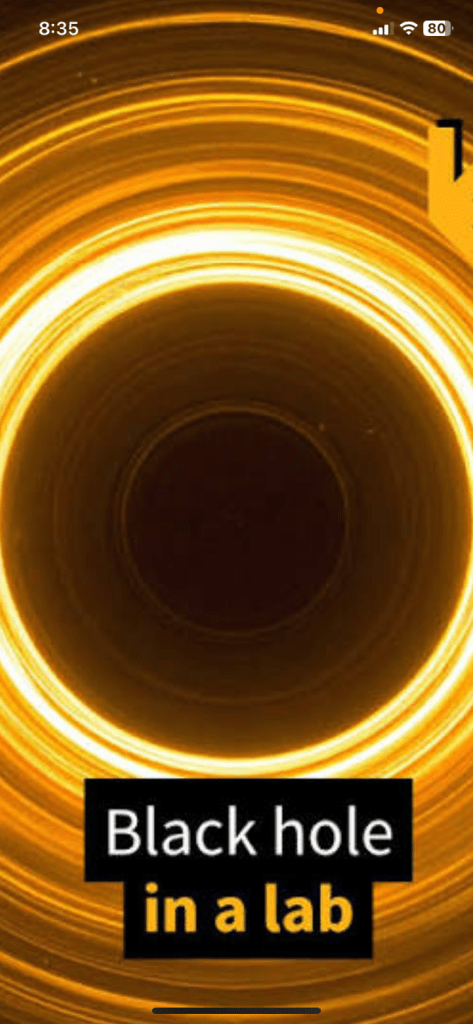
Physicists successfully simulated a black hole in a laboratory by creating a one-dimensional chain of atoms to mimic the event horizon. The experiment aimed to study Hawking radiation, a theoretical phenomenon where black holes are thought to emit a faint glow of particles.
Hawking radiation is predicted to occur when pairs of virtual particles pop in and out of existence near the event horizon. One particle from the pair falls into the black hole, while the other escapes, becoming a real particle and carrying away a tiny bit of the black hole’s energy. This process causes the black hole to slowly lose mass and eventually evaporate. The glowing observed in the lab simulation is the equivalent of this thermal radiation, lending support to Stephen Hawking’s theory. The simulation also suggested that quantum entanglement of particles at the event horizon is crucial for the radiation to occur.
A black hole analog could tell us a thing or two about an elusive radiation theoretically emitted by the real thing.
Using a chain of atoms in single file to simulate the event horizon of a black hole, a team of physicists in 2022 observed the equivalent of what we call Hawking radiation – particles born from disturbances in the quantum fluctuations caused by the black hole’s break in spacetime.
This, they say, could help resolve the tension between two currently irreconcilable frameworks for describing the Universe: the general theory of relativity, which describes the behavior of gravity as a continuous field known as spacetime; and quantum mechanics, which describes the behavior of discrete particles using the mathematics of probability.
For a unified theory of quantum gravity that can be applied universally, these two immiscible theories need to find a way to somehow get along
This is where black holes come into the picture – possibly the weirdest, most extreme objects in the Universe. These massive objects are so incredibly dense that, within a certain distance of the black hole’s center of mass, no velocity in the Universe is sufficient for escape. Not even light speed.
That distance, varying depending on the mass of the black hole, is called the event horizon. Once an object crosses its boundary, we can only imagine what happens, since nothing returns with vital information on its fate. But in 1974, Stephen Hawking proposed that interruptions to quantum fluctuations caused by the event horizon result in a type of radiation very similar to thermal radiation.
If this Hawking radiation exists, it’s way too faint for us to detect yet. It’s possible we’ll never sift it out of the hissing static of the Universe. But we can probe its propertiesby creating black hole analogs in laboratory settings
This, can open a venue for exploring fundamental quantum-mechanical aspects alongside gravity and curved spacetimes in various condensed matter settings,” the researchers wrote
Please like subscribe comment your precious comment on universe discoveries
Full article source google
https://youtu.be/C9hFQd19RsI?si=8CYmhJmDG9mq5rQv
Please click on the above link to see black hole in a lab video
 Universe discoveries
🙏🌹
Aum Shanti
LikeLiked by 1 person