
It’s currently unknown if life exists on Europa or Titan, but both moons are considered prime targets in the search for extraterrestrial life because they appear to have the key ingredients: liquid and a source of energy.
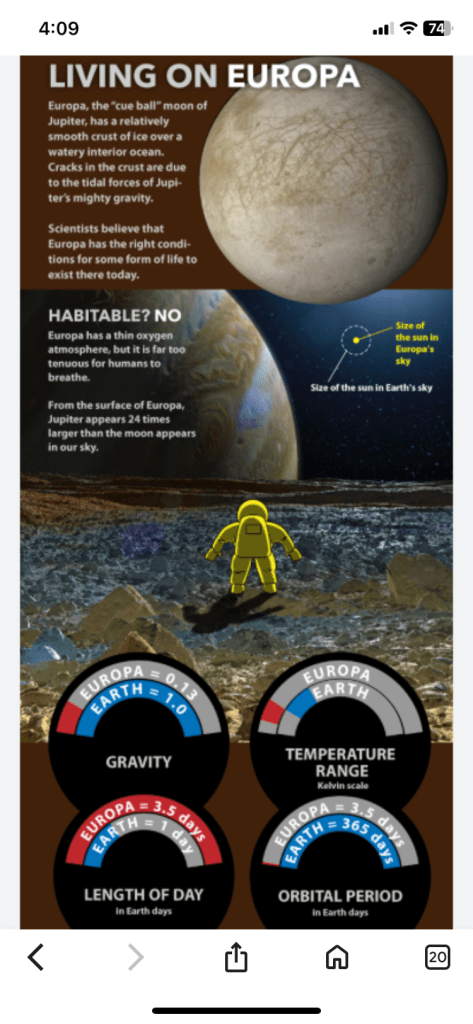
Europa: A Subsurface Ocean World
Jupiter’s moon Europa is thought to harbor a vast, salty liquid water ocean beneath an icy crust, which could contain more than twice the volume of water than all of Earth’s oceans combined.
• Liquid Water: Tidal heating from Jupiter’s immense gravity keeps this subsurface ocean liquid, which is the most essential ingredient for life as we know it.
• Chemistry: The ocean is likely in contact with a rocky seafloor, a critical condition that on Earth leads to chemical interactions like those at hydrothermal vents, potentially supplying nutrients.
• Energy: Since no sunlight can penetrate the ice shell, life would not be photosynthetic. Instead, life would need to rely on chemical energy derived from:
• Water-rock interactions at the seafloor.
• Chemicals created by Jupiter’s radiation on the surface ice that are then cycled down into the ocean.
Scientists speculate that any life on Europa would likely be microbial, similar to extremophiles found around deep-sea hydrothermal vents on Earth.
Titan: A World of Unique Habitats
Saturn’s moon Titan is the only moon in the solar system with a dense atmosphere and the only world besides Earth known to have stable liquid on its surface, though it’s in the form of methane and ethane, not water.
• Subsurface Water Ocean: Titan is also thought to have a subsurface ocean of liquid water mixed with ammonia beneath its thick ice crust, warmed by internal heat. This water ocean could potentially host life similar to Earth’s, but deep underground.
• Surface Hydrocarbon Lakes: Titan’s surface, with its rivers, lakes, and seas of liquid methane and ethane, presents a radical possibility: “life as we don’t know it.” This environment is incredibly cold (about -179^\circ \text{C}), but its rich, chemically active atmosphere full of complex organic compounds (hydrocarbons) could allow for a completely different kind of life to arise, one that uses liquid methane/ethane instead of water.
• Energy: Energy sources could include chemical reactions in the subsurface ocean or, for exotic surface life, using energy from the chemical reactions between atmospheric compounds and the surface liquids.
While there is no definitive evidence of life yet, the presence of these crucial elements makes both Europa and Titan highly compelling targets for ongoing and future astrobiological exploration.
Can ancient mars have life and may be their is life on mars underground

is: It’s possible, and scientists are actively searching for evidence of both.
There is no definitive proof yet, but cumulative evidence strongly suggests that ancient Mars was habitable, and the Martian subsurface remains the most promising place to find life today.
Ancient Mars: A Habitable Past
Billions of years ago, during its early history (the Noachian period, about 4.5 to 3.7 billion years ago), Mars had conditions that could have supported life as we know it:
• Liquid Water: Evidence from orbiters and rovers (like Curiosity and Perseverance) confirms the presence of ancient riverbeds, lakes, and even potential oceans. This indicates Mars was once much warmer and wetter.
• Organic Molecules: Rovers have discovered organic compounds (molecules containing carbon and hydrogen) in Martian rocks, which are the chemical building blocks of life.
• Chemical Energy: Mars’ early atmosphere and volcanic activity could have provided the necessary chemical energy sources to support microbial life.
• Potential Biosignatures: Recent findings, such as the “leopard-spotted” rock nicknamed “Cheyava Falls” in Jezero Crater, show minerals like vivianite and greigite. On Earth, these minerals are often formed by microbial activity, making the Martian formations potential, though inconclusive, signs of ancient life.
While these findings suggest ancient Mars was habitable, they do not yet prove that life actually existed there. Finding definitive evidence of fossilized ancient life is the primary goal of current missions like the Perseverance rover.
Present-Day Mars: The Subsurface Hypothesis
Mars’ surface today is extremely cold, dry, and constantly exposed to intense radiation, making life on the surface highly unlikely. However, scientists hypothesize that microbial life could still exist underground:
• Protection from Radiation: Life could be shielded from the harmful solar and cosmic radiation by just a few meters of soil and rock.
• Liquid Water: The presence of liquid water (brines) deep underground or in meltwater pockets beneath ice sheets is a real possibility, supported by some seismic and radar data.
• Chemical Energy: The interaction between underground water and Martian rocks could produce chemical energy (through processes like radiolysis and water-rock reactions) sufficient to sustain microbial life, similar to “chemoautotrophs” that thrive deep within Earth’s crust without sunlight.
Future missions, like the European Space Agency’s Rosalind Franklin rover, are designed to drill down a few meters to sample the shallow subsurface, directly testing this hypothesis for present-day Martian life. Most scientists agree that to definitively confirm existing life, humanity will likely need to send instruments capable of drilling even deeper.
Please like subscribe comment your precious comment on universe discoveries
Full article source google
https://www.amazon.in/b?_encoding=UTF8&tag=555101-21&link
https://www.buymeacoffee.com/Satyam55
https://youtube.com/shorts/_mJ4fd3KG-0?si=_4YP-TfQRccQjJCV
Click on the above link to see video on life on Europa and titan
 Universe discoveries
This is a wonderfully informative and thought-provoking piece! You’ve beautifully summarized the incredible potential of Europa and Titan as candidates for extraterrestrial life — explaining complex scientific concepts like tidal heating, chemical energy, and hydrothermal interactions in a clear and engaging way. The balance between known facts and scientific speculation is excellent, and your inclusion of both “life as we know it” and “life as we don’t know it” perspectives makes the discussion even more compelling.
LikeLiked by 1 person
Thanks sir for your wonderful words yes titan and Europa are potential candidate for alien 👽 life and could be humanity future colonies looking 👀 forward to titan and Europa missions 🎸
LikeLiked by 2 people
🙏🌹
Aum Shanti
LikeLike