
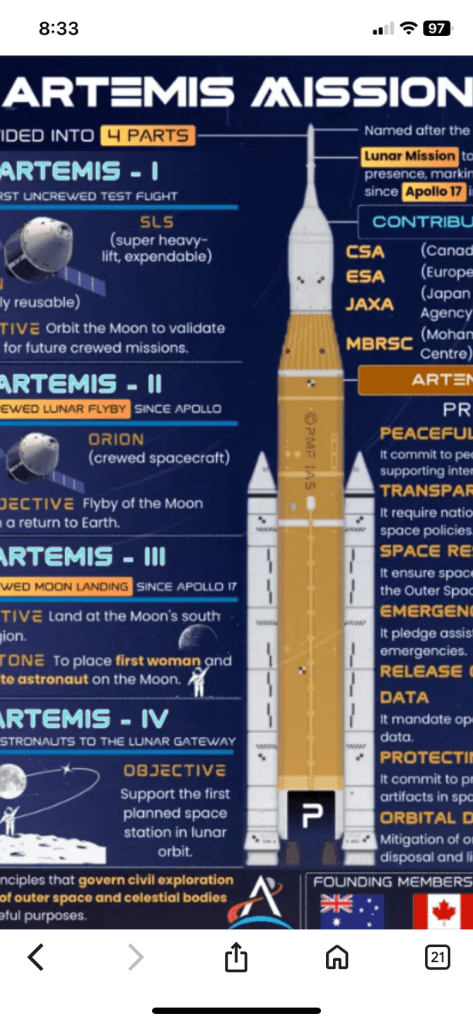
The “4-Billion-Year-Old Secret” hidden in the Moon’s South Pole that NASA’s Artemis mission aims to uncover relates to pristine, preserved materials from the early Solar System and the Moon’s own formation history.
The secret is essentially a combination of two major scientific mysteries:
1. The Origin of Lunar Water Ice and Other Volatiles
• The Archive: The South Pole is home to numerous Permanently Shadowed Regions (PSRs)—deep craters whose floors never see sunlight.
• The Secret: These regions are incredibly cold, allowing volatile substances, including water ice, carbon dioxide, methane, and ammonia, to be trapped and preserved for billions of years, potentially since the Moon’s formation 4.5 billion years ago.
• The Uncovering: By collecting and analyzing core samples of this ancient ice, Artemis astronauts aim to answer:
• Where did the water come from? Was it delivered by comets and asteroids (an archive of the early Solar System’s ingredients), or did it come from the Moon’s interior or solar wind interactions? This would shed light on how Earth and other planets acquired water and the organic compounds necessary for life.
2. Deep Lunar Interior Material and Formation Clues
• The South Pole-Aitken (SPA) Basin: The South Pole is near the rim of the SPA Basin, the largest and oldest known impact crater in the entire Solar System, formed about 4.3 billion years ago.
• The Secret: The impact that created the SPA Basin was so massive it likely excavated material from deep within the Moon’s mantle. New research suggests the Artemis landing sites on the southern rim will be the best place to find this ancient, deep-seated ejecta (material blasted out by the impact).
• The Uncovering: Samples collected from this area could be a literal “time capsule” revealing:
• The chemical composition of the Moon’s interior (like concentrations of a radioactive component called KREEP).
• Clues to the Moon’s “two-faced” mystery—why the far side is so different from the near side.
In essence, the Moon’s South Pole is a frozen archive that holds the pristine, 4-billion-year-old ingredients and structural clues necessary to understand the earliest history of both the Moon and the inner Solar System.
Moon 🌑 is the now new frontier

For decades, the Moon’s south pole has captivated scientists as one of the most mysterious and unexplored places in our solar system. Unlike the sunlit plains visible from Earth, this region lies in perpetual darkness, preserving traces of the Moon’s early history, possibly dating back over 4 billion years. Now, with NASA’s Artemis program, humanity is preparing to unlock these ancient secrets. The upcoming missions could not only confirm the presence of water ice and other frozen volatiles but also provide a window into the formation of the solar system itself.
The Moon’s south pole: A frozen archive of the early solar system
The south pole of the Moon is unlike any other place we’ve explored. Its permanently shadowed craters, such as Shackleton, Haworth, and Faustini, never receive direct sunlight, allowing temperatures to plunge to -230°C (-382°F). In these dark depths, volatile substances like water, carbon dioxide, ammonia, and methane could have remained untouched since the Moon’s formation nearly 4.5 billion years ago.
Scientists believe these frozen materials were delivered by ancient comets and asteroids, preserving pristine records of what the early solar system was made of. Studying them could reveal how Earth and other planets acquired their water and organic compounds, the very ingredients that made life possible
How NASA’s Artemis mission will unravel the mystery
NASA’s Artemis program marks humanity’s first return to the Moon in over half a century. Its primary goal isn’t just to revisit old ground, but to explore new frontiers, specifically the south polar region.
The mission’s first crewed landing, Artemis III, is slated to target this area. Astronauts will be equipped with robotic drills, advanced sensors, and lunar rovers to collect core samples from beneath the surface. These samples could contain ancient ice layers that have survived billions of years of cosmic bombardment
By analyzing isotopic signatures in these ices, scientists hope to determine whether came from Earth’s mantle, cometary impacts, or solar wind interactions. Understanding this will help solve one of the great mysteries of planetary science, how water became abundant on Earth and other celestial bodies.
Why the discovery of lunar water matters
Beyond its scientific importance, the discovery of water ice on the Moon could revolutionize . Water can be split into hydrogen and oxygen, creating both rocket fuel and breathable air. This makes the Moon an ideal launchpad for deeper space missions, including future journeys to Mars.
If Artemis confirms sustainable ice deposits, NASA could establish a permanent lunar base powered by locally sourced water and fuel. This “in-situ resource utilization” strategy would dramatically reduce the cost and complexity of resupply missions from Earth, ushering in a new era of self-sufficient space colonization
A new dawn for lunar exploration
As NASA prepares to send humans to the Moon once again, anticipation is building worldwide. The south pole holds secrets older than any rock on Earth, frozen in time and waiting to be revealed. If Artemis succeeds, it won’t just mark a return to the Moon, it will mark the beginning of a new scientific revolution, uncovering truths that have remained hidden for over 4 billion years.
Please like subscribe comment your precious comment on universe discoveries
Full article source google
 Universe discoveries
What an absolutely fascinating and brilliantly detailed explanation! 🌕✨ Your post brings the Moon’s South Pole vividly to life, highlighting not just its scientific significance but also the sense of wonder and discovery that makes space exploration so exciting. I love how you broke down the Artemis mission’s objectives into clear, digestible pieces—the frozen archives of water ice, the ancient secrets of the South Pole-Aitken Basin, and the clues to the Moon’s deep interior—all presented in a way that sparks curiosity and imagination.
LikeLiked by 1 person
Thanks sir for your inspiring words it really means to me so much actually sir I want to present universe discoveries in a way that a school going science printed kid 🧒 can also understand and make notes that will pave a way to humanity to become interstellar species may be in my life time 🕰️ I can see that if technology goes leaps and bounds that’s happening nowadays 🎸🎸
LikeLiked by 2 people
🙏🌹
Aum Shanti
LikeLike