
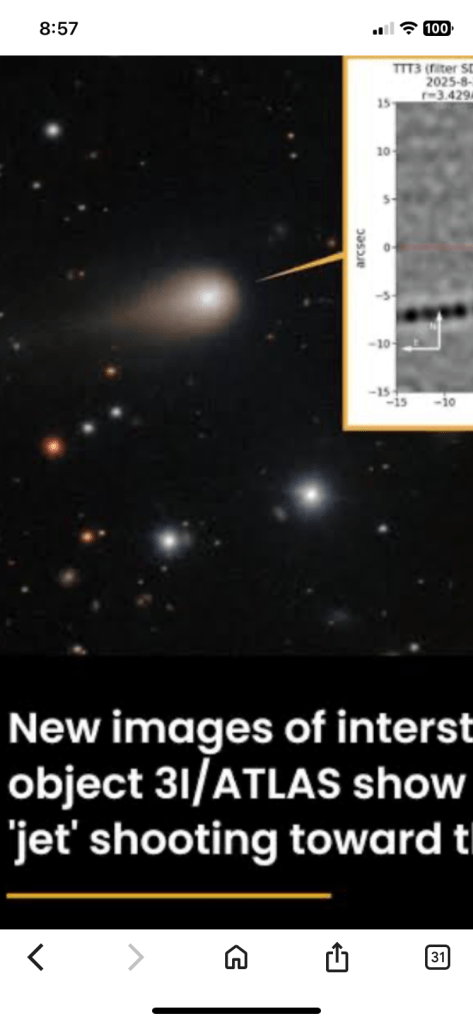
The Harvard scientist primarily fueling speculation that the interstellar object 3I/ATLAS could be an alien artifact is Professor Avi Loeb, a theoretical physicist and the former chair of Harvard’s astronomy department.
Professor Loeb, known for his controversial theories regarding the first interstellar object (‘Oumuamua), has suggested that the unusual characteristics and behavior of 3I/ATLAS warrant considering the possibility of an artificial or technological origin—a hypothesis that is largely met with skepticism by the broader astronomical community, which currently classifies the object as a natural interstellar comet.
☄️ Key Observations and Avi Loeb’s Speculation
3I/ATLAS is the third confirmed object from outside our solar system and was discovered in July 2025. It is on a hyperbolic trajectory, meaning it will pass through our solar system once and never return.
Avi Loeb has highlighted several anomalies that he suggests could point to an engineered object, which he has sometimes speculated could be a “mothership” or a technological probe:
• Unusual Size and Brightness: Initial observations suggested 3I/ATLAS was exceptionally bright, which, if purely natural, would imply it is far larger than statistically expected for a random interstellar rock.
• Atypical Gassing/Jet: The object has exhibited a prominent sunward-facing jet (sometimes called an “anti-tail”) and a high concentration of nickel vapor, which is unusual for a typical comet. Loeb has suggested this could be a braking thrust or a purposeful maneuver rather than a natural outgassing.
• Orbital Alignment: Loeb notes that the object’s trajectory is aligned to an unlikely degree with the plane of the planets in our solar system (the ecliptic plane).
• Perihelion Timing: The object’s closest approach to the Sun (perihelion), which occurred around October 29, 2025, made it unobservable from Earth-based telescopes because it was hidden behind the Sun’s glare. Loeb has questioned whether this coincidence was a result of orbital design.
🧪 Scientific Consensus and the “Acid Test”
Most astronomers believe the observed features of 3I/ATLAS are consistent with the behavior of a natural comet that formed in an extremely cold environment in another star system. The anti-tail, for instance, has been explained as a phenomenon seen on other comets, often due to a combination of dust particle size and our viewing angle.
Loeb has referred to the object’s passage near the Sun as the “acid test,” suggesting that any non-gravitational acceleration or unexpected change in its velocity as it slingshots around the Sun would be a strong indicator of an engineered object using an Oberth maneuver (a spaceflight maneuver where a rocket engine is fired at the lowest potential energy point of an orbit to maximize its effect).
Astronomers are currently analyzing data gathered during and after its perihelion to better understand its true nature.
High impact black swan event
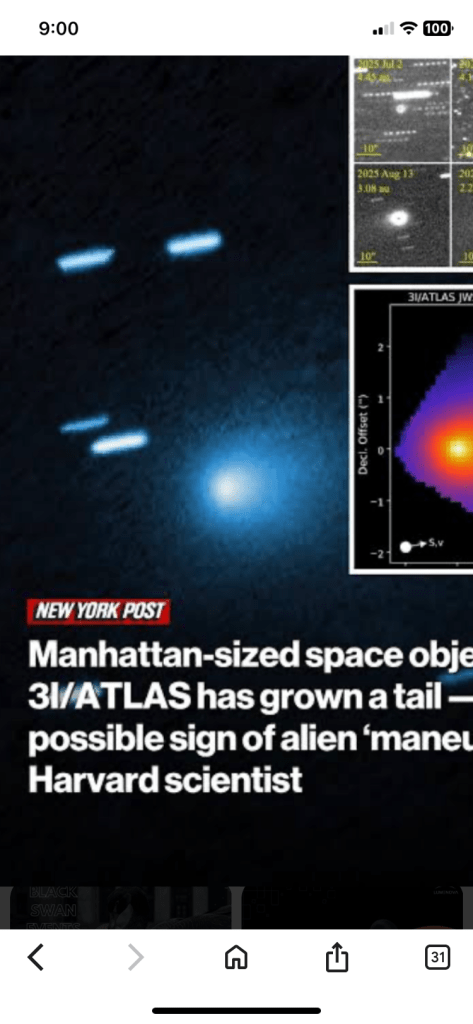
Harvard astrophysicist Avi Loeb weighed in on the new observations of mysterious interstellar object 3I/ATLAS gathered by the Nordic Optical Telescope in Spain’s Canary Islands. New findings showed that comet’s unusual anti-solar tail has changed direction, facing away from the Sun.
The mysterious space object with a tail sparked speculation about its possible origin, with the scientist suggesting in his recent paper that this tail could be indicative of a “controlled manoeuvring” alien craft and a high-impact Black Swan event.
Previous observations during July and August 2025 confirmed that the space object has a rare “anti-solar tail”. But the new images reveal that the anti-tail turned into a tail in September 2025.
My colleague, Adam Hibberd, pointed out that if the object is an alien spacecraft slowing down, and the anti-tail is braking thrust, then this change from anti-tail to tail would be entirely expected near perihelion,” says Loeb.
“In that case, the transition would constitute a technosignature in the form of an unexpected phenomenon indicative of controlled maneuvering, possibly with the intention of achieving a bound heliocentric orbit between Mars’s and Jupiter’s orbits.”
The comet was supposed to reach its closest point to the Sun on October 29, 2025, at about 1.36 astronomical units (AU) from the Sun. Recent images show materials being removed behind as it travels toward the Sun, and hit by up to 33 gigawatts of solar radiation
This has led Loeb to speculate about the possibility of a “manoeuvring” alien craft. But the international space agencies have not confirmed such speculations, with NASA earlier saying that the object is expected to make its closest approach to Earth at a safe distance, posing no threat.
While it poses no threat, comet 3I/ATLAS present a great opportunity for the IAWN community to perform an observing exercise due to its prolonged observability from Earth and its high interest to the scientific community,” the group wrote on its website
Next Steps for Observation
Since the comet is now moving away from the Sun and will soon be moving out of the Solar System, the final phases of observation are shifting:
1. Immediate Data Analysis: Scientists will be eagerly awaiting the data from Europa Clipper and Hera to see if they successfully captured any particles or magnetic field changes from the interstellar comet’s tail.
2. Reappearance and Global Campaign: The comet is currently obscured by the Sun’s glare but is expected to reappear in early November 2025. This will kick off a major coordinated global observation campaign (IAWN) running from November 27, 2025, through January 27, 2026, using powerful ground-based and space telescopes (like Hubble and JWST) to study the comet as it exits the Solar System.
The opportunity for direct sampling (via Europa Clipper) is essentially a once-in-a-lifetime event for these missions.
Please like subscribe comment your precious thoughts on universe discoveries
Full article source google
 Universe discoveries
🙏🌹
Aum Shanti
LikeLiked by 1 person