

Werner Heisenberg’s connection to India primarily stems from his 1929 visit and his philosophical discussions with the renowned Indian poet and polymath, Rabindranath Tagore 🇮🇳.
🤝 Heisenberg and Tagore
• The Meeting: Heisenberg, a key figure in quantum mechanics, visited India in 1929 as part of a world lecture tour. During this trip, he met with Rabindranath Tagore in Kolkata.
• The Discussion: The two engaged in lengthy conversations that covered science and Indian philosophy. Heisenberg reportedly found the introduction to Indian thought comforting.
• Philosophical Parallels: According to accounts, these discussions highlighted philosophical parallels between the new reality proposed by quantum mechanics (specifically the concepts of relativity, interconnectedness, and impermanence) and the foundational principles of Indian spiritual traditions, particularly the Upanishads.
• Influence on Thought: Heisenberg is quoted as stating that the conversations with Tagore helped make some of the “crazy” ideas of quantum physics—which broke away from classical Newtonian determinism—”suddenly make more sense,” as he realized a whole culture subscribed to similar ideas.
❗ Clarification on the Uncertainty Principle
It is a common point of discussion (and sometimes political rhetoric in India) that the Uncertainty Principle was inspired by or based on the Vedas or Indian philosophy.
• Timeline: Heisenberg proposed the Uncertainty Principle in 1927. His meeting with Tagore and his exposure to Indian philosophy occurred in 1929.
• Conclusion: Therefore, Indian philosophy did not directly inspire the creation of the principle. Instead, the philosophical connection made in 1929 is better described as post-facto confirmation or a source of comfort and moral support for the revolutionary concepts he had already developed.
You can learn more about this famous interaction between science and philosophy in this short video: When Heisenberg met Tagore.
Heisenberg achievements and life story
Werner Karl Heisenberg was one of the most pivotal and complex figures in 20th-century physics, known for his revolutionary contributions to quantum mechanics and his controversial role during World War II.
🌟 Major Achievements
Heisenberg’s foundational work completely changed the understanding of the atomic and subatomic world, moving physics from a deterministic to a probabilistic framework.
📜 Life Story Timeline
Early Life and Education (1901–1923)
• 1901: Born in Würzburg, Germany.
• 1920: Began studying physics at the University of Munich, where he worked under Arnold Sommerfeld, a renowned theoretical physicist. He later studied at the University of Göttingen under Max Born.
• 1923: Received his Ph.D. at the remarkably young age of 22.
The Quantum Revolution (1924–1933)
• 1924–1927: Worked with Niels Bohr in Copenhagen, a collaboration that was crucial to his development of quantum theory (known as the Copenhagen Interpretation).
• 1925: Published the paper that introduced Matrix Mechanics.
• 1927: Formulated the Uncertainty Principle and was appointed Professor of Theoretical Physics at the University of Leipzig at age 26, making him one of the youngest full professors in Germany.
• 1929: Went on a world lecture tour, including his famous meeting with Rabindranath Tagore in India.
• 1932: Awarded the Nobel Prize in Physics “for the creation of quantum mechanics.”
The War Years and Controversy (1933–1945)
• 1933: Adolf Hitler came to power, and Heisenberg faced political attacks from proponents of “Aryan physics,” who tried to discredit him and other Jewish physicists.
• 1939–1945: He became the principal scientist leading the German nuclear energy project (the “Uranium Club”) during World War II.
• The extent of his commitment to the Nazi cause and whether he deliberately slowed down the German atomic bomb program is a subject of intense historical debate, particularly surrounding his 1941 meeting with Niels Bohr in Copenhagen.
• 1945: Captured by Allied forces and interned at Farm Hall in England with other German scientists. Transcripts of their conversations there provided insight into their program.
Post-War Legacy (1946–1976)
• 1946: Returned to Germany and helped reorganize the Max Planck Institute for Physics (initially in Göttingen, later in Munich).
• 1957: Was a key signatory of the Göttingen Manifesto, a declaration by 18 leading German atomic scientists who publicly opposed the West German army being equipped with nuclear weapons.
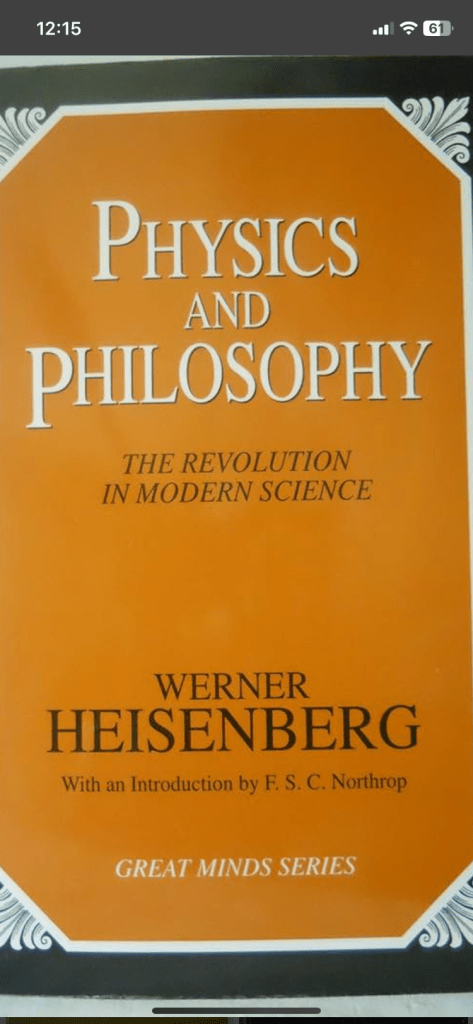
• 1976: Died in Munich, West Germany. His philosophical reflections on science are captured in his book, Physics and Philosophy.
Please like subscribe comment your precious comment on universe discoveries
Full article source google
 Universe discoveries
🙏🌹
Aum Shanti
LikeLiked by 1 person