

The high reflectivity of exoplanet LTT 9779 b is due to a dense, super-metal-rich atmosphere oversaturated with vapors that condense into highly reflective metallic clouds. It reflects about 80% of the light from its host star, making it the most reflective exoplanet known.
Key Details
- Cloud Composition: The atmosphere contains thick, mirror-like clouds likely made of silicate minerals (the same material in glass and sand) and metals like titanium.
- Extreme Temperatures: The dayside of the planet reaches scorching temperatures of around 2,000°C (3,632°F). At such high heat, water clouds cannot exist, and even metal or glass clouds were previously thought impossible to form.
- Formation Mechanism: The clouds form due to the atmosphere being extremely oversaturated with metal and silicate vapors, similar to how a hot, steamy bathroom forms condensation even though the air is hot.
- Survival in the “Neptune Desert”: LTT 9779 b is located in the “hot Neptune desert,” an area where planets of its size are typically stripped of their atmospheres by intense stellar radiation. Scientists believe the metallic clouds help the planet survive by reflecting radiation and making the atmosphere heavy and harder to blow away.
- Discovery: The planet’s highly reflective nature was uncovered by a follow-up investigation using the European Space Agency’s CHEOPS (CHaracterising ExOPlanet Satellite) mission, which measured the slight decrease in light when the planet passed behind its star (a secondary eclipse).
European space agency ( Cheops)
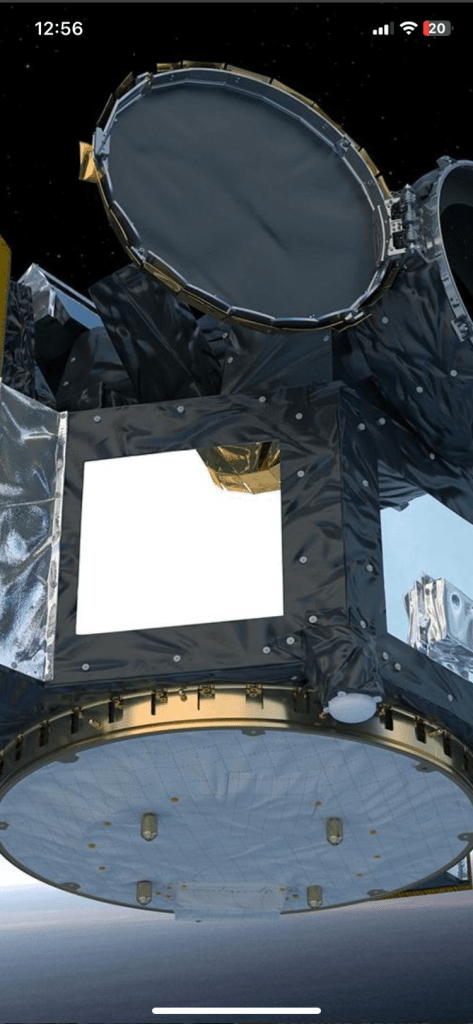
The CHEOPS (CHaracterising ExOPlanet Satellite) mission is the European Space Agency’s first small-class (S-class) space mission, dedicated to precisely measuring the sizes of known exoplanets orbiting nearby, bright stars.
Mission Objectives
The primary goal of CHEOPS is to collect high-precision data on exoplanets with sizes ranging from that of Earth to Neptune. By observing the slight dip in a star’s brightness as a planet passes in front of it (known as the transit method), CHEOPS can determine the planet’s radius.
Combining these precise radius measurements with existing mass estimates (typically obtained from ground-based telescopes using the radial velocity method) allows scientists to calculate the exoplanet’s density, which provides crucial insights into its:
- Composition and structure: Determining whether a planet is predominantly rocky like Earth, gaseous like Jupiter, or a mix, like Neptune.
- Formation and evolution: The data helps constrain theories about how planetary systems form and evolve, including processes like planetary migration and atmosphere loss.
- Atmospheric properties: Observations of phase curves and occultations help identify planets with significant atmospheres and understand heat distribution mechanisms.
Key Achievements and Discoveries
Since its launch in December 2019, CHEOPS has made numerous significant contributions to exoplanet science:
- Characterizing extreme worlds: It provided detailed measurements of WASP-189 b, one of the hottest known exoplanets, which glows like a small star.
- Unusual planet shapes and systems: CHEOPS data revealed the first-ever detection of a deformed, rugby-ball-shaped exoplanet (WASP-103 b), stretched by the strong tidal forces of its host star. It also studied a unique system with five of its six planets locked in a precise rhythmic orbital “dance”.
- Identifying “golden targets”: The mission identifies prime candidates for more detailed follow-up observations by powerful future facilities like the James Webb Space Telescope (JWST) and the upcoming Extremely Large Telescope (ELT).
- Surprising discoveries: Beyond exoplanets, CHEOPS took a break from its core mission to help discover an unexpectedly distant and stable ring system around the dwarf planet Quaoar within our own solar system.
- LTT 9779 b: As noted in the previous interaction, CHEOPS’s high-precision measurements were key to confirming LTT 9779 b as the most reflective exoplanet known, acting like a giant cosmic mirror with metallic clouds.
CHEOPS is the first in a trio of upcoming ESA exoplanet missions, paving the way for the future PLATO and Ariel missions, which are set to launch later this decade.
Please like subscribe comment your precious comment on universe discoveries
Full article source google
 Universe discoveries
🙏🌹
Aum Shanti
LikeLiked by 1 person